Resolving Axios Authentication Issues in React with Django REST Framework
Автор: vlogize
Загружено: 2025-09-04
Просмотров: 4
Learn how to troubleshoot and fix the issue of authentication credentials not being provided when sending requests from React JS using Axios to a Django REST API.
---
This video is based on the question https://stackoverflow.com/q/64698551/ asked by the user 'DzITC' ( https://stackoverflow.com/u/10976145/ ) and on the answer https://stackoverflow.com/a/64699122/ provided by the user 'Nisharg Shah' ( https://stackoverflow.com/u/8798220/ ) at 'Stack Overflow' website. Thanks to these great users and Stackexchange community for their contributions.
Visit these links for original content and any more details, such as alternate solutions, latest updates/developments on topic, comments, revision history etc. For example, the original title of the Question was: Authentication credentials were not provided when sending request from React JS axios
Also, Content (except music) licensed under CC BY-SA https://meta.stackexchange.com/help/l...
The original Question post is licensed under the 'CC BY-SA 4.0' ( https://creativecommons.org/licenses/... ) license, and the original Answer post is licensed under the 'CC BY-SA 4.0' ( https://creativecommons.org/licenses/... ) license.
If anything seems off to you, please feel free to write me at vlogize [AT] gmail [DOT] com.
---
Troubleshooting Axios Authentication Issues in React and Django REST Framework
When building web applications that communicate between a front-end and back-end, developers often encounter authentication issues. If you're using React for the front-end and Django REST Framework for the back-end, you might face a common error: "Authentication credentials were not provided." This usually occurs when making API calls using Axios without properly sending authentication tokens. In this guide, we will guide you through the problem and how to resolve it effectively.
The Problem Explained
As a developer, you may have successfully set up your Django REST API with Token Authentication using Django Rest Framework and Knox. However, while developing your front-end application with React, you might run into issues where the server does not recognize your JWT tokens sent via Axios requests. This is primarily due to improper configuration of the request headers when sending the API call from React.
A Closer Look at the Issue
In the case described, the back-end server verifies requests made from a tool like Postman correctly, as they send the required token in the headers. Here’s an example of a successful request made via Postman:
[[See Video to Reveal this Text or Code Snippet]]
However, the same request made from the React application comes back with username empty:
[[See Video to Reveal this Text or Code Snippet]]
This indicates that the token may not be correctly attached or formatted in the Axios request.
The Solution
Step-by-Step Guide to Fix the Issue
Modify the Axios Request Function: When sending the POST request from React, ensure that token information is being sent correctly. Your Axios post request should specify the correct configuration.
Here’s an updated version of your Axios request:
[[See Video to Reveal this Text or Code Snippet]]
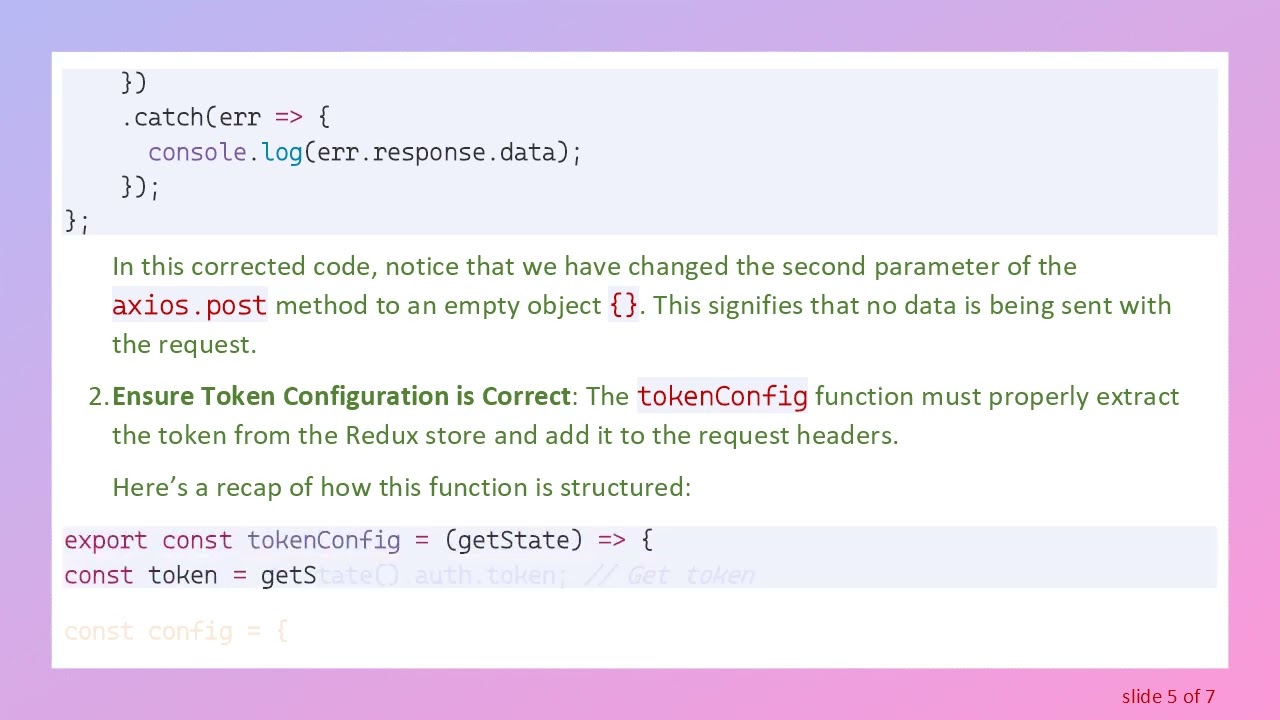
In this corrected code, notice that we have changed the second parameter of the axios.post method to an empty object {}. This signifies that no data is being sent with the request.
Ensure Token Configuration is Correct: The tokenConfig function must properly extract the token from the Redux store and add it to the request headers.
Here’s a recap of how this function is structured:
[[See Video to Reveal this Text or Code Snippet]]
Test Your Changes: After making the adjustments, test your React application again to see if the server correctly identifies the user making the request.
Additional Tips
Cross-Origin Resource Sharing (CORS): Ensure that your Django server is configured to allow CORS requests from your React application if they are hosted on different origins.
Console Logs: Use console.log statements for debugging. Log the headers being sent at each request to validate if the token is attached properly.
Ensure Authentication Token is Fresh: Tokens may expire, so ensure you are using a valid token each time your application makes a request.
Conclusion
Having a seamless communication between your React front-end and Django REST Framework backend is crucial for the success of your application. By following the outlined steps and ensuring that your authentication tokens are correctly set up and sent with Axios requests, you can effectively resolve the "Authentication credentials were not provided" issue.
Remember, troubleshooting issues is a part of the development process, and knowing how to debug and adapt your code will ultimately lead to a more robust application. Happy coding!
Доступные форматы для скачивания:
Скачать видео mp4
-
Информация по загрузке: