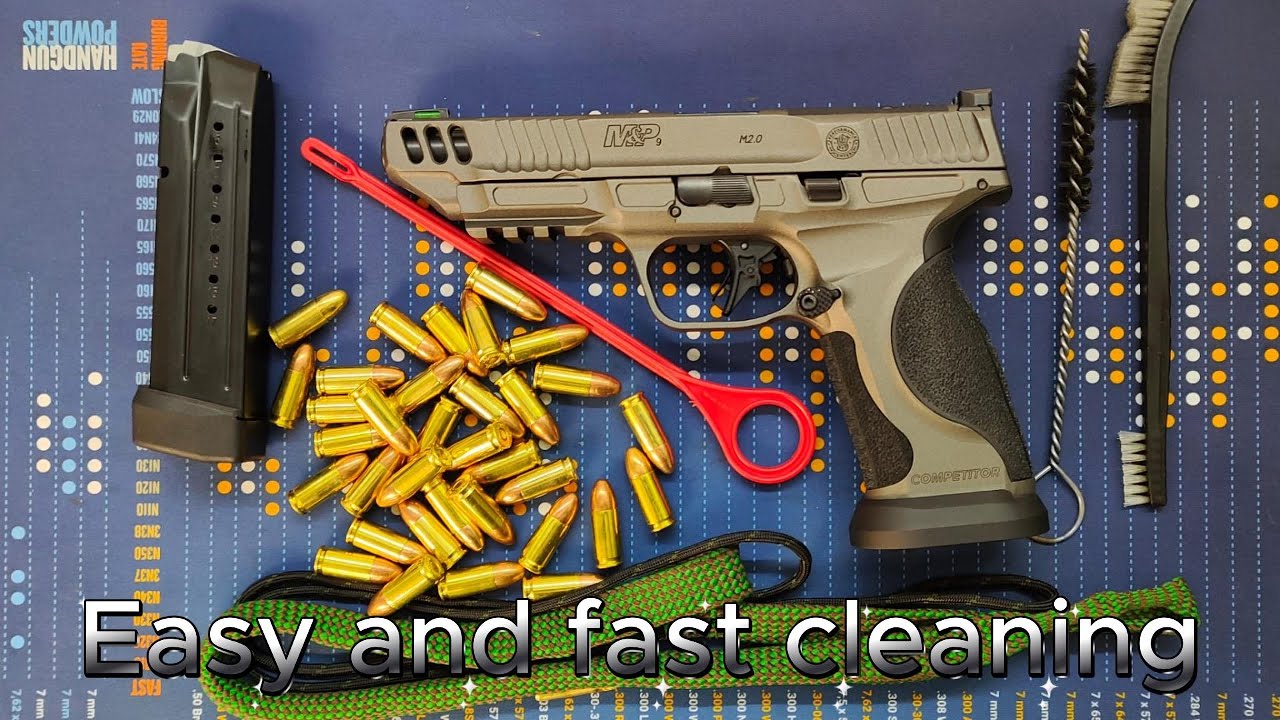
How to Clean Smith and Wesson M&P Semi-Auto Pistol. Field strip.
Автор: GunLab
Загружено: 2026-01-11
Просмотров: 29
Smith & Wesson Brands, Inc. (S&W) is an American firearm manufacturer headquartered in Maryville, Tennessee, United States.
Smith & Wesson was founded by Horace Smith and Daniel B. Wesson as the "Smith & Wesson Revolver Company" in 1856, after their previous company, also called the "Smith & Wesson Company" and later renamed as "Volcanic Repeating Arms", was sold to Oliver Winchester and became the Winchester Repeating Arms Company. The modern Smith & Wesson had been previously owned by Bangor Punta and Tomkins plc before being acquired by Saf-T-Hammer Corporation in 2001. Smith & Wesson was a unit of American Outdoor Brands Corporation from 2016 to 2020 until the company was spun out in 2020.
History
Volcanic Repeating Arms
Main article: Volcanic Repeating Arms
Horace Smith and Daniel B. Wesson founded the Smith & Wesson Company in Norwich, Connecticut in 1852 to develop the Volcanic rifle. Smith developed a new Volcanic Cartridge, which he patented in 1854. The Smith & Wesson Company was renamed Volcanic Repeating Arms in 1855 and was purchased by Oliver Winchester. Smith left the company and returned to his native Springfield, Massachusetts, while Wesson stayed as plant manager with Volcanic Repeating Arms for eight months.[3] Volcanic Repeating Arms was insolvent in late 1856, after which it was reorganized as the New Haven Arms Company in April 1857, and eventually as the Winchester Repeating Arms Company by 1866.
Smith & Wesson Revolver Company
As Samuel Colt's patent on the revolver was set to expire in 1856, Wesson began developing a prototype for a cartridge revolver. His research pointed out that a former Colt employee named Rollin White held the patent for a "bored-through" cylinder, a component he would need for his invention. Wesson reconnected with Smith, and the two partners approached White to manufacture a newly designed revolver-and-cartridge combination.] After Wesson left Volcanic Repeating Arms in 1856, he rejoined Smith to form the Smith & Wesson Revolver Company, which would become the modern Smith & Wesson company.
Rather than make White a partner in their company, Smith & Wesson paid him a royalty of $0.25 on every revolver they made. This arrangement left White responsible for defending his patent, which eventually led to his financial ruin, while it was very advantageous for Smith & Wesson.
19th century
Smith & Wesson's revolvers came into popular demand with the outbreak of the American Civil War, as soldiers from all ranks on both sides of the conflict made private purchases of the revolvers for self-defense.[5]
The orders for the Smith & Wesson Model 1 revolver outpaced the factory's production capabilities. In 1860, demand volume exceeded the production capacity, so Smith & Wesson expanded into a new facility and began experimenting with a new cartridge design more suitable than the .22 Short that it had been using.
At the same time, the company's design was being infringed upon by other manufacturers, which led to numerous lawsuits filed by Rollin White. In many of these instances, part of the restitution came in the form of the offender being forced to stamp "Manufactured for Smith & Wesson" on the revolvers in question.
White's vigorous defense of his patent caused a problem for arms makers in the United States at the time, as they could not manufacture cartridge revolvers. At the war's end, the U.S. Government charged White with causing the retardation of arms development in America.
Demand for revolvers declined at the close of the Civil War, so Smith & Wesson focused on developing arms suitable for use on the American frontier. In 1870, the company switched focus from pocket-sized revolvers to a large frame revolver in heavier calibers (.44 S&W American). The U.S. Army adopted this new design, known as the Smith & Wesson Model 3, as the first cartridge-firing revolver in U.S. service.
In 1899, Smith & Wesson introduced its most widely used revolver, the .38 Military & Police (also known as the Smith & Wesson Model 10). With over 6 million produced, it became the standard sidearm of American police officers for much of the 20th century.[6] An additional 1 million of these guns were made for the U.S. Military during World War II.
SmithandWesson#9x19#Competitor#DirtyHarry#MP9#2.0#Steelframe#PerformanceCenter#
@GunLabTact
Доступные форматы для скачивания:
Скачать видео mp4
-
Информация по загрузке: