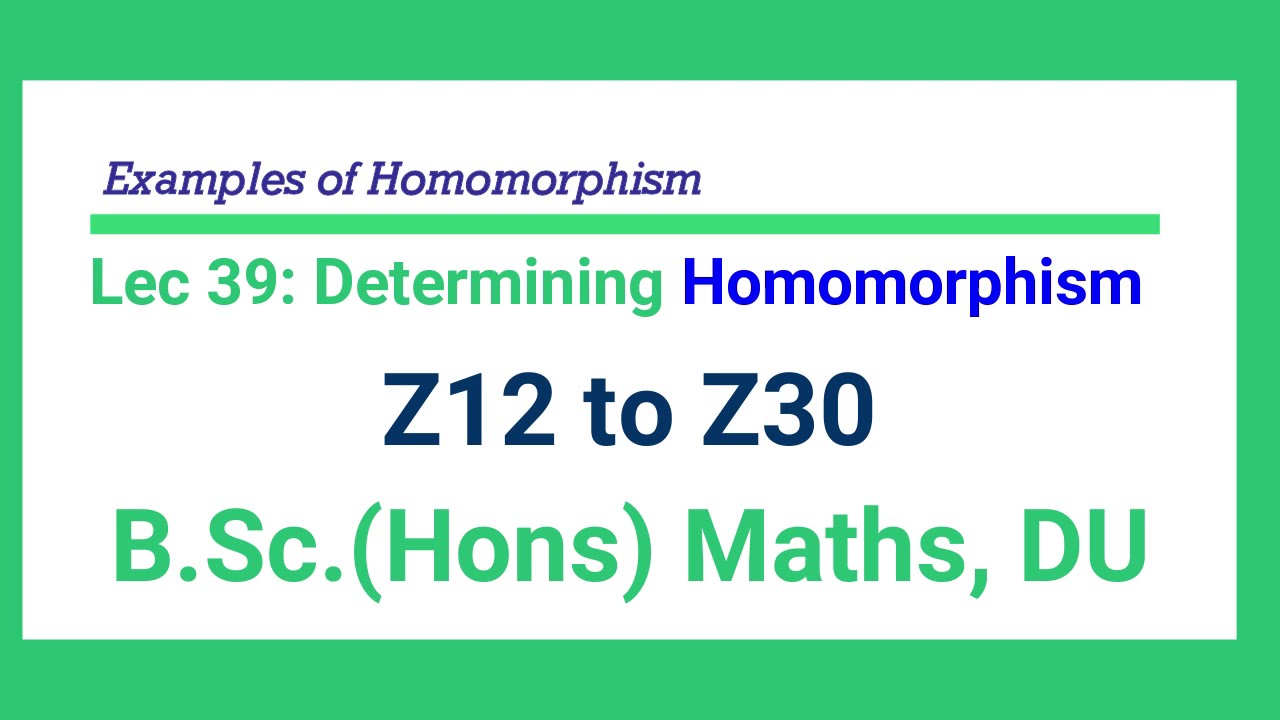
L#15 | 2022 | RING THEORY AND LINEAR ALGEBRA-I | PROPERTIES OF RING HOMOMORPHISM | B.Sc. Mathematics
Автор: COSMOS LEARNING
Загружено: 2022-02-13
Просмотров: 958
PROPERTIES OF RING HOMOMORPHISM
Theorem 15.1 Properties of Ring Homomorphisms
Let f be a ring homomorphism from a ring R to a ring S. Let A be a
subring of R and let B be an ideal of S.
1. For any r [ R and any positive integer n, f(nr) 5 nf(r) and
f(rn) 5 (f(r))n.
2. f(A) 5 {f(a) | a [ A} is a subring of S.
3. If A is an ideal and f is onto S, then f(A) is an ideal.
4. f21(B) 5 {r [ R | f(r) [ B} is an ideal of R.
5. If R is commutative, then f(R) is commutative.
6. If R has a unity 1, S 2 {0}, and f is onto, then f(1) is the unity
of S.
7. f is an isomorphism if and only if f is onto and Ker f 5
{r [ R | f(r) 5 0} 5 {0}.
8. If f is an isomorphism from R onto S, then f21 is an
isomorphism from S onto R.
PROOF The proofs of these properties are similar to those given in
Theorems 10.1 and 10.2 and are left as exercises (Exercise 1).
The student should learn the various properties of Theorem 15.1
in words in addition to the symbols. Property 2 says that the homomor-
phic image of a subring is a subring. Property 4 says that the pullback
of an ideal is an ideal, and so on.
The next three theorems parallel results we had for groups. The
proofs are nearly identical to their group theory counterparts and are
left as exercises (Exercises 2, 3, and 4).
Theorem 15.2 Kernels Are Ideals
Let f be a ring homomorphism from a ring R to a ring S. Then Ker f
5 {r [ R | f(r) 5 0} is an ideal of R.
Theorem 15.3 First Isomorphism Theorem for Rings
Let f be a ring homomorphism from R to S. Then the mapping from
R/Ker f to f(R), given by r 1 Ker f S f(r), is an isomorphism. In
symbols, R/Ker f f(R).
Theorem 15.4 Ideals Are Kernels
Every ideal of a ring R is the kernel of a ring homomorphism of R.
In particular, an ideal A is the kernel of the mapping r S r 1 A
from R to R/A.
The homomorphism from R to R/A given in Theorem 15.4 is called
the natural homomorphism from R to R/A. Theorem 15.3 is often re-
ferred to as the Fundamental Theorem of Ring Homomorphisms.
In Example 17 in Chapter 14 we gave a direct proof that kxl is a
prime ideal of Z[x] but not a maximal ideal. In the following example
we illustrate a better way to do this kind of problem.
EXAMPLE 10 Since the mapping f from Z[x] onto Z given by
f( f(x)) 5 f(0) is a ring homomorphism with Ker f 5 kxl (see Exercise 29
in Chapter 14), we have, by Theorem 15.3, Z[x]/kxl Z. And because
Z is an integral domain but not a field, we know by Theorems 14.3 and
14.4 that the ideal kxl is prime but not maximal in Z[x].
Theorem 15.5 Homomorphism from Z to a Ring with Unity
Let R be a ring with unity 1. The mapping f: Z S R given by n S n ? 1
is a ring homomorphism.

Доступные форматы для скачивания:
Скачать видео mp4
-
Информация по загрузке: