Fixing Your Min Heap Implementation in Javascript
Автор: vlogize
Загружено: 2025-09-26
Просмотров: 0
Learn how to implement a Min Heap in Javascript correctly and troubleshoot common issues to ensure proper functionality.
---
This video is based on the question https://stackoverflow.com/q/63103317/ asked by the user 'milanf' ( https://stackoverflow.com/u/8418879/ ) and on the answer https://stackoverflow.com/a/63104674/ provided by the user 'Bergi' ( https://stackoverflow.com/u/1048572/ ) at 'Stack Overflow' website. Thanks to these great users and Stackexchange community for their contributions.
Visit these links for original content and any more details, such as alternate solutions, latest updates/developments on topic, comments, revision history etc. For example, the original title of the Question was: Implementing a Min Heap in Javascript?
Also, Content (except music) licensed under CC BY-SA https://meta.stackexchange.com/help/l...
The original Question post is licensed under the 'CC BY-SA 4.0' ( https://creativecommons.org/licenses/... ) license, and the original Answer post is licensed under the 'CC BY-SA 4.0' ( https://creativecommons.org/licenses/... ) license.
If anything seems off to you, please feel free to write me at vlogize [AT] gmail [DOT] com.
---
Implementing a Min Heap in Javascript: Troubleshooting and Solutions
Are you facing issues while implementing a Min Heap in Javascript? If you're struggling to maintain the expected order of elements upon removal, you're not alone! Let's dive into the common pitfalls of Min Heap implementations and discover how to rectify them effectively.
Understanding the Min Heap
A Min Heap is a complete binary tree where the value of each node is less than or equal to the values of its children. This structure allows for efficient retrieval of the smallest element, making it a popular choice for priority queues.
Why the Implementation Might Fail
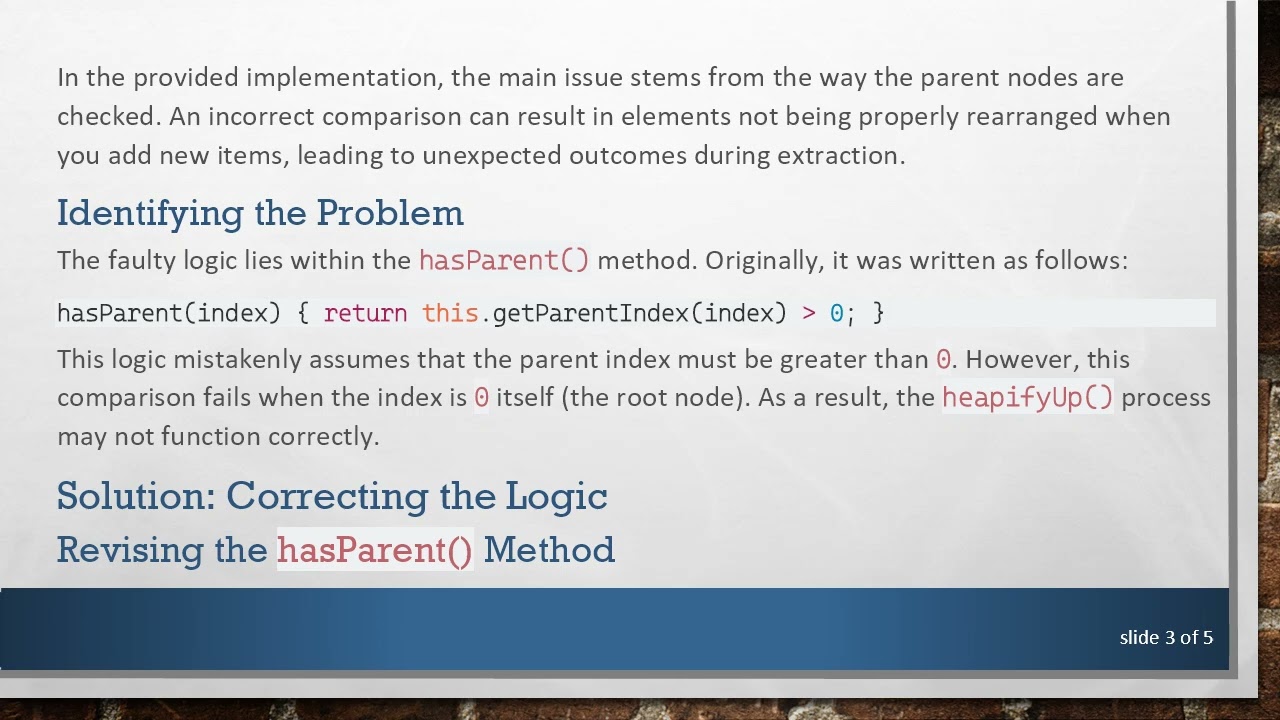
In the provided implementation, the main issue stems from the way the parent nodes are checked. An incorrect comparison can result in elements not being properly rearranged when you add new items, leading to unexpected outcomes during extraction.
Identifying the Problem
The faulty logic lies within the hasParent() method. Originally, it was written as follows:
[[See Video to Reveal this Text or Code Snippet]]
This logic mistakenly assumes that the parent index must be greater than 0. However, this comparison fails when the index is 0 itself (the root node). As a result, the heapifyUp() process may not function correctly.
Solution: Correcting the Logic
Revising the hasParent() Method
To resolve this issue, you can modify the hasParent() method in two possible ways. Here’s the corrected implementation:
Option 1: Check if the Parent Index is Greater Than or Equal to Zero
[[See Video to Reveal this Text or Code Snippet]]
Option 2: Simpler Method Using the Current Index
[[See Video to Reveal this Text or Code Snippet]]
Both of these implementations ensure that the root element is considered to have a parent when necessary, allowing for proper propagation of new elements into their correct positions.
Why This Matters
By correcting the hasParent() method, you guarantee that elements like 3 will be compared against their hierarchical parents accurately. This is crucial because, without accurate parent-child relationships, the Min Heap might not uphold its property and could lead to incorrect behavior during element removal.
Conclusion
In programming, even small errors can create significant bugs. By understanding the components and behavior of your data structures—like the Min Heap—you can effectively troubleshoot issues and ensure that your implementations work as intended. With simple adjustments to the hasParent() method, you can enjoy a fully functional Min Heap, ready to maintain order with efficiency and precision.
Feel free to reach out if you encounter further challenges or if you have any questions regarding this implementation! Happy coding!
Доступные форматы для скачивания:
Скачать видео mp4
-
Информация по загрузке: