How to Extract the Top N Keywords from a Tuple in Python
Автор: vlogize
Загружено: 2025-10-06
Просмотров: 0
Learn how to efficiently retrieve the top N keywords from a tuple in Python using slicing and list comprehension for better data analysis.
---
This video is based on the question https://stackoverflow.com/q/64019653/ asked by the user 'blkngoldbudda' ( https://stackoverflow.com/u/14267194/ ) and on the answer https://stackoverflow.com/a/64019883/ provided by the user 'John S' ( https://stackoverflow.com/u/11564608/ ) at 'Stack Overflow' website. Thanks to these great users and Stackexchange community for their contributions.
Visit these links for original content and any more details, such as alternate solutions, latest updates/developments on topic, comments, revision history etc. For example, the original title of the Question was: Getting top n results from a tuple
Also, Content (except music) licensed under CC BY-SA https://meta.stackexchange.com/help/l...
The original Question post is licensed under the 'CC BY-SA 4.0' ( https://creativecommons.org/licenses/... ) license, and the original Answer post is licensed under the 'CC BY-SA 4.0' ( https://creativecommons.org/licenses/... ) license.
If anything seems off to you, please feel free to write me at vlogize [AT] gmail [DOT] com.
---
Getting Top N Results from a Tuple in Python
In the world of data analysis and processing, we often find ourselves needing to extract valuable information from large data structures. One such common scenario is retrieving the top N results from a tuple containing keywords and their associated scores. If you’re working with such tuples and running into difficulties, don’t worry! This guide breaks down the solution step-by-step, helping you gain better insights from your data.
Understanding the Problem
Let’s say you have a tuple that contains keywords along with their scores, like this:
[[See Video to Reveal this Text or Code Snippet]]
While it's straightforward to access these elements, extracting the top N keywords based on their scores might not be as obvious. Some attempts might lead to errors, like trying to sort tuples improperly or issues with list handling.
The Solution
Here, we will provide an effective approach to accomplish this task using Python. Let’s break it down into clear steps.
Step 1: Accessing the Keyword List
Your first task is to access the second element of the tuple (the list of keywords and scores). This can be done easily:
[[See Video to Reveal this Text or Code Snippet]]
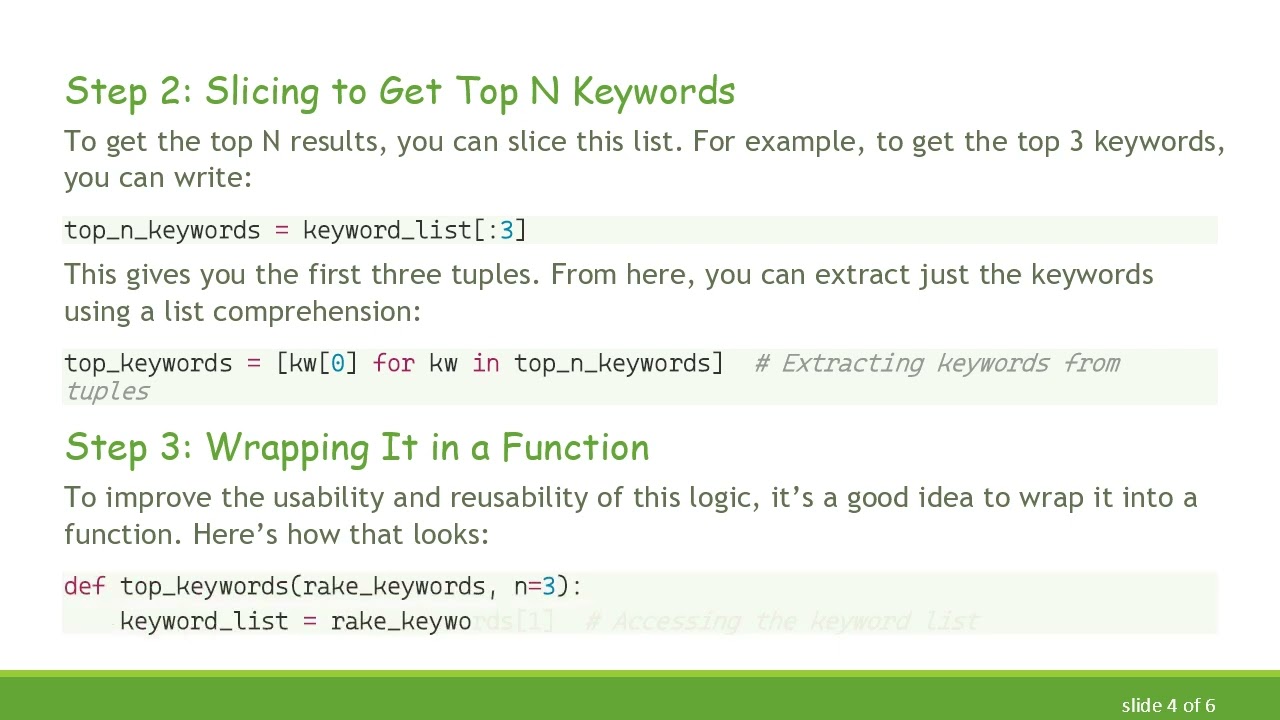
Step 2: Slicing to Get Top N Keywords
To get the top N results, you can slice this list. For example, to get the top 3 keywords, you can write:
[[See Video to Reveal this Text or Code Snippet]]
This gives you the first three tuples. From here, you can extract just the keywords using a list comprehension:
[[See Video to Reveal this Text or Code Snippet]]
Step 3: Wrapping It in a Function
To improve the usability and reusability of this logic, it’s a good idea to wrap it into a function. Here’s how that looks:
[[See Video to Reveal this Text or Code Snippet]]
Step 4: Using the Function
Now that you have your function, you can easily call it to get the top N keywords from any similar tuple. For instance:
[[See Video to Reveal this Text or Code Snippet]]
Conclusion
Retrieving the top N results from a tuple in Python may initially look challenging, especially with different data structures and types. However, by leveraging simple slicing techniques and list comprehensions, we can effectively extract the information we need. This approach not only allows for efficient data handling but also makes your code cleaner and more maintainable.
So, the next time you're dealing with keyword extraction in Python, remember this method to enhance your data analysis efforts!
Доступные форматы для скачивания:
Скачать видео mp4
-
Информация по загрузке: