33. gcd(a,b)=1⇒gcd(a^n,b^n )=1| gcd(a,b)=1⇒gcd(a+b,ab)=1 | Problems 2.4 | question 5, 6 and 11
Автор: ACADEMY OF MATHEMATICAL SCIENCES
Загружено: 2025-11-17
Просмотров: 29
Elementary Number Theory by David M. Burton | Problems 2.4
Chapter#2 Divisibility Theory in the Integers
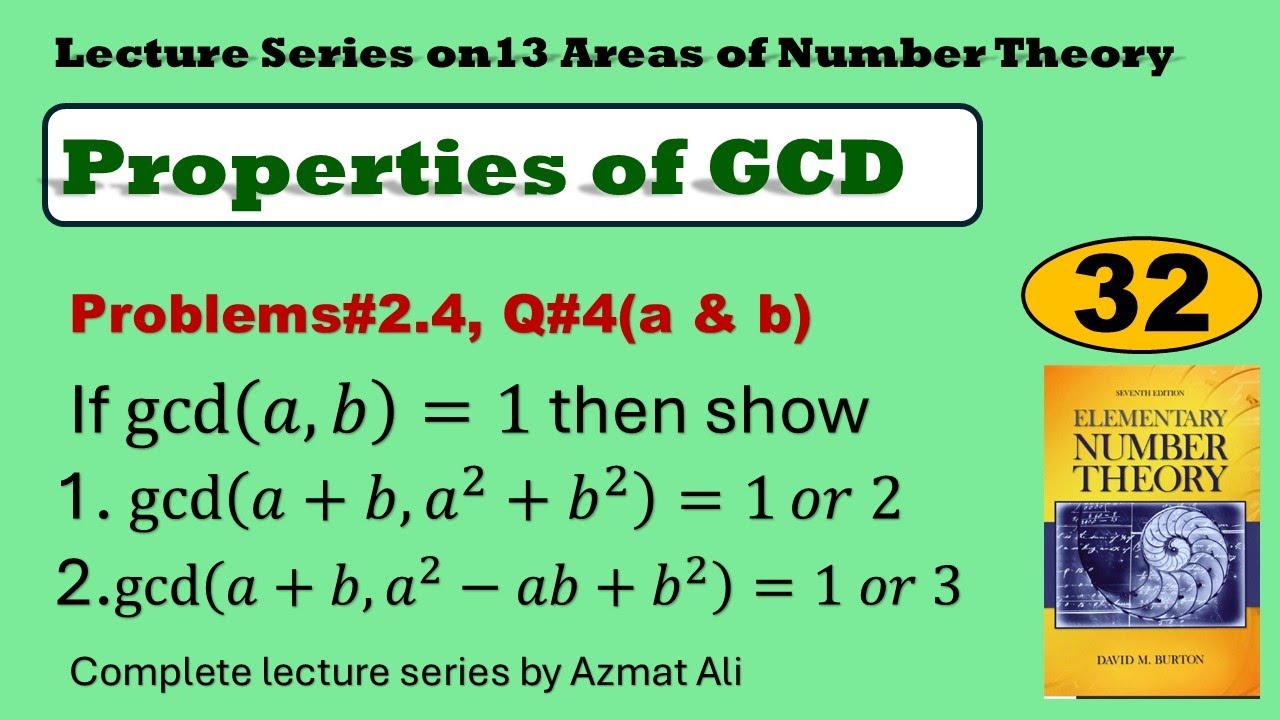
In this lecture I will discuss question number 5, 6 and 11 of problems 2.4. This questions are related to properties of greatest common divisor (gcd). This question can be stated as
1. For n≥1, and positive integers a and b, show that if gcd(a,b)=1, then gcd(a^n,b^n )=1
2. gcd(a,b)=1⇒gcd(a+b,ab)=1
3. gcd(gcd(a,b),c)=gcd(gcd(a,c),b)=gcd(gcd(b,c),a)=d
-------------------------------------------------------------------------------------------------------------------------------------------------------
▶️ Link to 13 Core areas of Number Theory
• Comprehensive Number Theory Course: 13 Cor...
-------------------------------------------------------------------------------------------------------------------------------------------------------
#NumberTheory #DavidMBurton #ElementaryNumberTheory #DivisibilityTheory #GCD #GreatestCommonDivisor #MathematicsLecture #MathsForBSStudents #MathsLectureSeries #HigherMathematics #UniversityMathematics #Maths4U #IntegerProperties #MathTutorial #MathProblemSolving
#professorazmatali
#academyofmathematicalsciences

Доступные форматы для скачивания:
Скачать видео mp4
-
Информация по загрузке: