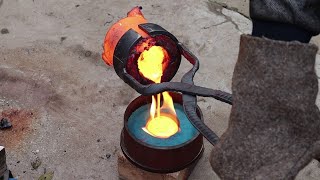
Clinker Chemistry | Importance of clinker liquid phase | Cement Chemistry
Автор: CementPDM
Загружено: 2021-08-11
Просмотров: 16255
Lecture-7 Clinker Chemistry | Importance of clinker liquid phase | Cement Chemistry by Dr. K Mohan.
Dr K Mohan is an internationally renowned and an acclaimed cement scientist. He is a former Director General of National Council for Cement and Building Materials (NCCBM).
He holds a Ph.D. degree in Cement Chemistry from University of Aberdeen, Scotland, U.K.
Clinker is produced by heating kiln feed comprising of limestone, clay and corrective materials like laterite, bauxite etc. to a temperature of 1400 – 14500C.
A series of chemical reactions take place from 1000C TO 14500C during the kiln feed burning in the rotary kiln and clinker compounds (minerals/ phases) are formed.
Chemical Composition of Clinker:
Oxide Common Name Composition Range (%)
CaO Lime 60 ~ 67
SiO2 Silica 17 ~ 25
Al2O3 Alumina 3 ~ 8
Fe2O3 Iron Oxide 4 ~ 6
MgO Magnesia 1 ~ 5
CaOf Free (Uncombined) Lime 1 ~ 2
• In addition, alkalis (Na2O & K2O), chloride and SO3 are also present in small amounts.
Phase Composition (Compound Composition) of Clinker:
• The four main compounds of clinker are: C3S, C2S, C3A and C4AF.
C3S 3CaO. SiO2 Tricalcium Silicate
(Alite) 45 ~ 60 %
C2S 2CaO. SiO2 Dicalcium Silicate
(Belite) 15 ~ 35 %
C3A 3CaO. Al2O3 Tricalcium Aluminate
(Aluminate/ Celite) 5 ~ 12 %
C4AF 4CaO. Al2O3. Fe2O3 Tetra calcium Alumino Ferrite
(Ferrite) 10 ~ 14 %
• In addition, 1 – 2% free lime, 1 – 5% periclase (MgO), small amounts of alkali sulphates and alkali chlorides are also present.
• Besides clinker contains liquid phase or clinker melt in the range of 26 – 30%.
Structures of clinker compounds:
• Now let us look at the structures of these different compounds and what causes them to have differences in their reactivity. C3S is probably the most important compound in modern cement because it is related to the early strength development that we desire in the cements.
• The irregular structure of the C3S crystalscauses C3S to have a high reactivity. The high reactivity also implies a high heat of hydration, that means when C3S reacts it liberates a lot of heat and that is one of the problems in modern cement that modern cements release tremendous amount of heat upon hydration.
• Depending upon the impurities that are present in the system and the kind of heating processes that occur in the kiln followed by the cooling process, you can actually get multiple polymorphs of the C3S.
• Polymorphs indicate different crystal forms of the same compound. For example, calcium carbonate is present as calcite or as aragonite. Both of them are calcium carbonate but they have different crystal forms. So those are polymorphs of calcium carbonate. Similar to that C3S has various polymorphs.
• Aliteis the name given to impure C3S which contains magnesium oxide, aluminium oxide and iron oxide along with smaller quantities but very important quantities of the alkalis and sulphates. Primarily, the alkali sulphates are the ones which have attached themselves to the surface of the clinker particles and these alkali sulphates are the ones which lead to a high degree of reactivity with the Alite.
• Seven polymorphs of alite are known: three triclinic polymorphs T1, T2, T3, three monoclinic M1, M2, M3, and a rhombohedral high temperature polymorph R. In industrial clinkers, the M1 and M3 polymorphs are mostly stabilized at room temperature by the presence of sulfate or magnesium impurities respectively. M1 polymorph is more reactive than M3 polymorph.
Importance of Liquid phase:
• Clinker liquid phase or clinker melt is the fraction of the kiln feed that melts between the upper transition zone and the burning zone (i.e. between 900-1400oc).
• Plant chemists and kiln operators are usually more concerned with the amount of liquid present rather than the rheological properties (fluid properties, such as viscosity) of the liquid, although the latter is much more important during the clinkering reactions than the former.
• For most commercial clinker, the amount of liquid phase in the burning zone varies between 26 to 30%. Higher values can be damaging to most refractory bricks in the absence of a stable coating.
• The most important clinker mineral C3S(alite) requires the presence of liquid for its formation. In the absence of liquid alite formation is extremely slow and would render commercial clinkering impossible.
• Liquid phase viscosity increase linearly with the A/F(alumina modulus) ratio. For a given burning temperature, high C3A clinkers tend to nodulize better than low C3A clinkers.
• Another important property of the liquid phase is its surface tension or its ability to 'wet' the lining. The surface tension has a direct impact on clinker fineness, coating adherence to the lining and clinker quality.
#Cementpdm #Clinkerchemistry #Cementchemistry

Доступные форматы для скачивания:
Скачать видео mp4
-
Информация по загрузке: