How to Successfully Convert and Display Base64 Images from Flask Server in NativeScript Apps
Автор: vlogize
Загружено: 2025-09-24
Просмотров: 0
Learn how to send a `Base64 Image` from a Flask server to a NativeScript app and troubleshoot common issues with clear, step-by-step instructions.
---
This video is based on the question https://stackoverflow.com/q/62611335/ asked by the user 'Mahmoud Youssef' ( https://stackoverflow.com/u/9979796/ ) and on the answer https://stackoverflow.com/a/62625892/ provided by the user 'Mahmoud Youssef' ( https://stackoverflow.com/u/9979796/ ) at 'Stack Overflow' website. Thanks to these great users and Stackexchange community for their contributions.
Visit these links for original content and any more details, such as alternate solutions, latest updates/developments on topic, comments, revision history etc. For example, the original title of the Question was: base64 image from flask to nativescript
Also, Content (except music) licensed under CC BY-SA https://meta.stackexchange.com/help/l...
The original Question post is licensed under the 'CC BY-SA 4.0' ( https://creativecommons.org/licenses/... ) license, and the original Answer post is licensed under the 'CC BY-SA 4.0' ( https://creativecommons.org/licenses/... ) license.
If anything seems off to you, please feel free to write me at vlogize [AT] gmail [DOT] com.
---
Sending Base64 Images from Flask to NativeScript: A Step-by-Step Guide
In modern mobile application development, transferring images efficiently is crucial for creating interactive and rich user experiences. One common method is to encode images in Base64 and transmit them as strings between your server and client. This article tackles a specific problem: how to properly send and display a Base64 image from a Flask server to a NativeScript app. If you've faced issues with displaying images in your NativeScript app after retrieving them from Flask, you're not alone. Let’s walk through the solution together.
The Challenge
You have a Flask server that accepts an image in Base64 format, decodes it, processes it, and then returns it as an encoded Base64 string. Upon receiving the image in your NativeScript app, you’re not able to display it properly. The expression img returns null when logged, indicating that there’s likely an issue with the data handling during the transfer. Below are the critical parts of both the server and client code you may be working with:
Server Code
[[See Video to Reveal this Text or Code Snippet]]
Client Code (NativeScript)
[[See Video to Reveal this Text or Code Snippet]]
The Solution
The problem lies in how the image data is processed in the server code. The response returned needs to be correctly formatted into a valid Base64 image string. Below are the revised steps to ensure that images are successfully encoded and sent back to the NativeScript app.
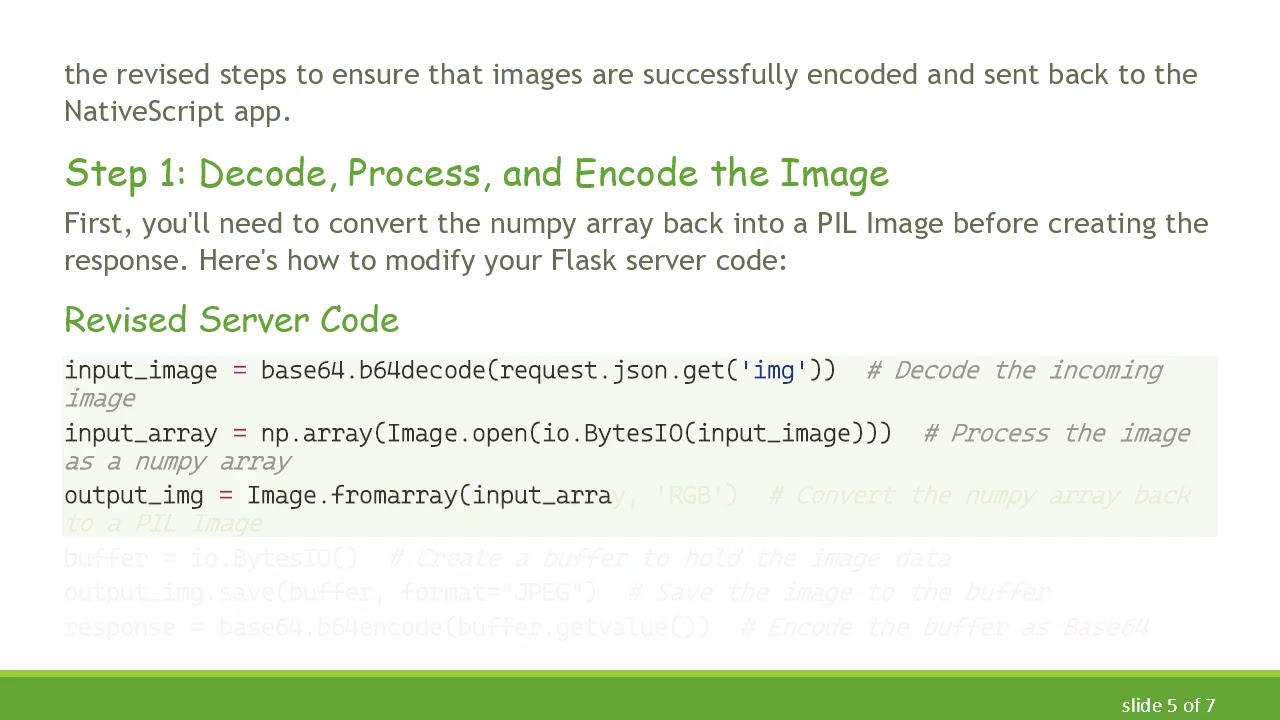
Step 1: Decode, Process, and Encode the Image
First, you'll need to convert the numpy array back into a PIL Image before creating the response. Here's how to modify your Flask server code:
Revised Server Code
[[See Video to Reveal this Text or Code Snippet]]
Step 2: Displaying Image in NativeScript
Make sure that the client-side code properly handles the Base64 data returned from the Flask server. The res.data should contain the correct Base64 string to generate an image.
Adjusting Client Code
[[See Video to Reveal this Text or Code Snippet]]
Conclusion
With these modifications, you should be able to fetch and display images properly in your NativeScript application from your Flask backend. Remember, when handling images and data formats across different platforms, attentive processing is key! Ensure that all steps—decoding, processing, encoding, and formatting—are followed diligently.
By following the outlined solution, you can enhance your application’s performance and deliver a smoother user experience. If you encounter further challenges, feel free to explore additional documentation or seek community assistance. Happy coding!
Доступные форматы для скачивания:
Скачать видео mp4
-
Информация по загрузке:





![Камеди клаб [НОВЫЙ 2026] [full HD] Сборник избранных смешных и юмористических эпизодов | часть 5](https://image.4k-video.ru/id-video/hFezUJlKMmM)