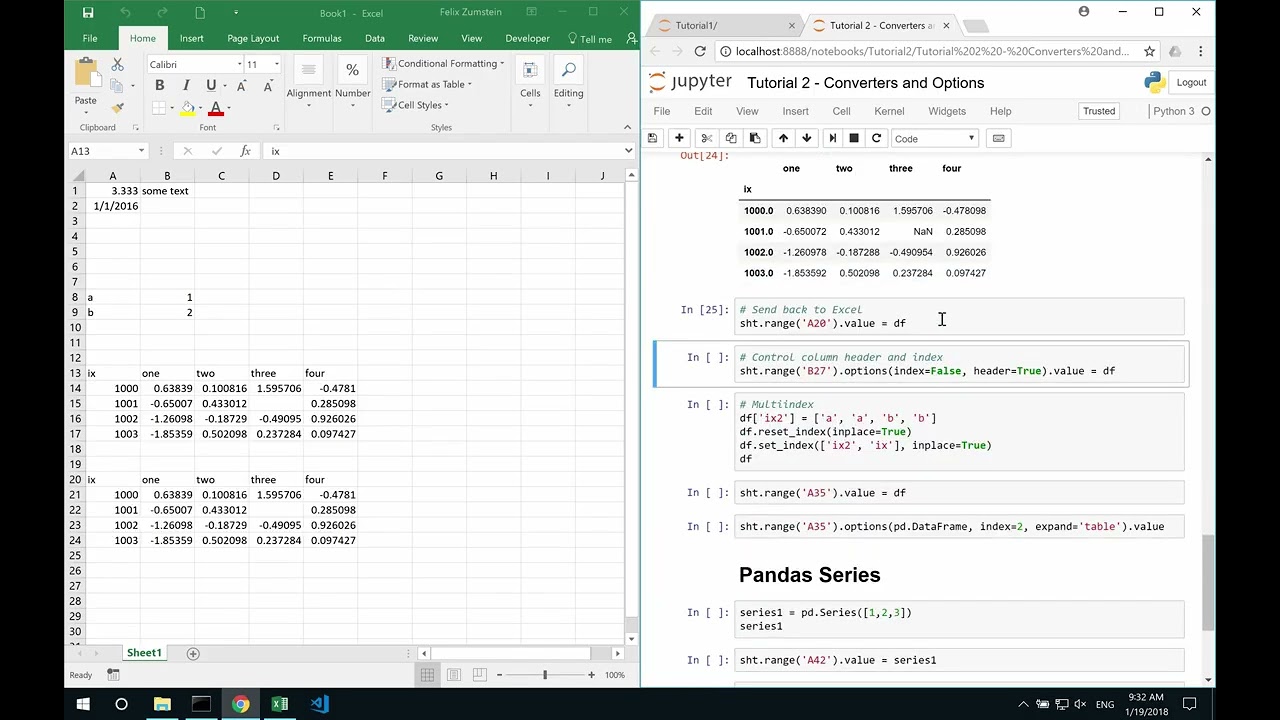
How to Group and Resample Time Series Data with Pandas in Python
Автор: vlogize
Загружено: 2025-09-20
Просмотров: 5
Learn how to effectively group and resample time series data in Pandas to compute means and differences between multiple sensor measurements.
---
This video is based on the question https://stackoverflow.com/q/62620852/ asked by the user 'Thomas' ( https://stackoverflow.com/u/398059/ ) and on the answer https://stackoverflow.com/a/62624898/ provided by the user 'filippo' ( https://stackoverflow.com/u/5629339/ ) at 'Stack Overflow' website. Thanks to these great users and Stackexchange community for their contributions.
Visit these links for original content and any more details, such as alternate solutions, latest updates/developments on topic, comments, revision history etc. For example, the original title of the Question was: Grouping timeseries with same time stamp
Also, Content (except music) licensed under CC BY-SA https://meta.stackexchange.com/help/l...
The original Question post is licensed under the 'CC BY-SA 4.0' ( https://creativecommons.org/licenses/... ) license, and the original Answer post is licensed under the 'CC BY-SA 4.0' ( https://creativecommons.org/licenses/... ) license.
If anything seems off to you, please feel free to write me at vlogize [AT] gmail [DOT] com.
---
Mastering Time Series Grouping with Pandas
Handling large datasets can be daunting, especially when it comes to time series data from multiple sensors. In this guide, we will explore a common problem faced by those working with sensor data: aligning timestamps for accurate calculations. Specifically, we'll focus on how to group time series data with the same timestamp using Pandas in Python, allowing for effective calculations such as averages and differences across multiple sensors.
The Challenge: Grouping Time Series Data
Imagine you have a dataset containing temperature readings from various locations:
[[See Video to Reveal this Text or Code Snippet]]
Your objective is to align the timestamps of the individual sensors so you can calculate means or differences among them. However, due to sensor failures, you might also encounter missing data, which adds another layer of complexity.
Solution Overview
To successfully group your time series data, we will take a systematic approach, involving the following steps:
Pivot the DataFrame: This will help us create a separate time series column for each sensor.
Interpolate Missing Data: We'll fill in any missing values with interpolation to ensure all data points are aligned.
Resample the Data: Finally, resampling at a defined interval will allow for mean calculations across the sensors.
Now let’s break down each of these steps in detail.
Step 1: Pivot the DataFrame
Pivoting the DataFrame allows us to rearrange the data such that each sensor has its own column. Here’s how to accomplish this:
[[See Video to Reveal this Text or Code Snippet]]
The resulting DataFrame will look like this:
[[See Video to Reveal this Text or Code Snippet]]
Step 2: Interpolate Missing Data
Next, we need to interpolate the missing values so that the temperature readings are filled in. This maintains the integrity of our dataset while providing us with complete data points for analysis.
[[See Video to Reveal this Text or Code Snippet]]
The updated DataFrame now looks like this:
[[See Video to Reveal this Text or Code Snippet]]
Step 3: Resample the Data
Finally, we will resample the data to a consistent time interval. In this example, we will resample to 1-minute intervals. This step aggregates the data by mean values, making it easier to analyze.
[[See Video to Reveal this Text or Code Snippet]]
Now, you’ll get a resampled DataFrame that allows you to calculate means easily across the aligned timestamps:
[[See Video to Reveal this Text or Code Snippet]]
Final Thoughts
With the dataset now properly organized and resampled, you're in a great position to calculate the means and differences between various sensors effectively. Depending on your actual data, you can also consider filling in missing values using techniques such as .nearest() or applying a rolling mean if only a few entries are missing.
By mastering these steps, you’ll enhance your ability to work with time series data in Pandas, paving the way for more insightful analyses. If you have any questions or need further clarification, feel free to drop a comment!

Доступные форматы для скачивания:
Скачать видео mp4
-
Информация по загрузке: