Targeted protein degradation (via PROTACs, molecular glues, etc.) and stabilization (via DUBTACs)
Автор: the bumbling biochemist
Загружено: 2022-10-22
Просмотров: 4074
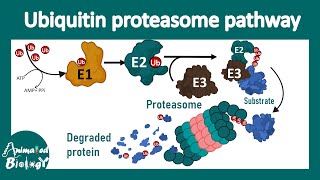
Our bodies use the Ubiquitin-Proteasome System (UPS) to target unwanted proteins (via the addition of chains of a small protein called ubiquitin) to the proteasome (protein-shredder). Much more on the the UPS and how it works “normal-function-wise” in a past post I will link to. But today I want to talk about how we can hijack this system to send specific proteins (maybe ones that are overactive or otherwise causing problems) for degradation or or rescue ubiquitinated proteins from being degraded. The first of those (targeting for degradation) is called Targeted Protein Degradation (TPD) and it uses PROTACs, molecular glues, and other small molecules (drug-like compounds to call over the ubiqutin-adders (ubiquitin ligases). The rescue angle, Targeted Protein Degradation (TPD), uses related molecules called DUBTACs which calls over deubiquitinases to remove ubiquitin tags (kinda like veto-ing the cells’ decision to trash the protein). These strategies are all the rage these days and have a lot of promise, but, unfortunately, also have some challenges. So today, the good, the bad, and the frustrating or targeted protein degradation and stabilization (but mostly degradation).
blog form: https://bit.ly/tpd_protac_etc
If you need to get caught up first, no problem - here’s that past post on the ubiquitin-proteasome system I mentioned: https://bit.ly/ubiquitinylation & • The Ubiquitin Proteasome System - the bioc...
Now I’m going to dive in…
In Targeted Protein Degradation (TPD), you induce an interaction between a protein target and an E3 ubiquitin ligase using a small molecule, leading the protein to be ubiquitinated and degraded by the proteasome.
There are two main types of small molecules that can be used for this: PROTACs and molecular glues
PROTAC stands for Proteolysis-Targeting Chimeras
these have 2 parts - one part specifically binds to the protein of interest and the other part binds to the ligase
the ligase-binding part can be hooked up to different protein-targeting parts to target different proteins to the proteasome
commonly-used ligase-binding parts (and the 2 (out of about 600 human E3 ligases) used most commonly are Cereblon (CRBN) and von Hippel-Lindau (VHL)
these are just the substrate-binding parts (the substrate receptors) of the ligase complex - like all ubiquitin ligases, they work as part of a larger complex, with additional parts enabling the ubiquitin addition
in the case of CRBN, it acts as part of the Cullin 4A (CUL4A) E3 ligase complex, with DNA-binding protein 1 (DDB1) and RBX1
in the case of VHL, it acts as part of the CRL2VHL E3 ligase complex, with Elongin B and C, Cullin 2 (CUL2) and RING box protein 1 (RBX1)
molecular glue degraders have a single part that binds both the protein of interest and the ligase, promoting an interaction between the two that didn’t exist before or strengthening a weak one
in the case where a new interaction is formed, we say that the protein target becomes a neosubstrate, with “neo” indicating “new”
molecular glue degraders are harder to design and are often found “by accident”
classic examples include thalidomide (which targets CRBN) and analogs of it (such as lenalidomide and pomalidomide)- in fact, thalidomide’s side effects have been attributed to it causing the degradation of
some of these are referred to as immunomodulatory drugs (IMIDs)
On the flip side of twiddling with protein levels with the help of the ubiquitin-proteasome system is Targeted Protein Stabilization (TPS). This uses Deubiquitinase-Targeting Chimeras (DUBTACs) to call deubiquitinases (DUBs) over to ubiquitinated proteins to remove the ubiquitin tags, rescuing the protein before it would get sent to the proteasome.
it’s kinda like pulling your retainer out of the trash bag before that bag gets poured into the incinerator? Not a perfect analogy, but hopefully you get the gist
PROTACs and DUBTACs are both examples of heterobifunctional molecules - they have 2 (“bi”) functional parts (parts that “do” stuff”), and those parts and functions are different (“hetero”). In each case, one of the parts, the ligase or DUB-targeting part, is more “generic” in the sense that you can add that lots of different small molecules in order to target lots of different proteins. The other part, however, has to be really specific for the protein of interest. And it has to bind that protein of interest in a spot nearby a lysine amenable to ubiquitination. Oh, and that combination molecule has to successfully make it to and into cells. So it’s a lot harder than it sounds!
Why try?
Why not just go after conventional small molecules, such as just going after that small protein-targeting part? A few reasons.
Finished in comments

Доступные форматы для скачивания:
Скачать видео mp4
-
Информация по загрузке: