Christo and Jeanne-Claude / Кристо и Жан-Клод (1935-2020, 1935-2009)
Автор: gtsenov
Загружено: 2018-01-23
Просмотров: 7864
Christo (Christo Yavashev), an American artist of Bulgarian birth, studied at the Fine Arts Academy in Sofia (1953–6), after which he spent six months in Prague. There he encountered Russian Constructivism, which impressed him with its concern for monumental visionary structures. He escaped first to Vienna, studying briefly in 1957 at the Akademie der Bildenden Künste, and in 1958 to Paris. Like his contemporaries, Christo rebelled against abstraction, seeing it as too theoretical and proposing in its place a manifestly physical art composed of real things. Christo began by wrapping everyday objects, including tin cans and bottles, stacks of magazines, furniture (e.g. Wrapped Chair, 1961; New York), automobiles, or various objects such as Wrapped Luggage Rack (1962; New York). From 1961 he collaborated with his wife, Jeanne-Claude [née de Guillebon] (b Casablanca, 13 June 1935, d New York, 18 Nov 2009). Industrial materials, usually polypropylene sheeting or canvas tarpaulins held in place with irregularly tied ropes, were used for the wrappings. The use of fabric sometimes involved wrapping an object, sometimes a bundle; these coverings partly obscured the object’s contours and hampered its function, thus transforming it into an aesthetic presence. In 1964, just after moving to New York, this repertory of forms was augmented by a series of life-sized store fronts, for example Store Front (1964; New York), the view through their plate-glass windows blocked by hanging fabrics or by sheets of paper stretched across their fronts, again rendering their function uncertain.
Working on the principle that the alteration of one element in a context affected all of its parts, in 1961 the first Project for a Wrapped Public Building (collaged photographs and typed text; New York) was conceived. With its normal interior function unimpeded, the obscured structure would become a disquieting presence in its urban setting. A related contextual intrusion was realized on the Rue Visconti in Paris on 27 June 1962 with the blocking of a small street by a stack of oil drums; the brightly coloured drums in this temporary work, Iron Curtain—Wall of Oil Barrels, 1961–1962, formed an unexpected and impenetrable street presence. In 1968 Christo and Jeanne-Claude produced the first of a number of temporary full-scale realizations, Wrapped Kunsthalle, Berne, Switzerland, which enshrouded the museum in a pale fabric and ropes so that it became a ghostly presence in its urban environment. Subsequently they directed their energies primarily to the realization of temporary projects in which they varied the notions of obscuring through wrapping, blocking and the altering of context by the intrusion of an unexpected element, accompanied by an increasingly large scale made possible by the use of industrial technique and engineering. With such works Christo and Jeanne-Claude helped establish the terms of a new art form known as environmental art.
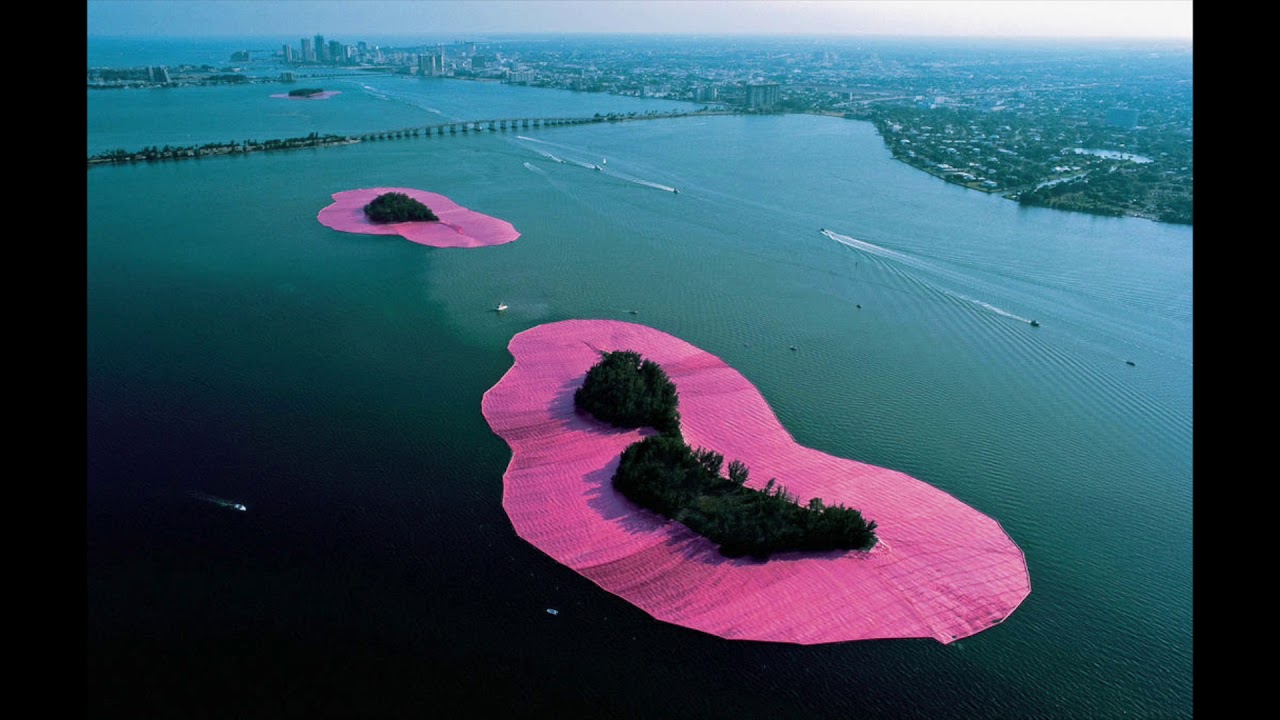
The partnership’s most celebrated realizations include Wrapped Coast—One Million Square Feet, Little Bay, Sydney, Australia (1969), the wrapping of a mile of Australian ocean shore; Valley Curtain, Rifle, Colorado, 1970–72, in which an orange nylon curtain 417 m wide was suspended across a valley; Running Fence, Sonoma and Marin Counties, California, 1972–6, a meandering intrusion of white nylon, 5.5 m high and 39.5 km long, across the northern California landscape that ultimately disappeared into the Pacific Ocean; The Pont Neuf Wrapped, Paris, 1975–85, enshrouding the oldest bridge in Paris; and Surrounded Islands, Biscayne Bay, Greater Miami, Florida, 1980–83, in which an expanse of 600,000 sq. m of bright pink fabric placed around 11 islands mysteriously isolated them from the surrounding water. One of the most discussed and symbolically rich later projects was the Wrapped Reichstag, Berlin, 1971–95, first proposed in 1976 and realized finally in 1995. Similarly long in the making was The Gates, Central Park, New York City, 1979–2005. For 16 days in February 2005, more than 7500 saffron-coloured fabric panels of varying sizes floated on metal ‘gate’ frames above the many entrances and paths that traverse New York’s Central Park. The large sums of money required to realize such proposals were raised through the sale of original drawings and collages in which Christo and Jeanne-Claude visualized various aspects of the project in question, as well as earlier works. They regarded the public endeavour, generally involving large numbers of people and directed to the often stubborn and difficult process of procuring permissions and rights of way, as an essential element in the realization of the work. Although they remained residents of New York, Christo and Jeanne-Claude, more than perhaps any artists of their generation, continued to conceive of the entire world as the platform for their extraordinary schemes.
Music: J. S. Bach - The Well-Tempered Clavier: Prelude No. 1 in C Major
Доступные форматы для скачивания:
Скачать видео mp4
-
Информация по загрузке: