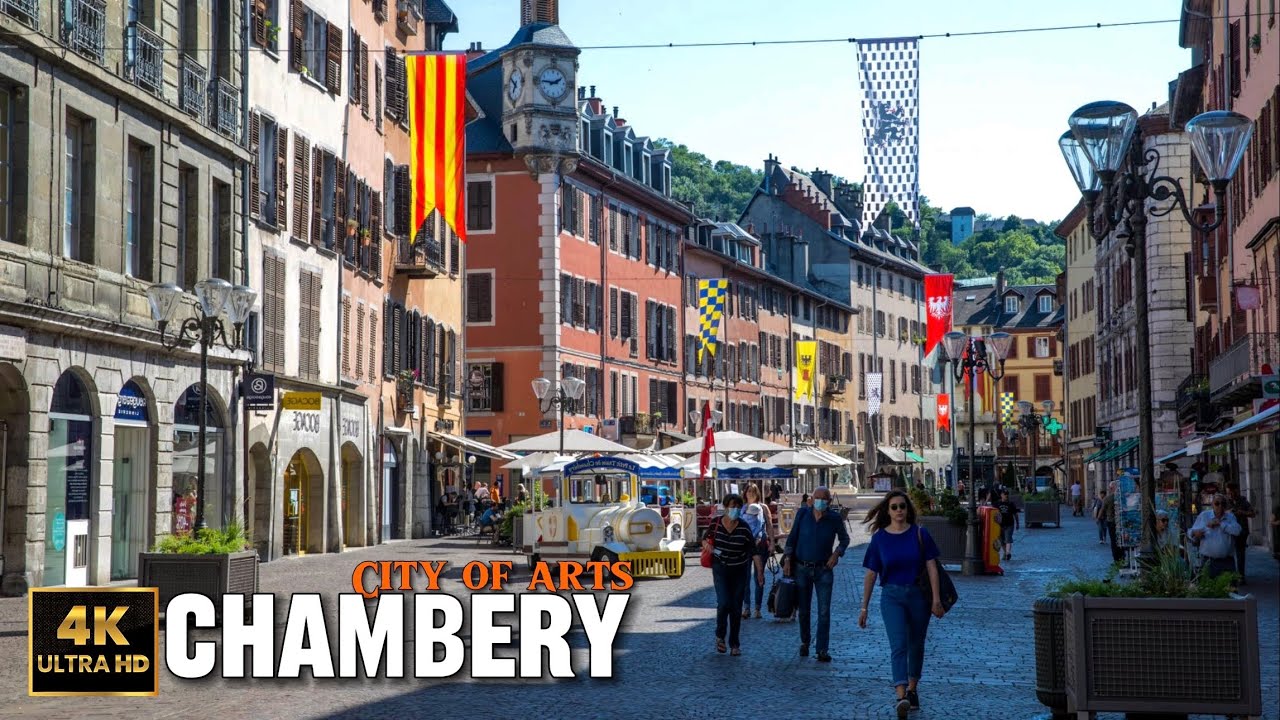
CHAMBÉRY - the French city where you can taste the sweetness of life (Joie de vivre!)
Автор: Erik History Hiker
Загружено: 2023-12-19
Просмотров: 872
#Chambéry
Chambéry is the prefecture and largest city of the Savoie department in the Auvergne-Rhône-Alpes region of southeastern France. The population of the commune of Chambéry was 59,172 as of 2020, while the population of the Chambéry metropolitan area was 255,790.
The city is located at the foot of the French Alps between Bauges and Chartreuse mountains, making Chambéry an important railway and highway crossroads.
It has been the historical capital of the Savoy region since the 13th century, when Amadeus V, Count of Savoy, made the city his seat of power. The annexation of Savoy merged the city to France in 1860. Together with other alpine towns Chambéry engages in the Alpine Town of the Year Association for the implementation of the Alpine Convention to achieve sustainable development in the Alpine Arc. Chambéry was awarded Alpine Town of the Year 2006.
Fontaine des Éléphants
The Fontaine des Éléphants ("Elephants Fountain") is the most famous landmark in Chambéry. It was built in 1838 to honour Benoît de Boigne's feats when he was in India. The monumental fountain has realistic sculptures of the head and forelimbs of four lifesize elephants truncated into the base of a tall column in the shape of the savoyan (savoyarde) cross, topped by a statue of de Boigne. At first, the landmark was mocked by the local residents who were annoyed by it, but it now is accepted as one of the city's symbols. Since the early controversy, the statue kept its nickname of les quatre sans culs, ("the four without arses", which sounds in French similar to the title of the best-known movie by nouvelle vague director François Truffaut: Les quatre cents coups, "The 400 Blows"). A total restoration was done between December 2014 and July 2015.
Les Charmettes
In 1728, a young Jean-Jacques Rousseau fled a watch-making apprenticeship in nearby Geneva and took refuge with Françoise-Louise de Warens, or Madame de Warens, who became his mistress and mentor. They first resided in the city of Annecy before moving on to Chambéry. Madame de Warens - whom Rousseau affectionately referred to as maman (mother) - was 13 years Rousseau's senior. From the summer of 1736, Rousseau and maman moved into a country house called Les Charmettes in the neighborhood of Chambéry. Located in the hollow of a wooded valley, Les Charmettes figures prominently in Rousseau's Confessions (Books V and VI). According to him, his short sojourn at Les Charmettes constituted "the short period of my life's happiness" and was instrumental in the development of his love of nature and the simple country life.
During the revolutionary and subsequent Romantic periods, Les Charmettes became a symbol of Rousseau's revolutionary thought as well as a shrine attracting such literary and political celebrities as George Sand and Alphonse de Lamartine. In 1905 Les Charmettes was classified an historical monument by the French government. The house and its grounds are now a museum open to the public.

Доступные форматы для скачивания:
Скачать видео mp4
-
Информация по загрузке:








![[4K]🇫🇷 Анси, Франция: жемчужина французских Альп | Знакомство со старым городом и озером Анси. 2024](https://imager.clipsaver.ru/EP0ds51ohIg/max.jpg)