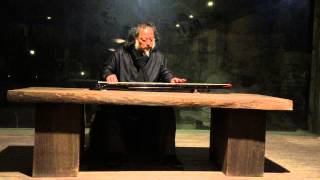
[Guqin] Guangling San - Liu Li I 广陵散 - 刘丽
Автор: 紐約古琴研究會New York Guqin Association
Загружено: 2017-04-13
Просмотров: 4119
Guangling San literally translates to san-type melody from Guangling, historical center of Yangzhou, Jiangsu Province.
The melody is commonly attributed to Xi Kang (223 - 262), one of the Seven Sages of the Bamboo Grove who engaged in separating themselves from the dangerous political situation of third century China in favor of devoting themselves to a life of art and leisure.
A powerful melody heavily seeped in political morality, the piece requires the 2nd string (symbolizing the minister) to be loosened to the same tune as the 1st string (symbolizing the lord). It traces the story of Nie Zheng, whose story would have been forgotten in history had things gone according to his plans. Wanted for murder, he was forced to go into hiding with his mother and older sister. For some time he lived life as a common butcher.
His good friend and government official Yan Zhongzi, however, needed Nie’s services. He had just reported Xia Lei, the counselor of Han, to the state’s lord for treacherous behavior, and feared retaliation. It was kill or be killed.
Knowing that Nie Zheng was a capable and enthusiastic fighter, Yan made extravagant efforts to recruit him, offering all kinds of riches.
But however good a friend Yan Zhongzi was or how much money he offered him to kill Xia Lei, Nie Zheng could not accept. He had to take care of his elderly mother to the end of her days.
Time passed, and eventually Nie Zheng’s mother passed away. He presented himself before Yan Zhongzi, expressing his gratitude for the respect with which the latter had treated him and his family during their previous meetings. Now that his filial duty to his parents was complete, Nie Zheng could serve Yan without qualms.
Nie Zheng’s approach to his mission could hardly be simpler. Knife in hand, he simply barged into Xia Lei’s residence, cutting down the statesman and those around him.
Nie Zheng then committed suicide, taking care to mutilate his face beyond recognition before stabbing himself in the gut. A few deft strokes of the blade was all it took for Nie Zheng to destroy his identity.
Knife in hand, he simply barged into Xia Lei’s residence, cutting down the statesman and those around him. The authorities were shocked and immediately demanded to know the identity of this spontaneous killer. The body was displayed at the city market: anybody who could accurately identify it would be rewarded with a large sum of gold.
Enter Nie Zheng’s elder sister, Nie Rong. Hearing the news of the assassination, she instantly knew her brother was the perpetrator. She also knew that he had let go of his own aspirations to protect her.
While on the surface Nie Zheng accepted Yan Zhongzi’s request out of loyalty to a friend, he had really wanted to become a hero. For his sister’s sake, however, he opted not to leave his name in history.
Nie Rong would not have any of it. In grief, she came to the market and firmly declared that the corpse was her little brother. Then she revealed the entire story of Nie Zheng, from his initial refusal to carry out the deed out of filial duty, to his eventual decision out of loyalty to Yan Zhongzi.
Overcome with shock and grief, Nie Rong let out three resounding cries, and fell lifeless to the floor where her brother lay.
The integrity with which members the Nie family treated each other became famous among the fractured territories of the Eastern Zhou Dynasty, finally making its way into record history via Sima Qian's "Records of the Grand Historian" (史记).
![[Guqin] Guangling San - Liu Li I 广陵散 - 刘丽](https://ricktube.ru/thumbnail/WiREUTDQ4Qs/hq720.jpg)
Доступные форматы для скачивания:
Скачать видео mp4
-
Информация по загрузке:
![[Guqin] Solitary Orchid - Liu Li | 幽兰 - 刘丽](https://ricktube.ru/thumbnail/RL-qEqa4wcY/mqdefault.jpg)


![[Guqin] Mist and Clouds over Xiao-Xiang - Liu Li 潇湘水云 - 刘丽](https://ricktube.ru/thumbnail/N0XZA1kYoRk/mqdefault.jpg)