Mastering Unit Testing in Angular 8: How to Effectively Test Your Filter Method
Автор: vlogize
Загружено: 2025-10-05
Просмотров: 1
Learn how to unit test your Angular 8 application effectively! Dive into step-by-step solutions for thorough testing of filter methods in your components.
---
This video is based on the question https://stackoverflow.com/q/63916283/ asked by the user 'Mr.M' ( https://stackoverflow.com/u/4659026/ ) and on the answer https://stackoverflow.com/a/63916435/ provided by the user 'IAfanasov' ( https://stackoverflow.com/u/390161/ ) at 'Stack Overflow' website. Thanks to these great users and Stackexchange community for their contributions.
Visit these links for original content and any more details, such as alternate solutions, latest updates/developments on topic, comments, revision history etc. For example, the original title of the Question was: How to unit test for the given code in Angular 8
Also, Content (except music) licensed under CC BY-SA https://meta.stackexchange.com/help/l...
The original Question post is licensed under the 'CC BY-SA 4.0' ( https://creativecommons.org/licenses/... ) license, and the original Answer post is licensed under the 'CC BY-SA 4.0' ( https://creativecommons.org/licenses/... ) license.
If anything seems off to you, please feel free to write me at vlogize [AT] gmail [DOT] com.
---
Mastering Unit Testing in Angular 8: How to Effectively Test Your Filter Method
Unit testing is a critical aspect of software development, and with Angular 8, testing your components effectively ensures your application is robust and reliable. In this guide, we'll explore how to unit test a filter method in Angular 8, addressing common pitfalls and providing solid testing practices.
The Problem: Testing a Filter Method
Let’s consider a scenario where you have a method in your Angular component that applies a filter to a data source. Here's the method in question:
[[See Video to Reveal this Text or Code Snippet]]
You want to ensure that when this method is called with a specific filter value, it correctly filters the data sources. However, your initial attempt at unit testing looked like this:
[[See Video to Reveal this Text or Code Snippet]]
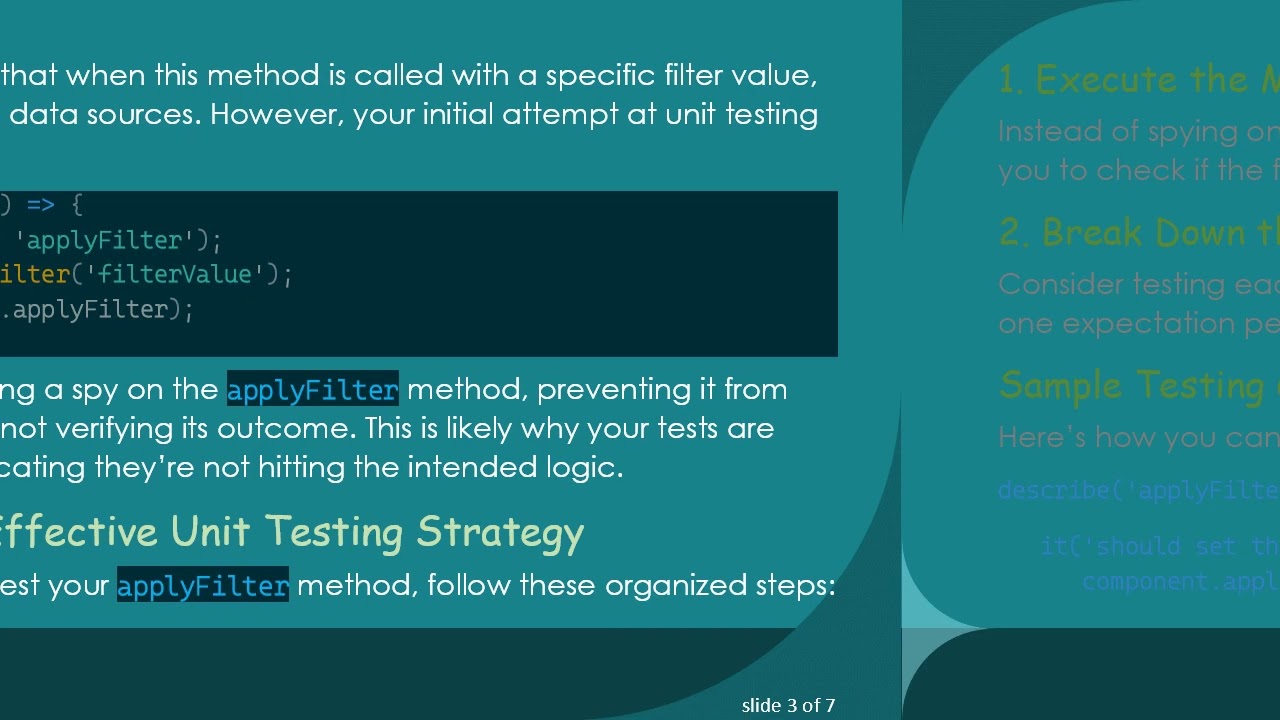
The issue? You're using a spy on the applyFilter method, preventing it from executing and thus not verifying its outcome. This is likely why your tests are covered in red, indicating they’re not hitting the intended logic.
The Solution: Effective Unit Testing Strategy
To successfully unit test your applyFilter method, follow these organized steps:
1. Execute the Method
Instead of spying on the method, directly call it to verify its behavior. This allows you to check if the filter has been applied correctly.
2. Break Down the Test Cases
Consider testing each aspect of the method in separate it blocks. Having one expectation per block makes your tests easier to read and maintain.
Sample Testing Code
Here’s how you can structure your unit tests:
[[See Video to Reveal this Text or Code Snippet]]
Key Points
Direct Method Execution: Call the method directly to verify its function.
Multiple Test Cases: Create a separate test for each functional expectation.
Input Normalization: Include tests for input scenarios like trimming and case sensitivity.
Conclusion
By executing the applyFilter method instead of spying on it and structuring your tests for readability and maintainability, you ensure that your testing suite accurately verifies the functionality of your Angular code. Following these strategies will not only help you fix the existing test issues but also lay a strong foundation for building a robust testing culture in your Angular applications.
Through diligent unit testing, you can maintain the health of your application and confidently implement new features. Happy testing!
Доступные форматы для скачивания:
Скачать видео mp4
-
Информация по загрузке:


![Камеди клаб [НОВЫЙ 2026] [full HD] Сборник избранных смешных и юмористических эпизодов | часть 5](https://image.4k-video.ru/id-video/hFezUJlKMmM)