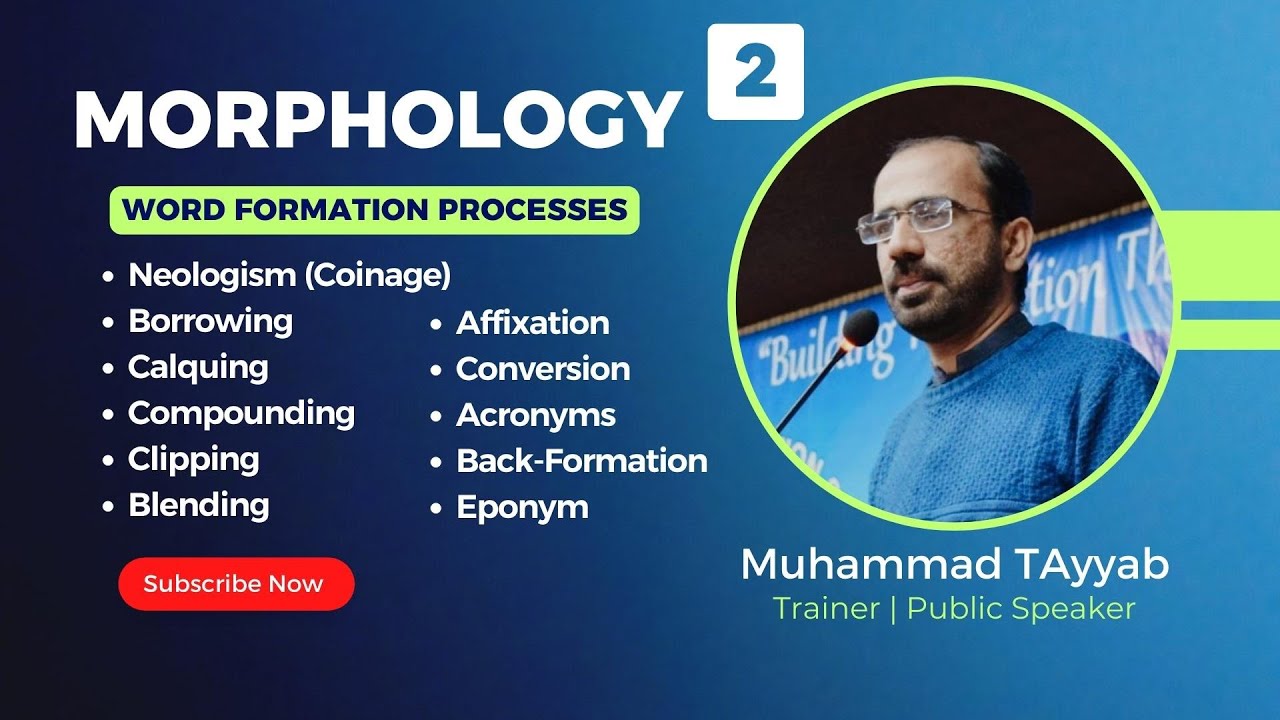
Morphology Part 2 | Word Formation Processes in English | Linguistics | Muhammad Tayyab
Автор: M T Learning Institute
Загружено: 2023-03-19
Просмотров: 9632
To Book a one-on-one Meeting on Mentoga, click on the link
https://bit.ly/3X0BCzM
In this video, Muhammad Tayyab explains Word Formation Processes. In linguistics (particularly morphology), word formation refers to the ways in which new words are created on the basis of other words or morphemes.
1. Neologism (Coinage): A neologism is a process of forming a new word by coining.
2. Borrowing: a word borrowed from another language, as cliché is from French. The borrowed words are called loan words.
3. A loanword (or loan word) is a word directly taken into one language from another with little or no translation. Examples: Biology, boxer ,ozone from German
4. Clipping: We use clipping when we shorten or ‘clip’ one or more syllables from a word. We also commonly clip proper names for people. ad: advertisement, advert, lab: laboratory, Matt: Matthew
5. Acronyms are a type of abbreviation formed when the initial letters of two or more words are combined in a way that produces consonant and vowel sequences found in words. Acronyms are normally pronounced as words: RAM: random access memory (RAM is a term used to describe a computer’s memory.)
Initials are similar to acronyms but are pronounced as sets of letters, not as words:
6. Blending: A blend is a word formed from parts of two other words. A blend is a word formed by joining parts of two words after clipping. An example is smog, which comes from smoke and fog, or brunch, which comes from 'breakfast' and 'lunch'.
blog: blend of web and log, motel: blend of motor and hotel, smog: blend of smoke and fog
Most blends are formed by one of the following methods:
A. The beginning of one word is added to the end of the other. For example, brunch is a blend of breakfast and lunch. This is the most common method of blending.
B. The beginnings of two words are combined. For example, cyborg is a blend of cybernetic and organism.
C. One complete word is combined with part of another word. For example, guesstimate is a blend of guess and estimate.
D. Two words are blended around a common sequence of sounds. For example, the word Californication, from a song by the Red Hot Chili Peppers, is a blend of California and fornication.
7. Back-formation: Back-formation refers to the process of creating a new lexeme (“a new "word") by removing actual or supposed affixes. The resulting neologism is called a back-formation. Back-formations are shortened words created from longer words, thus back-formations may be viewed as a sub-type of clipping. For example, the noun resurrection was borrowed from Latin, and the verb resurrect was then backformed hundreds of years later from it by removing the -ion suffix
8. Affixation: Changing words by adding morphemes in the front or the back of a free morpheme or base; sub-divided into prefigation & suffigation.
9. Compounding: A compound is a lexeme (a word) that consists of more than one other lexeme. For example, the English compound doghouse, where house is the head and dog is the modifier, is understood as a house intended for a dog. cupcake, cup holder, email
N + N lipstick , teapot
Adj + N fast food , soft drink
V + N breakfast , sky-dive
N + V sunshine , babysit
10. Conversion: Conversion involves the change of a word from one word class to another. For example, the verbs to email and to microwave are formed from the nouns email and microwave: Can you text her? (verb from noun text, meaning to send a text-message)
They are always jetting somewhere. (verb from noun jet) If you’re not careful, some downloads can damage your computer. (noun from verb download) OK, so the meeting’s on Tuesday. That’s a definite. (noun from adjective)
It’s a very big if and I’m not at all sure we can afford it. (noun from conjunction, meaning ‘it’s not at all certain’)
All companies have their ups and downs. (nouns from prepositions)
We also use conversion when we change a proper noun into a common noun:
Has anybody seen my Dickens? (copy of a book by Dickens)
11. Eponymy: It is also a word formation process in which new words (usually adjectives) are formed from a person name. For example, Shakespearean from Shakespeare. His machiavellian talent always let him get promotion otherwise he doesn't deserve. machiavellian from Machiavelli who is an Italian author.
________________________/𝐅𝐨𝐥𝐥𝐨𝐰 𝐮𝐬 𝐨𝐧 𝐒𝐨𝐜𝐢𝐚𝐥 𝐌𝐞𝐝𝐢𝐚\____________________________
𝐅𝐚𝐜𝐞𝐛𝐨𝐨𝐤 / muhammadtayyab130
𝐓𝐰𝐢𝐭𝐭𝐞𝐫 / mtayyab9211
𝐈𝐧𝐬𝐭𝐚𝐠𝐫𝐚𝐦 / muhammad.tayyab.786
𝐓𝐢𝐤𝐓𝐨𝐤 https://bit.ly/3mTVRyM
𝐒𝐧𝐚𝐜𝐤 𝐕𝐢𝐝𝐞𝐨 https://sck.io/u/cHPBlhUl
𝐋𝐢𝐤𝐞𝐞 https://l.likee.video/p/2I6RPr
#muhammadtayyab #morphology #wordformationprocesses
Доступные форматы для скачивания:
Скачать видео mp4
-
Информация по загрузке:


![شرح تفصيلي لل [مورفولوجي] (morphology) باللغة العربية](https://imager.clipsaver.ru/ESgDmxgVAqk/max.jpg)