How to Copy a Text File from Linux to a Python Variable
Автор: vlogize
Загружено: 2025-10-09
Просмотров: 0
Learn how to effectively copy the contents of a log file from a Linux system into a Python variable using simple methods. Discover how to utilize the `open` function or `subprocess` module in your scripts.
---
This video is based on the question https://stackoverflow.com/q/64786375/ asked by the user 'dddd4' ( https://stackoverflow.com/u/14555612/ ) and on the answer https://stackoverflow.com/a/64786459/ provided by the user 'ErdoganOnal' ( https://stackoverflow.com/u/9655292/ ) at 'Stack Overflow' website. Thanks to these great users and Stackexchange community for their contributions.
Visit these links for original content and any more details, such as alternate solutions, latest updates/developments on topic, comments, revision history etc. For example, the original title of the Question was: Copy text file from linux to python variable
Also, Content (except music) licensed under CC BY-SA https://meta.stackexchange.com/help/l...
The original Question post is licensed under the 'CC BY-SA 4.0' ( https://creativecommons.org/licenses/... ) license, and the original Answer post is licensed under the 'CC BY-SA 4.0' ( https://creativecommons.org/licenses/... ) license.
If anything seems off to you, please feel free to write me at vlogize [AT] gmail [DOT] com.
---
How to Copy a Text File from Linux to a Python Variable: A Step-by-Step Guide
If you're a developer or a data scientist working with logs in Python, you might eventually run into the need to read and store the contents of a text file directly into a variable. For instance, you may have a log file named mylogfile.log and want to contain all its contents in a variable for further analysis or processing. It might seem straightforward but often leads to confusion, particularly if you're trying to execute shell commands directly from Python.
In this guide, we're going to explore how to copy a text file from a Linux environment into a Python variable effectively, addressing common pitfalls along the way. Let’s jump right in!
The Problem
You've tried using the command:
[[See Video to Reveal this Text or Code Snippet]]
However, this command doesn't work as expected because it executes the command in the shell and outputs the contents to the terminal, causing your script to hang or not behave as intended.
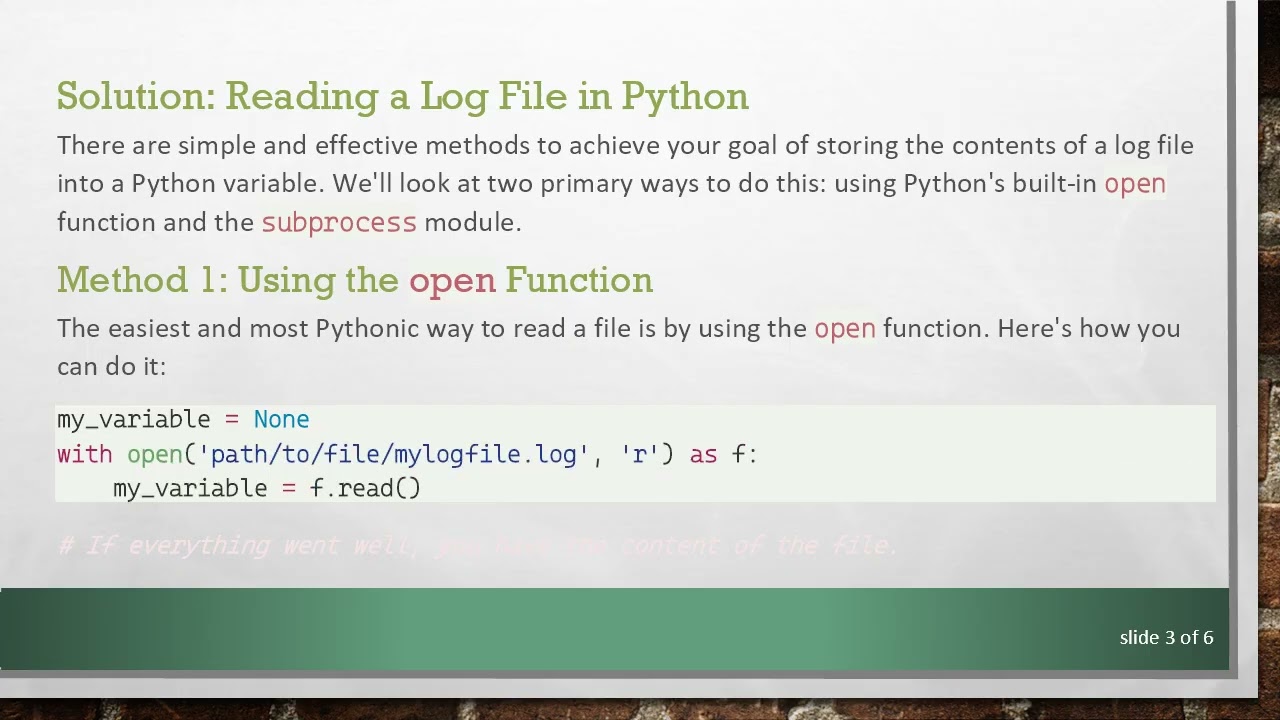
Solution: Reading a Log File in Python
There are simple and effective methods to achieve your goal of storing the contents of a log file into a Python variable. We'll look at two primary ways to do this: using Python's built-in open function and the subprocess module.
Method 1: Using the open Function
The easiest and most Pythonic way to read a file is by using the open function. Here's how you can do it:
[[See Video to Reveal this Text or Code Snippet]]
Explanation:
with open('file', 'r'): This line opens the log file in read mode.
f.read(): This function reads the entire content of the file into the variable my_variable.
The with statement ensures that the file is properly closed after its suite finishes, maintaining resource management.
Method 2: Using the subprocess Module
If you prefer to execute shell commands, you can use the subprocess module. Here's an example:
[[See Video to Reveal this Text or Code Snippet]]
Explanation:
import subprocess: This imports the subprocess module needed to run shell commands.
check_output(): This method runs the command and captures its output to my_variable.
Parameters:
text=True: Ensures that the output is treated as a string rather than bytes.
shell=True: Allows you to run the command as if it were executed in a shell.
Conclusion
Either method described above will allow you to effectively copy the contents of a file into a Python variable. The first method using the open function is generally recommended for simplicity and readability, while the second method using subprocess can be useful for more complex command executions.
By understanding these techniques, you can streamline your data processing workflows, especially when dealing with logs and other text files. Happy coding!
Доступные форматы для скачивания:
Скачать видео mp4
-
Информация по загрузке:



![Python - Полный Курс по Python [15 ЧАСОВ]](https://image.4k-video.ru/id-video/cfJrtx-k96U)