Cognitive Behavioral Therapy for Eating Disorders. Learning English by Listening and Reading.
Автор: Psicólogo Julio Nieto
Загружено: 2022-07-30
Просмотров: 20
Cognitive Behavioral Therapy for Eating Disorders. Learning English by Listening and Reading.
NO PULSES AQUÍ: / @psicologojulionieto
https://www.psych.theclinics.com/arti...
Cognitive Behavioral Therapy for Eating Disorders.
Rebecca Murphy.
Suzanne Straeble.
Zafra Cooper.
Christopher G.
Cognitive behavioral therapy.
Eating disorders:
Anorexia nervosa.
Bulimia nervosa.
The eating disorders provide one of the strongest indications for cognitive behavioral therapy (CBT). Two considerations support this claim. First, the core psychopathology of eating disorders, the over-evaluation of shape and weight, is cognitive in nature. Second, it is widely accepted that CBT is the treatment of choice for bulimia nervosa and there is evidence that it is as effective with cases of “eating disorder not otherwise specified” (eating disorder NOS),
the most common eating disorder diagnosis. This article starts with a description of the clinical features of eating disorders and then reviews the evidence supporting cognitive behavioral treatment. Next, the cognitive behavioral account of eating disorders is presented and, last, the new “trans diagnostic” form of CBT is described.
Eating disorders and their clinical features.
Classification and Diagnosis:
Eating disorders are characterized by a severe and persistent disturbance in eating behavior that causes psychosocial and, sometimes, physical impairment. The DSM-IV classification scheme for eating disorders recognizes 2 specific diagnoses, anorexia nervosa (AN) and bulimia nervosa (BN), and a residual category termed eating disorder NOS.
The diagnosis of anorexia nervosa is made in the presence of the following features:
The over-evaluation of shape and weight; that is, judging self-worth largely, or even exclusively, in terms of shape and weight. This has been described in various ways and is often expressed as a strong desire to be thin combined with an intense fear of weight gain and fatness.
defined as maintaining a body weight less than 85% of that expected or a body mass index (BMI; weight kg/height m2 or weight lb/[height in]2 × 703) of 17.5 or less.
The unduly low weight is pursued in a variety of ways with strict dieting and excessive exercise being particularly prominent. A subgroup also engages in episodes of binge eating and/or “purging” through self-induced vomiting or laxative misuse.
For a diagnosis of bulimia nervosa 3 features need to be present:
Overvaluation of shape and weight, as in anorexia nervosa.
Recurrent binge eating. A “binge” is an episode of eating during which an objectively large amount of food is eaten for the circumstances and there is an accompanying sense of loss of control.
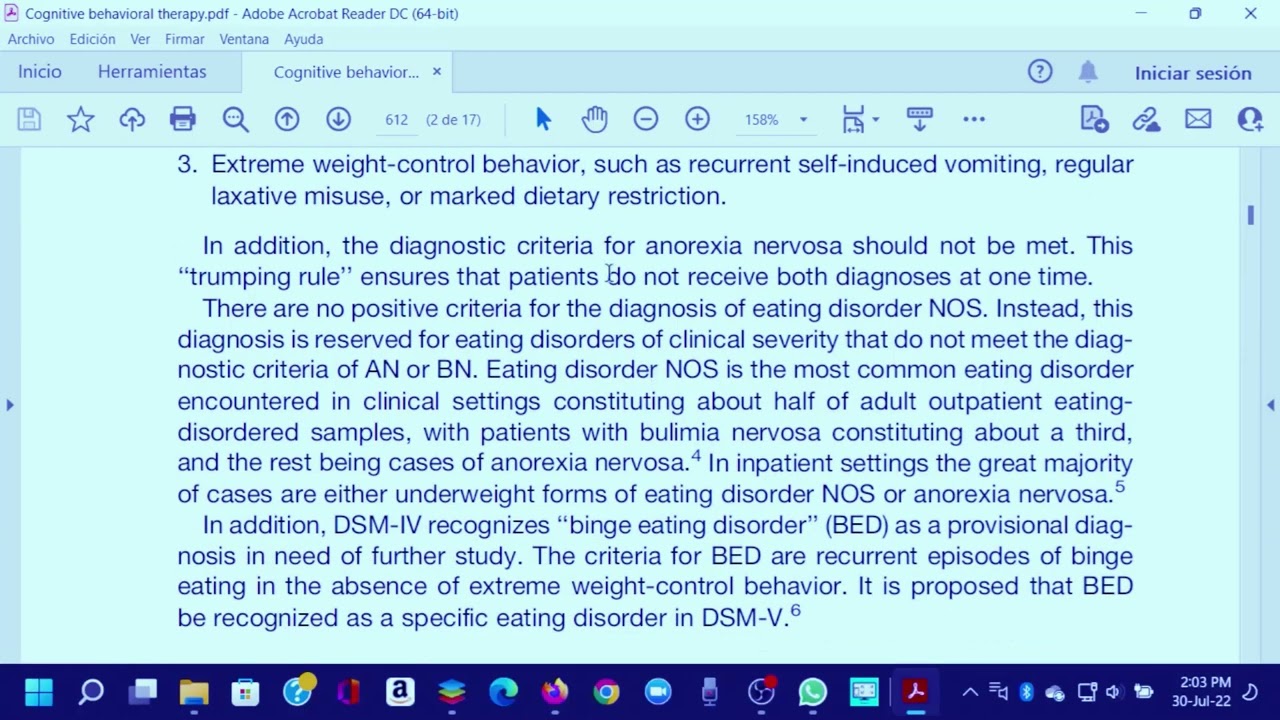
Extreme weight-control behavior, such as recurrent self-induced vomiting, regular laxative misuse, or marked dietary restriction.
In addition, the diagnostic criteria for anorexia nervosa should not be met. This “trumping rule” ensures that patients do not receive both diagnoses at one time.
There are no positive criteria for the diagnosis of eating disorder NOS. Instead, this diagnosis is reserved for eating disorders of clinical severity that do not meet the diagnostic criteria of AN or BN. Eating disorder NOS is the most common eating disorder encountered in clinical settings constituting about half of adult outpatient eating-disordered samples, with patients with bulimia nervosa constituting about a third, and the rest being cases of anorexia nervosa.
In inpatient settings the great majority of cases are either underweight forms of eating disorder NOS or anorexia nervosa.
In addition, DSM-IV recognizes “binge eating disorder” (BED) as a provisional diagnosis in need of further study. The criteria for BED are recurrent episodes of binge eating in the absence of extreme weight-control behavior. It is proposed that BED be recognized as a specific eating disorder in DSM-V.6
Clinical Features
Anorexia nervosa, bulimia nervosa, and most cases of eating disorder NOS share a core psychopathology: the overevaluation of the importance of shape and weight and their control. Whereas most people judge themselves on the basis of their perceived performance in a variety of domains of life (such as the quality of their relationships, their work performance, their sporting prowess), for people with eating disorders self-worth is dependent largely, or even exclusively, on their shape and weight and their ability to control them. This psychopathology is peculiar to the eating disorders (and to body dysmorphic disorder).
Доступные форматы для скачивания:
Скачать видео mp4
-
Информация по загрузке: