How to Marshal XML with JAXB to Avoid End Tags in Java ROOT Elements
Автор: vlogize
Загружено: 2025-09-28
Просмотров: 3
Learn how to efficiently marshal XML using JAXB and STAX in Java, while avoiding end tags for your `ROOT` elements in complex data structures.
---
This video is based on the question https://stackoverflow.com/q/63517760/ asked by the user 'Aniket' ( https://stackoverflow.com/u/5392822/ ) and on the answer https://stackoverflow.com/a/63611032/ provided by the user 'Aniket' ( https://stackoverflow.com/u/5392822/ ) at 'Stack Overflow' website. Thanks to these great users and Stackexchange community for their contributions.
Visit these links for original content and any more details, such as alternate solutions, latest updates/developments on topic, comments, revision history etc. For example, the original title of the Question was: Need XML root element without end tag using JAXB STAX in combination
Also, Content (except music) licensed under CC BY-SA https://meta.stackexchange.com/help/l...
The original Question post is licensed under the 'CC BY-SA 4.0' ( https://creativecommons.org/licenses/... ) license, and the original Answer post is licensed under the 'CC BY-SA 4.0' ( https://creativecommons.org/licenses/... ) license.
If anything seems off to you, please feel free to write me at vlogize [AT] gmail [DOT] com.
---
Introduction
When working with XML in Java, the combination of JAXB (Java Architecture for XML Binding) and STAX (Streaming API for XML) can be a powerful approach for marshaling data. However, developers often encounter issues while trying to control the output format of their XML, especially when it comes to the presence of unnecessary end tags for certain elements. In this guide, we’ll explore a common issue faced by developers: how to marshal a list of objects into XML without generating end tags for the ROOT elements.
The Problem
You may find yourself in a situation where you need to marshal a list of objects into XML format, and while the actual output might seem technically correct, the structure might not meet your specifications. If you have a class that looks like this for the ROOT, for example:
[[See Video to Reveal this Text or Code Snippet]]
When marshaled, you may see an output like this:
[[See Video to Reveal this Text or Code Snippet]]
While this is functional XML, it does not have the desired format. The expected output would be:
[[See Video to Reveal this Text or Code Snippet]]
Here, each ROOT element should be self-closing and should not have an explicit end tag.
Solution Overview
Unfortunately, achieving the desired output format using JAXB directly can be challenging without creating an additional wrapper class. This is because the JAXB specification does not allow for the nillable attribute to be applied to @ XmlRootElement. However, we can apply some strategies to achieve a better output format without a complete redesign of our code.
Implementing JAXB with the JAXB_FRAGMENT Property
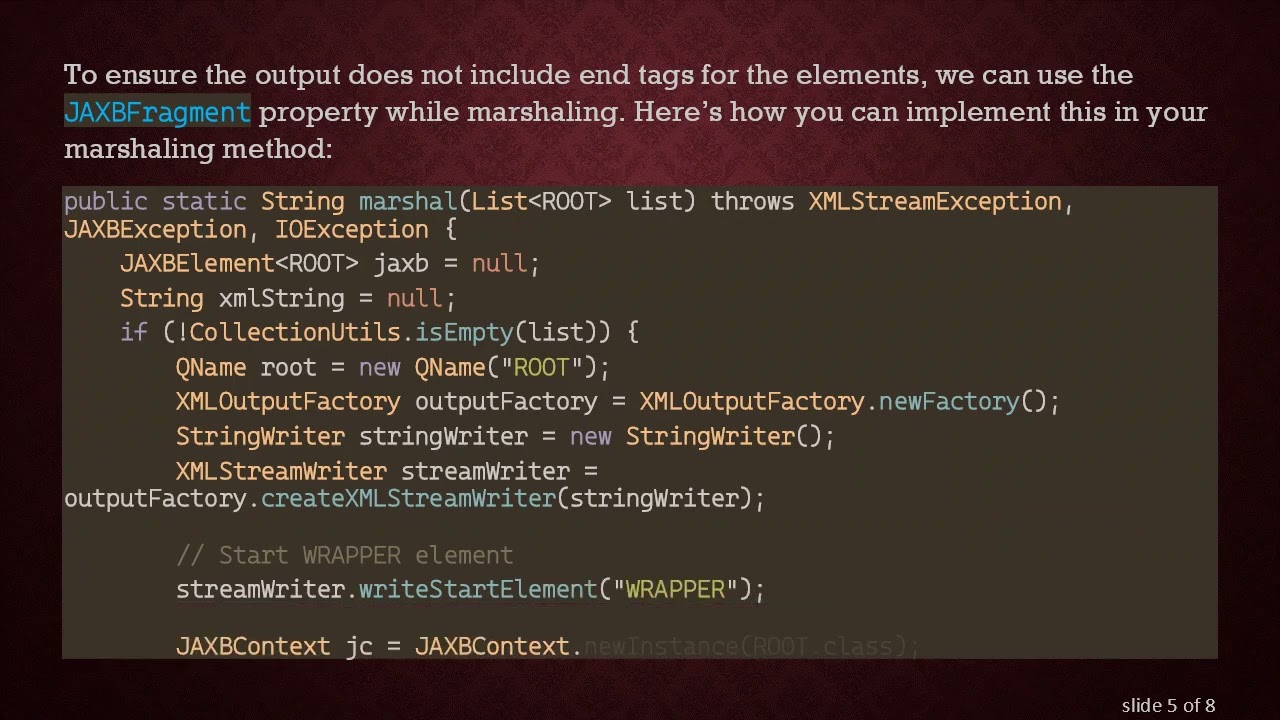
To ensure the output does not include end tags for the elements, we can use the JAXBFragment property while marshaling. Here’s how you can implement this in your marshaling method:
[[See Video to Reveal this Text or Code Snippet]]
Key Concepts Explained
JAXBContext and Marshaller: These are used to bind your Java classes to XML representation.
JAXB_FRAGMENT Property: By setting this property to true, we ensure that XML contents are fragmented – thereby avoiding unwanted end tags.
XMLStreamWriter: Used for writing XML stream, ensures we manually control the structure.
Conclusion
While JAXB is a robust way to work with XML in Java, understanding its nuances and behavior with respect to XML output can help you shape your data format accurately. By leveraging the JAXB_FRAGMENT property in conjunction with STAX, we can marshal data into a more concise, self-closing tag format, without compromising on the integrity of your data representation. Although there may not always be a straightforward path, with some adjustments and understanding of the underlying mechanics, you can achieve the XML output you need.
Final Thoughts
Remember that sometimes the best solution may involve additional wrapper classes or redesigning parts of your data structure, but with the right approach, you can often find a way to make it work as needed.
Доступные форматы для скачивания:
Скачать видео mp4
-
Информация по загрузке: