Hydrogen Energy: Fueling the Future with Novel Materials | Dr. Upendra Kumar
Автор: Shri Vishwakarma Skill University
Загружено: 2026-01-18
Просмотров: 4
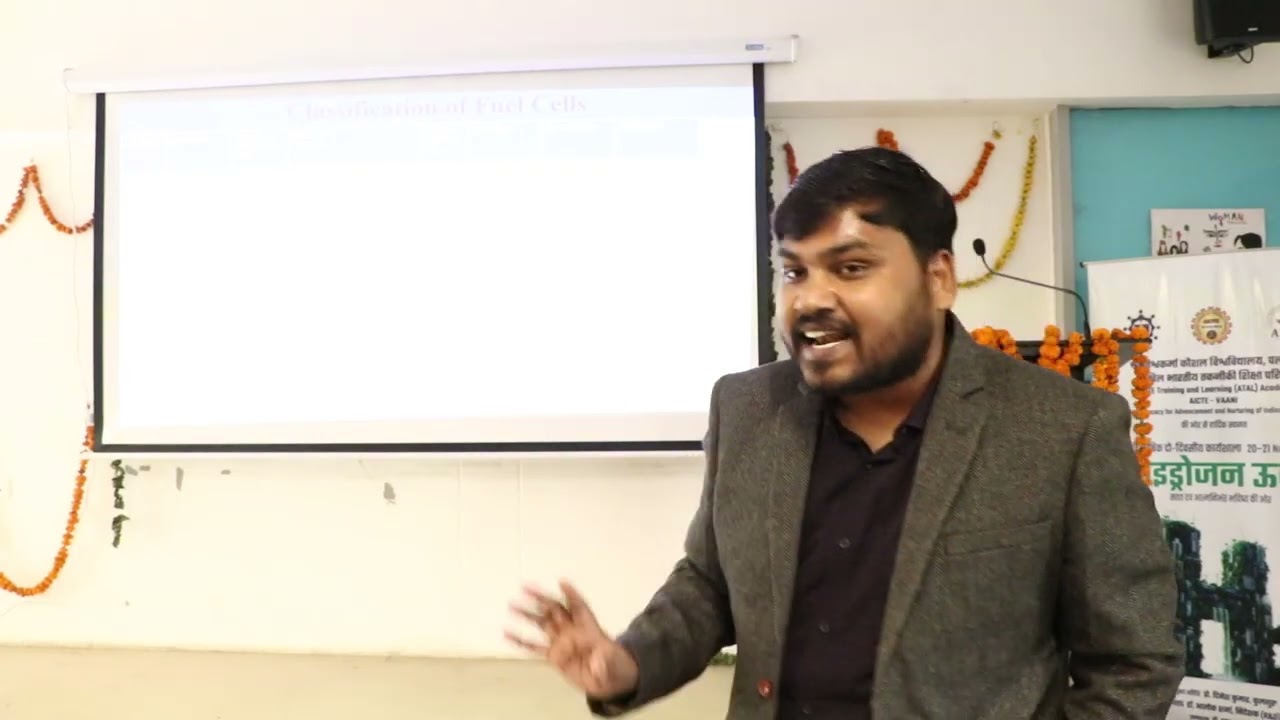
Fueling the Future: Novel Materials for Hydrogen-Based Energy Systems (Dr. Upendra Kumar)
Key Themes and Summary: Dr. Kumar's presentation centred on the development of novel materials for hydrogen-based energy systems, particularly solid oxide fuel cells (SOFCs), as a solution to the environmental and societal challenges posed by fossil fuels. He began by stressing the importance of motivation in research and the need for green, clean energy to mitigate greenhouse gas emissions from fossil fuels, which dominate modern energy needs.
The core discussion revolved around fuel cell fundamentals: At the anode, hydrogen gas is oxidized into H+ ions and electrons; at the cathode, oxygen is reduced, producing water as the only byproduct—hence, a non-harmful, sustainable energy source. He emphasized electrolytes' critical role, requiring high ionic conductivity (especially oxide ions), thermal stability, chemical compatibility with electrodes, low cost, and simple fabrication. Examples included materials like LSGM (Lanthanum Strontium Gallium Magnesium Oxide) and LSDFCO, but he highlighted challenges such as expensive platinum catalysts, high synthesis temperatures (up to 1800°C), and interfacial resistance between anode, electrolyte, and cathode.
To address these, Dr. Kumar detailed material modifications through doping (e.g., ion substitution) and processing optimizations (e.g., varying reaction temperature and time) to enhance structural and electrical properties. He explained characterization techniques:
• Impedance Spectroscopy: Measures conductivity as a function of frequency, modelling grain and grain boundary resistances via Nyquist plots (semicircles representing resistance-capacitance elements).
• X-Ray Diffraction (XRD): Confirms phase purity (e.g., cubic structure) by matching JCPS database patterns; detects impurities above 5%.
• Scanning Electron Microscopy (SEM): Analyzes microstructure, grain size uniformity, and densification to minimize porosity and gaps, ensuring efficient ion migration.
• Arrhenius Equation: Plots conductivity vs. temperature to calculate activation energy for ion migration (lower values indicate easier oxygen ion movement, e.g., electronic vs. ionic contributions at different temperatures).
Key achievements from his research included achieving ionic conductivity up to 0.07 S/cm, reduced activation energy (indicating dominant oxygen ion migration), and improved densification for compact structures with minimal grain boundary blocking. He compared synthesized materials favorably to commercial ones, noting cost reductions and better performance at lower temperatures. The talk concluded with acknowledgments of collaborators, funding (e.g., five projects, including from the United States), and facilities for applications in energy devices.
Доступные форматы для скачивания:
Скачать видео mp4
-
Информация по загрузке: