Symphony in D - Juan Crisóstomo de Arriaga
Автор: Sergio Cánovas
Загружено: 2017-11-25
Просмотров: 7297
Galicia Symphony Orchestra conducted by Jesús López Cobos.
I - Adagio - Allegro vivace - Presto: 0:00
II - Andante: 9:53
III - Menuetto. Allegro - Trio - Tempo I: 18:10
IV - Allegro con moto: 22:24
Arriaga's Symphony in D seems that it was written in 1824, but we have no data of the exact date nor of its premiere in Paris in 1825, when he was in France studying music. It is modelled after the Viennese classics, especially Mozart. Divided in the classical form of four movements (with the classical menuetto), the symphony is at first glance a more reasoned and conservative work than the three string quartets. The composer returns again to the sonata form, design with which he experimented constantly. On the other hand, it is a work that exemplifies in the best way the generative power of the thematic materials that the composer uses.
The first movement opens with an extensive introductory Adagio in D major, which will be the basis of the two themes of the allegro. Modulations and a progressive acceleration of the bass strings leads us to the Allegro vivace in sonata form. The main rhythmical theme, in D minor, is followed by a melodic second theme in F major, derived from previous materials. The development has several modulations, variations, imitations between the themes, with both being transformed. Then starts the recapitulation of the themes in the original key of D minor. The final idea is reached in D major as a resolution, but Arriaga gives a final harmonic turn and takes us back to D minor with the main motive and the final stretto.
The second slow movement is also written in sonata form. It begins with a noble theme in A major presented by the strings, being answered by an expressive melody from the oboe. There are indications that this theme may be inspired by Mozart and may also remind the andantino pastorale from his third string quartet, in both cases they share character and atmosphere. The second theme, in the key of E major, is presented by the violins, characterized by a bass Alberti from the bass and a fluid, simple and periodic melody. The development section is more harmoniously agitated with reworkings of the material previously used. After a reminder of the initial theme, the modulations to B minor and A major link to the recapitulation, which returns to the initial theme and the second theme in A major, a key that remains until the end of the movement.
The third movement is a classical menuetto in ternary form. Starts with the main theme in D major, which modulates to the dominant one and then the contrasting idea appears in B minor and G major. The initial idea is elaborated in G major and then returns to the key of D major. It is an example of the use of elegant dance rhythms, with very simple and little ornate themes. It corresponds to a binary formal scheme but the directionality that leads us through movement with chromatic writing and contrasts is surprising. The trio, framed in a binary structure, has as protagonist the flute, which plays a melody in D major, very simple and delicate accompanied by a tenutto of the strings and with a central phrase in charge of the oboe until the re-exposure of the trio and the final da capo of the menuetto.
The fourth movement is written in sonata form. It is, undoubtedly, the most popular, due to the beauty of its main theme, a simple succession of I-IV-VI chords (tonic, subdominant, dominant and tonic again) that Arriaga drew with great naturalness and inspiration melodic. The strings present a first agitated theme in D minor, contrasted with a second theme in F major. The development starts with modulating processes and polyphonic elaborations until returning to D minor and start the re-exposure by reaffirming the initial D minor but giving a turn to the second theme in D major. The tonality of D major is maintained until the end, variations of the introductory Adagio motif appear just before the final cadence of the work, providing unification and roundness to the work as a whole.
Regarding the first theme of the last movement, we find similarities with the first theme of the first movement of the tragic symphony of Schubert, composed a decade before Arriaga's symphony. Harmonically they are different but is interesting to see how Arriaga's compositions, without ever having heard Schubert's music, started evolving in a similar way before Arriaga died. The symphony ends in D major, the same tone with which it has begun. With which there is confusion when defining the tonality of this work. This process will lead in the future to the composers not to indicate the main tonality of their works.
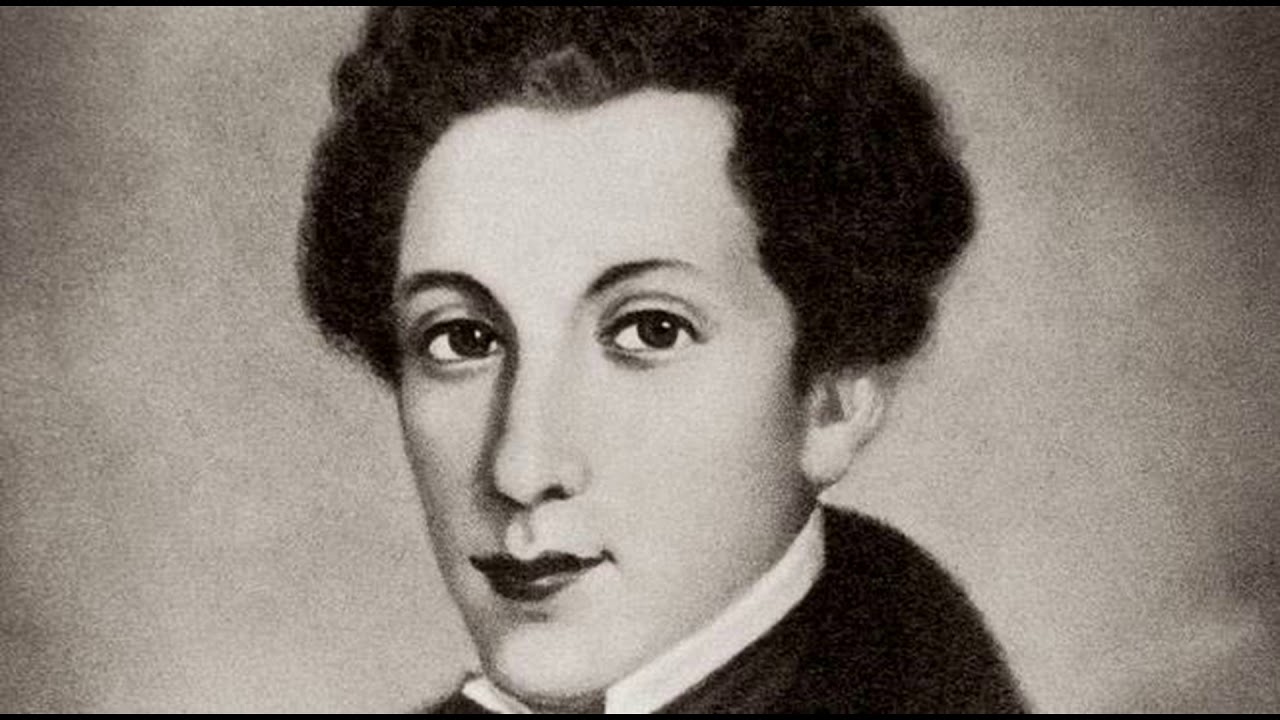
Picture: Modern portrait of Juan Crisóstomo de Arriaga.
Sources: https://bit.ly/2IeiOYD and https://bit.ly/2JWCHGD
To check the score: https://bit.ly/3cAnY4m
Доступные форматы для скачивания:
Скачать видео mp4
-
Информация по загрузке: