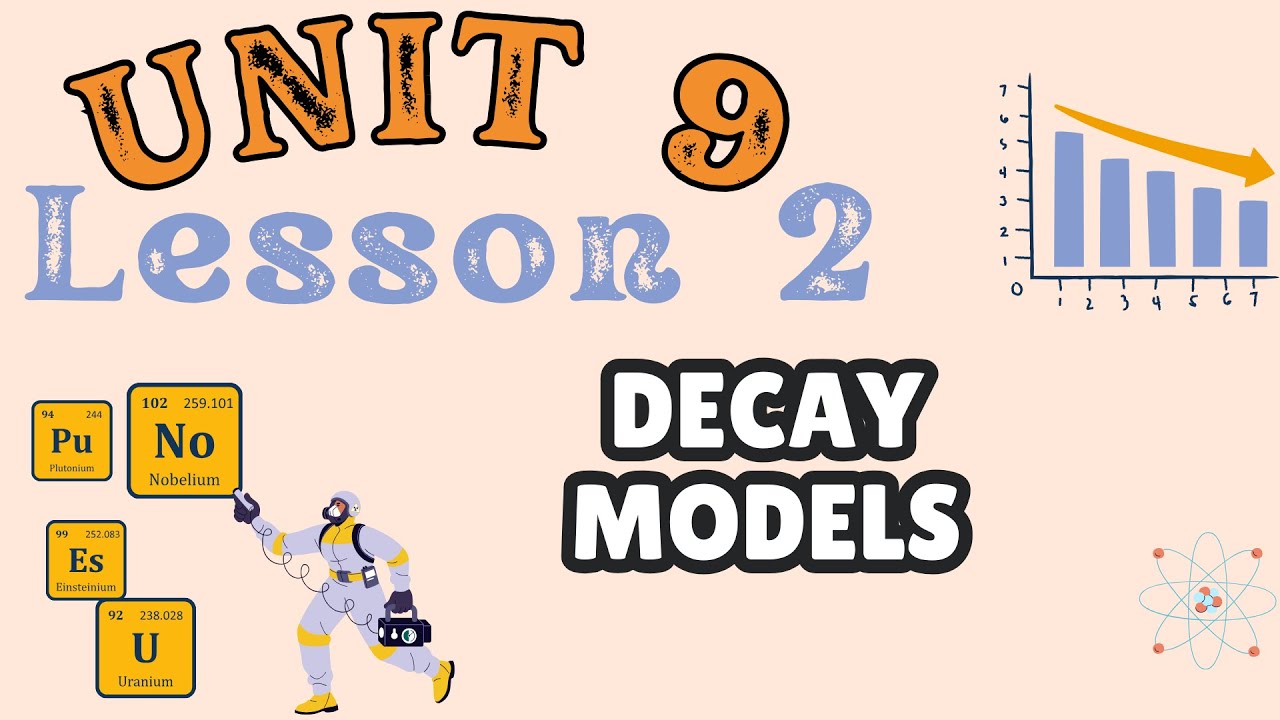
Math Models U9 L2 | Exponential Decay (Decay Factors, Percent Decrease & Half-Life)
Автор: Ellington Math
Загружено: 2026-01-09
Просмотров: 16
In Unit 9, Lesson 2, we shift from growth to the opposite process: exponential decay. This lesson focuses on situations where quantities decrease over time, such as depreciation, discounts, radioactive decay, and half-life models.
You’ll learn how decay models work, how they differ from growth models, and how to correctly interpret decay situations so you don’t accidentally grow something that is clearly shrinking (a very common math mistake).
📌 What you’ll learn in this video:
-What an exponential decay model represents
-How to identify decay situations in real life
-The difference between percent decrease and decay factor
-How to write and interpret exponential decay equations
-How half-life fits into decay models
-How graphs and tables reflect decreasing behavior over time
This lesson builds directly on Unit 9, Lesson 1 (Growth Models) and prepares you for more advanced real-life modeling later in the unit.
🧮 Calculator Notes
You will use your calculator to:
-analyze tables of values
-graph decay behavior
-determine whether data fits an exponential decay model
Be sure your calculator is set up correctly and follow along with the examples shown.
👩🏫 For Math Models Students
This video supports Math Models – Unit 9, Lesson 2 and is designed to help you understand why decay models work, not just how to plug numbers into a formula.
📎 Important reminder:
Percent decrease problems require careful reading. Decay factor ≠ decay rate. This lesson shows you how to spot the difference and avoid losing easy points.
🔜 Up Next in Unit 9
Lesson 3: Modeling Real-Life Situations
Lesson 4: Trigonometric Ratios
Lesson 5: Inverse Trigonometric Functions
Lessons 6–10: Periodic Motion & Advanced Trig Applications
Доступные форматы для скачивания:
Скачать видео mp4
-
Информация по загрузке: