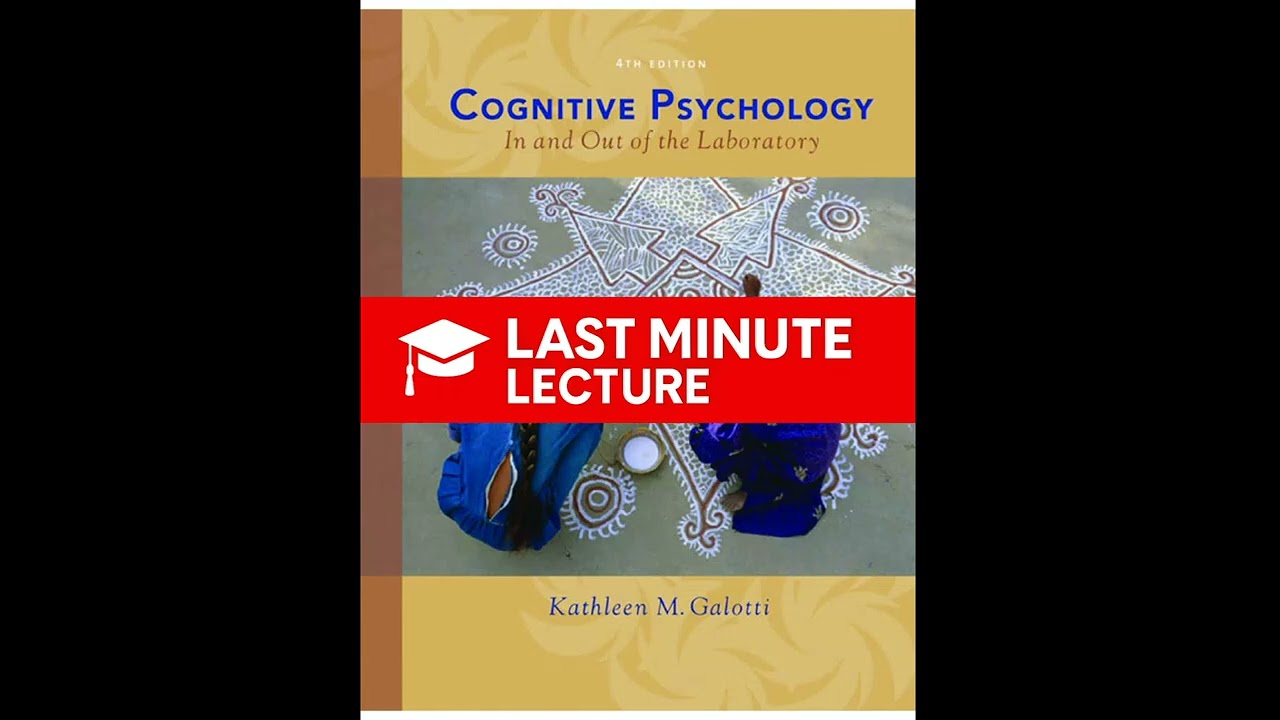
Use & Manipulation of Information | Part IV – Cognitive Psychology (4th)
Автор: Last Minute Lecture
Загружено: 2026-01-14
Просмотров: 1
This unit explores the complex mental landscape of human information manipulation, detailing how individuals use cognitive faculties to interpret, navigate, and decide within their environment. The exploration begins with the structure and function of language, characterized by its rule-governed regularity and its vast productivity. Linguistic analysis occurs across multiple levels, from the basic sounds of phonemes to the complex social etiquette of Gricean maxims in conversation. Cognitive theories, such as the Modularity Hypothesis and the Whorfian Hypothesis of linguistic relativity, examine whether language is an independent mental module or a primary driver of thought. Processing involves both top-down expectations and bottom-up data, supported by neurological structures like Broca’s and Wernicke’s areas. The text then transitions into the psychology of thinking and problem solving, distinguishing between well-defined and ill-defined challenges. Humans employ diverse strategies like means-ends analysis and reasoning by analogy, though they often face mental hurdles such as functional fixedness or rigid mental sets. The development of expertise changes how information is structured, allowing masters in a field to recognize intricate patterns and utilize specialized knowledge bases, a concept often modeled in computerized expert systems. Reasoning is further analyzed through the lens of deductive and inductive logic, where individuals must distinguish between certain validity and probabilistic strength. Performance on these tasks is frequently impacted by content effects and confirmation bias, as seen in the Wason selection task, suggesting that humans often rely on mental models or pragmatic schemata rather than abstract formal logic. Finally, the unit addresses decision making under uncertainty, where individuals must sift through alternatives using goal-setting and information-gathering phases. While normative models like multiattribute utility theory (MAUT) provide a mathematical ideal for choice, real-world behavior is characterized by cognitive illusions and heuristics, such as availability, representativeness, and framing effects. Concepts like the sunk cost effect and hindsight bias demonstrate how human judgment can be systematically distorted. Descriptive models like image theory and recognition-primed decision making emphasize the importance of personal values and expert intuition in selecting the best course of action.
📘 Read full blog summaries for every chapter:
https://lastminutelecture.com
📘 Have a book recommendation? Submit your suggestion here:
https://forms.gle/y7vQQ6WHoNgKeJmh8
Thank you for being a part of our little Last Minute Lecture family!
⚠️ Disclaimer: These summaries are created for educational and entertainment purposes only. They provide transformative commentary and paraphrased overviews to help students understand key ideas from the referenced textbooks. Last Minute Lecture is not affiliated with, sponsored by, or endorsed by any textbook publisher or author. All textbook titles, names, and cover images—when shown—are used under nominative fair use solely for identification of the work being discussed. Some portions of the writing and narration are generated with AI-assisted tools to enhance accessibility and consistency. While every effort has been made to ensure accuracy, these materials are intended to supplement—not replace—official course readings, lectures, or professional study resources. Always refer to the original textbook and instructor guidance for complete and authoritative information.
Доступные форматы для скачивания:
Скачать видео mp4
-
Информация по загрузке: