Deindustrialisation in British India | Impact on Indian Handicrafts | UPSC Modern History
Автор: Civils Simplified With Priyanshi
Загружено: 2026-01-07
Просмотров: 13
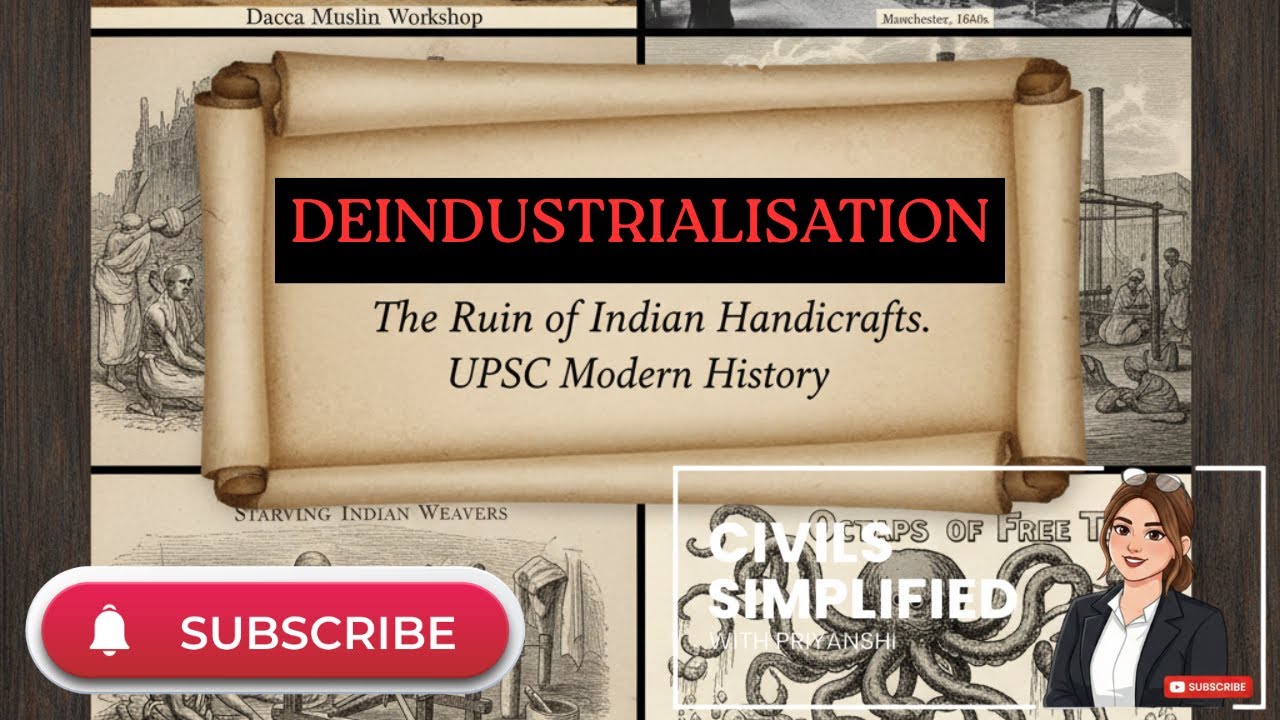
How did India go from being the world’s leading exporter of textiles to a mere importer of British goods? In this lecture, we decode the process of Deindustrialisation, the systematic destruction of the traditional Indian handicraft industry under British rule.
📚 About This Video
Welcome to Civils Simplified with Priyanshi.
In this session, we analyze the economic transformation of India from an industrial powerhouse to an "Agricultural Colony" of Britain. We will explore the "One-Way Free Trade" policy and the critiques offered by nationalist leaders like Dadabhai Naoroji and R.C. Dutt. This is an essential topic for UPSC Mains (GS Paper 1) and History Optional.
📖 Key Learning Points:
What is Deindustrialisation? Definition and the shift of the workforce from industry to agriculture.
The Causes:
One-Way Free Trade: The Charter Act of 1813 and the end of the Company's monopoly.
Loss of Patronage: The decline of Indian Princely Courts.
Industrial Revolution in Britain: Machine-made goods vs. Indian handloom.
The Impact:
Ruralisation of India: Why millions moved back to villages.
Pressure on Land: How deindustrialisation led to poverty and famines.
Nationalist Critique: How early nationalists used this concept to build the "Drain of Wealth" theory.
Доступные форматы для скачивания:
Скачать видео mp4
-
Информация по загрузке: