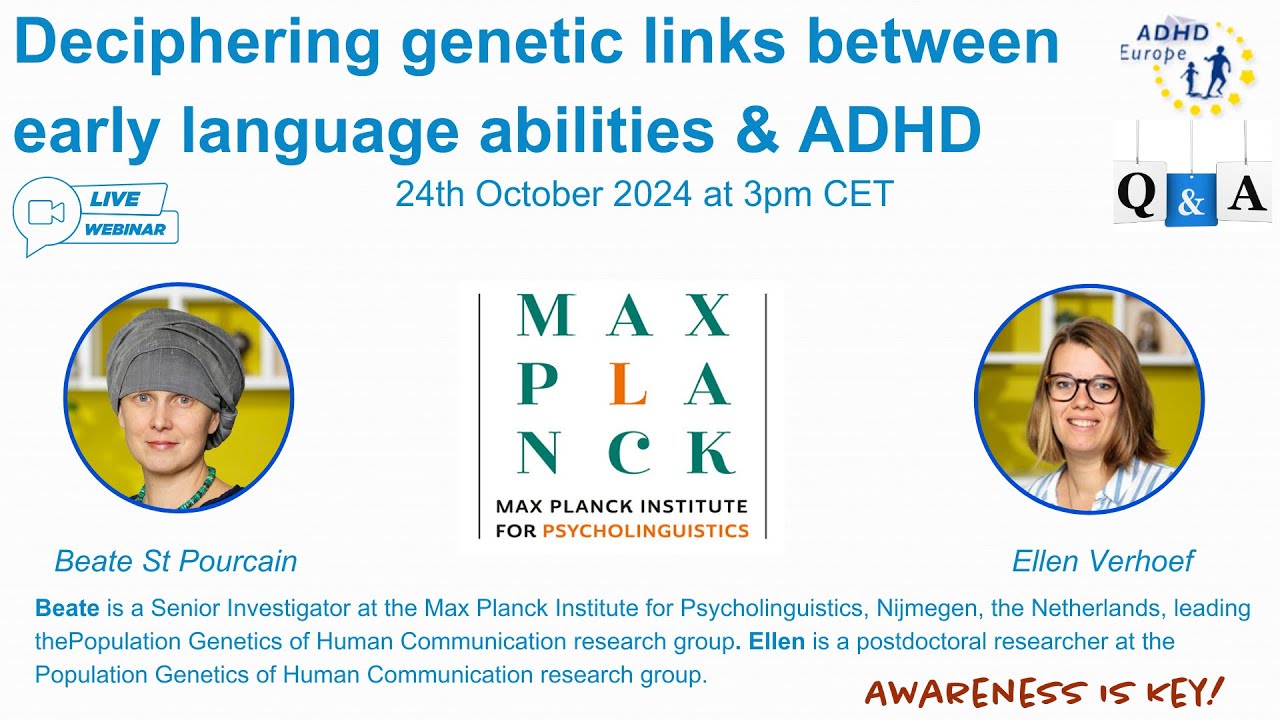
Deciphering genetic links between early language abilities & ADHD
Автор: Broadcasting ADHD Europe
Загружено: 2024-10-24
Просмотров: 191
Each child embarks on the developmental journey of language learning that typically results in the first spoken words at about 10 to 15 months of age, with notable individual differences. These individual differences are predictive of children’s later language, reading, and learning skills, as well as neurodevelopmental conditions such as ADHD, and can be partially related to underlying genetic factors. This talk will discuss the genetic influences underlying early word production and understanding, and rapid changes in the genetic overlap with ADHD, as captured by genome-wide analyses. In short, we investigated genetic influences contributing to infant (15-18 months) and toddler (24-38 months) vocabulary size by studying 17,298 English-, Danish- or Dutch-speaking children. We also examined genetic links with later-life outcomes, including ADHD, using summary information from large independent consortia. Our research showed that multiple genetic factors contribute to vocabulary size in early life, largely related to different developmental stages of language learning. Consistently, genetic associations with later-life measures, including ADHD, varied during development. In particular, in infancy, a larger number of spoken words was genetically associated with both an increased risk for ADHD and more ADHD symptoms. However, this genetic relationship reversed in toddlerhood: there, a smaller number of understood words was associated with more ADHD symptoms. The latter is consistent with previous research showing the inverse genetic overlap between ADHD and reading difficulties. While we do not yet fully understand the underlying mechanisms, it is possible that in infancy, when children are “learning to speak”, the number of spoken words captures also speech-related processes involving motor control. In contrast, during a subsequent developmental phase where children “speak to learn”, vocabulary size is more strongly linked to cognition and may reflect both verbal and cognitive abilities. Thus, adopting a developmental perspective, these findings can provide a better understanding of early speech- and language-related processes in ADHD.
Biographies
Beate St Pourcain is a Senior Investigator at the Max Planck Institute for Psycholinguistics, Nijmegen, the Netherlands, leading the Population Genetics of Human Communication research group. Her research aims to understand better genomic and non-genomic influences underlying children’s language, social and social-communication development, and how these processes are linked to neurodevelopmental conditions, such as ADHD. She is also an Affiliated Principal Investigator at the Donders Institute for Brain, Cognition and Behaviour, Radboud University, The Netherlands and co-chairs the Behaviour and Cognition working group within the EArly Genetics and Lifecourse Epidemiology (EAGLE) consortium as well as work within the Risk and Resilience in Developmental Diversity and Mental Health (R2D2) Consortium.
Ellen Verhoef is a postdoctoral researcher at the Population Genetics of Human Communication research group, embedded within the Max Planck Institute for Psycholinguistics, Nijmegen, the Netherlands. Ellen investigates the genetic underpinnings of language development, focussing on typically developing children. In addition, she is interested in genetic overlap of early-life language measures with later-life cognition and neurodevelopmental conditions, including ADHD. Ellen is a member of the Behaviour and Cognition working group within the Early Genetics and Lifecourse Epidemiology consortium (EAGLE), and part of her research is carried out under the umbrella of this consortium.
Доступные форматы для скачивания:
Скачать видео mp4
-
Информация по загрузке: