Real-Time Pulse Detection: Eulerian Magnification & AI Coding
Автор: BioniChaos
Загружено: 2026-01-17
Просмотров: 7
In this session, we attempt to turn a standard webcam into a medical-grade sensor using Eulerian Video Magnification. We start by debugging a "rookie mistake" where our algorithm was tracking the flashing light on the monitor rather than the actual blood flow in the skin.
We explore three distinct stages of development. First, we review a synthetic skin simulation that visualizes invisible hemodynamic signals through amplitude maps, phase maps, and velocity fields—essentially a digital "mood ring" for your arteries. We utilize Google's Gemini 2.5 Pro and NotebookLM to analyze the code and explain the math behind isolating the pulse signal from noise.
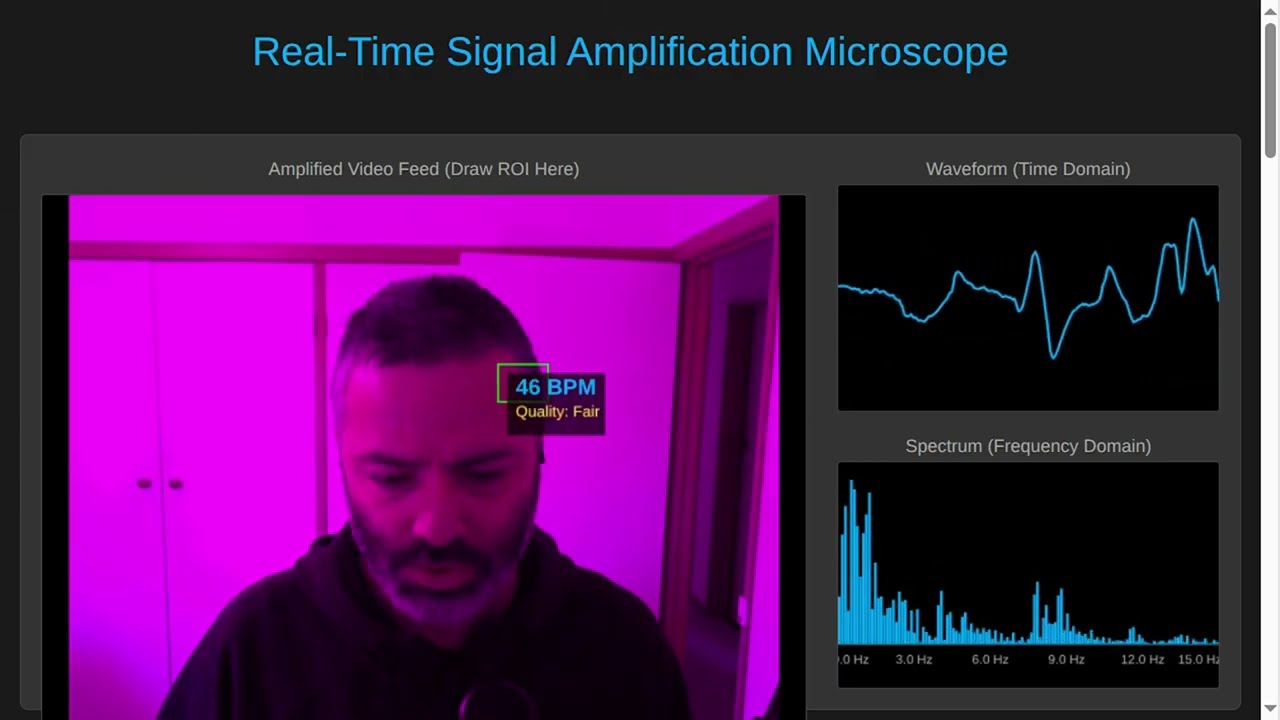
Next, we break down the signal processing logic, demonstrating how Fast Fourier Transforms (FFT) convert chaotic video noise into a clear frequency domain peak representing the heart rate (BPM). Finally, we deploy the live application, testing manual Region of Interest (ROI) selection versus automated face detection using MediaPipe. We tackle real-world challenges like lighting flicker, motion artifacts, and integrating WebGL shaders to amplify the subtle flushing of the skin in real-time.
All tools and demos discussed are available at BioniChaos.com.
#EulerianMagnification #SignalProcessing #ComputerVision #GeminiAI #WebDevelopment #BioniChaos #Telehealth #JavaScript #WebGL #FFT #BiomedicalEngineering #MediaPipe #CreativeCoding
00:00 The rookie mistake: Measuring screen reflection instead of heart rate
02:38 AI explanation of the synthetic skin simulation
04:00 Visualizing blood flow: Amplitude, Phase, and Velocity maps
08:45 NotebookLM breaks down the "ghost blush" code logic
13:40 Simulation 2: Understanding the Frequency Domain and FFT
17:30 How the algorithm finds the heartbeat signal amidst noise
22:15 deploying the real-time webcam pulse detector
25:30 Troubleshooting lighting and motion artifacts
31:00 Discussing automated face detection and future directions
36:00 Fixing the shader amplification bug with Gemini
41:50 Achieving a stable heart rate reading
45:30 Integrating MediaPipe for automated skin detection
52:00 Final overview: From raw video to hemodynamic data
Check out the tools we develop at https://bionichaos.com
Support BioniChaos on Patreon: / bionichaos
Become a channel member to get exclusive perks: / @bionichaos
Доступные форматы для скачивания:
Скачать видео mp4
-
Информация по загрузке: