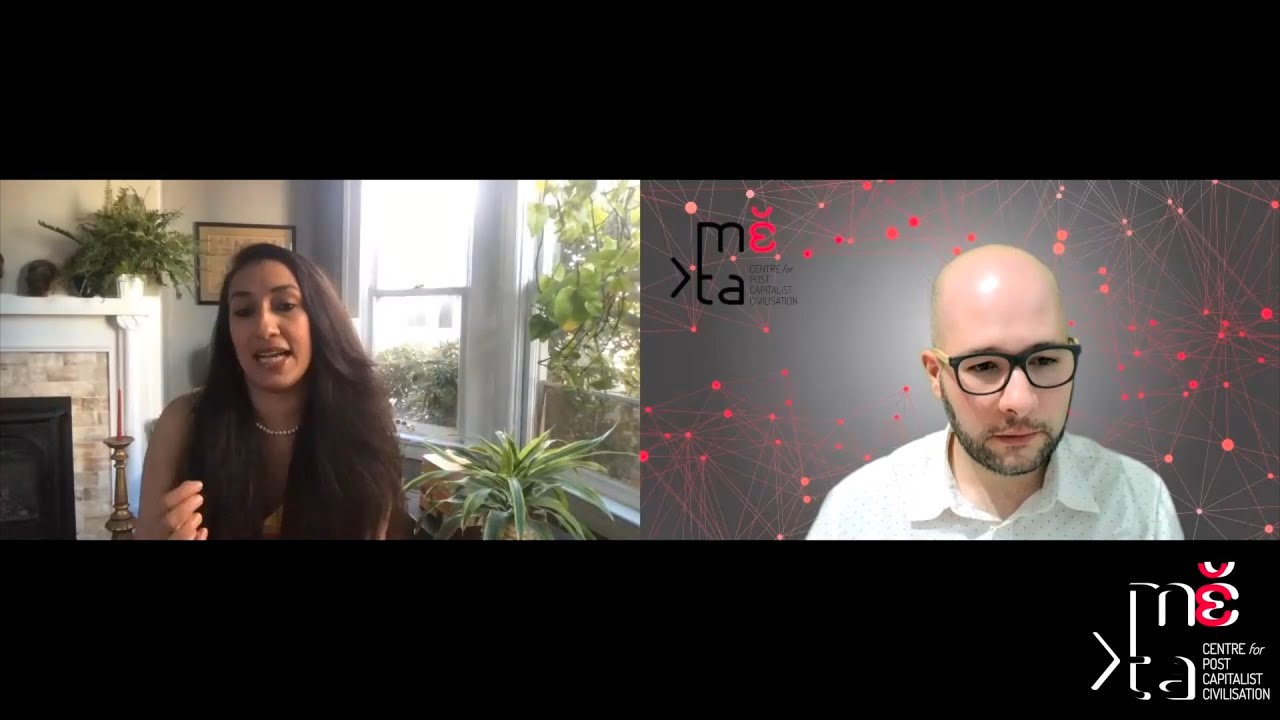
The Future of the History of Capitalism / Dr Antara Haldar, University of Cambridge
Автор: mέta — Centre for Postcapitalist Civilisation
Загружено: 2021-02-13
Просмотров: 2403
The Future of the History of Capitalism: A Discussion
—Dr Antara Haldar
University Lecturer in Empirical Legal Studies, University of Cambridge
Fellow, Center for Advanced Study in the Behavioral Sciences, Stanford University & Faculty Visitor, Harvard University
—Dr Sotiris Mitralexis
mέta, Centre for Postcapitalist Civilisation
Questions & Timestamps:
00:00 Welcome
02:51 Q1. We live in politically eschatological times. We know that an era is coming to a close — or rather, that it has already come to a close. [...]. We already witness the first stages of an emerging era that can only be described by that which it succeeds: we live in postcapitalist times. These may eventually prove to be utopian — or dystopian. Or anything in between. Given that you do acknowledge such an end-of-an-era in your work, how would you describe it? What is happening before our very eyes, yet beyond the daily news cycle?
06:40 Q2. I understand that you are currently working on a book manuscript on the institutional foundations of an altered paradigm of capitalism, as well as on the ‘Future of the History of Capitalism’. Could you introduce our audience to this area of inquiry?
09:57 Q3. A key concept in all this seems to be the 'homo economicus', i.e. the anthropology of dominant economics: as you have aptly put it, “he is infinitely rational, possessing both unlimited cognitive capacity and access to information, but with the persona of the Marlboro Man: ruggedly self-centered, relentlessly materialistic, and a complete lone ranger.” Yet you also point out that we now know this is not how human persons actually behave, and are. So, if we are not homines economici, what are we, according to the insights of behavioural economics? And how does the persistence of the old doctrine of the homo economicus influence our world today?
15:36 Q4. In discussing the limits of the dominant theories and the alternatives to them, I cannot but think that the usual narrative goes like this: the dominant theories, the theories in use, represent what we know, what is scientific, how the world demonstrably works — while alternatives to them are either speculative, deontological and/or wishful thinking. This is a critique often levelled against the Left, particularly concerning economics. Yet our discussion points out the opposite: that it is the dominant theories that prove not to be grounded in actual reality —hence, for example, the inability to prepare for the 2008 crisis— but in their own rather dark ‘wishful thinking’. What are your thoughts on this disparity between theory, i.e. the theory that is currently being put into practice globally, and reality, i.e. the way we witness the world actually operating? And why is the alternative more realistic than our current orthodoxy?
21:32 Q5. You have written that “[Economics] is even more ill-equipped to deal with looming seismic shifts on the horizon, such as the accelerating effects of climate change or how advances in artificial intelligence will affect workers. [...] Given the greatly amplified role of professional economists at every level of policy making, the extent to which economics is disconnected from reality is becoming more alarming.” How would you imagine this changing?
29:29 Q6. While you have noted the difficulties of trying to establish rule-of-law regimes in postcolonial countries or transition economies —with the joke being on the rule-of-law regimes rather than on the postcolonial countries and the transition economies—, it currently seems to me that the rule of law is being increasingly tested in quite a few of the ‘Western' countries. How do you see the future of the rule of law in those countries as well?
34:06 Q7. You have underscored the need for the West ‘to fetishize formal institutions less, and promote civic friendship more. We should place less emphasis on the purely procedural, and more on people’ and forge ‘a sense of community’ in order for institutions, or even states and large-scale governance structures, to function properly — otherwise we are ‘making them too rigid to survive’. How can we achieve this?
43:07 Q8. There’s quite a discussion taking place concerning the economic repercussions of the pandemic. How do you expect these repercussions to unfold in the post-pandemic world? And, importantly: to whose expense?
46:35 Q9. From the ‘Future of the History of Capitalism’ to the ‘History of the Future of Capitalism’: let us briefly imagine the best-case scenario and the worst-case scenario. In the former case, how would an altered paradigm of capitalism look like, including the transition to it? And in the latter case, what gloomy fate and doom awaits us?
12 February 2021
Доступные форматы для скачивания:
Скачать видео mp4
-
Информация по загрузке:




![Guy Standing & Yanis Varoufakis on Basic Income [ in English, ελληνικοί υπότιτλοι ]](https://imager.clipsaver.ru/iweLU5aVKrk/max.jpg)