Jean Renoir's "Nana" (1926)
Автор: Donald P. Borchers
Загружено: 2023-05-04
Просмотров: 21400
The vivacious and beautiful young actress, Nana (Catherine Hessling), seeks fame on the stages of Paris in the shows at the Théâtre des Variétés. When she ascends a staircase and is lowered by rope before an audience as a marionette-mermaid, she bombs as an actress.
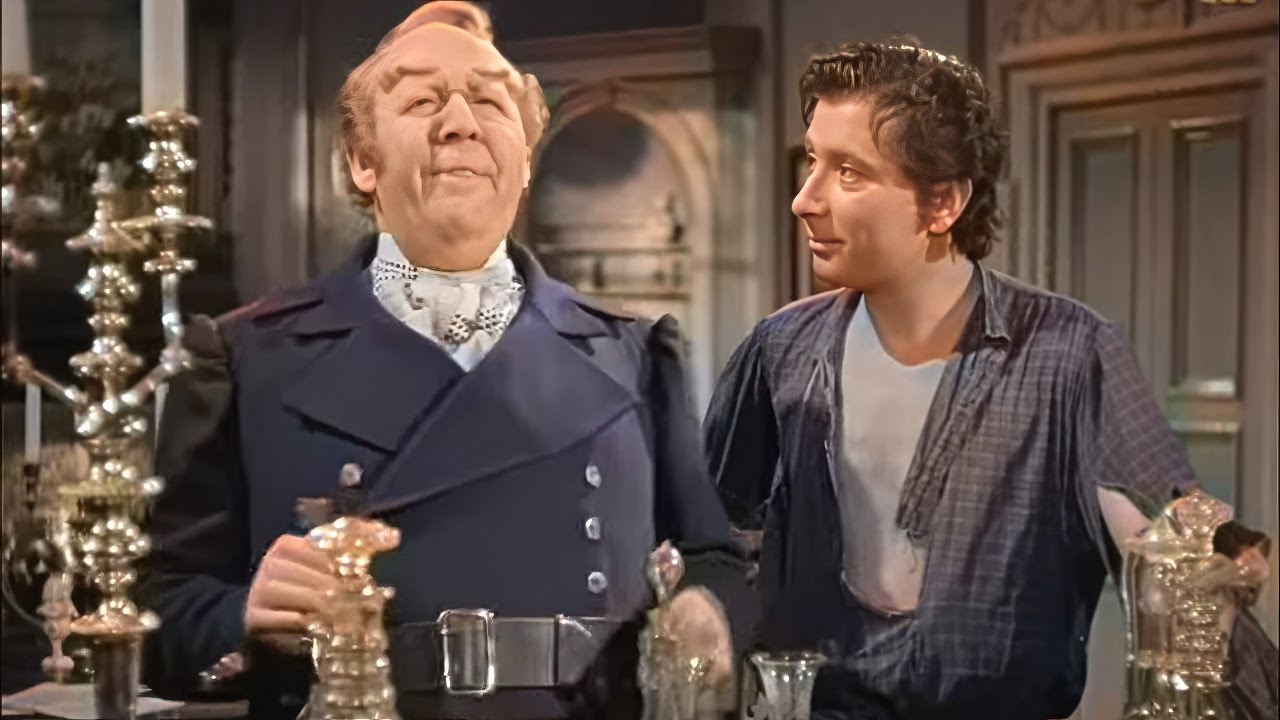
A government official, Count Muffat (Werner Krauss), stands backstage next to suits of armor, in the boudoir in full military regalia. He's a puppy lolling at her feet, and falls under her spell. Nana becomes his mistress. She is kept in a sumptuous fashion by the wealthy Count, living in the luxurious apartment which he provides for her.
Then Nana embarks on the life of a courtesan, using her allure and charisma more directly to entice and pleasure men. Admirers come and go, smitten and withered, and several prominent and wealthy men find themselves unable to withstand her charms.
Disgraced at the racetrack, Count Vandoeuvres (Jean Angelo) is consumed in a bonfire alongside the horse named after his object of desire. Meanwhile, the lovelorn nephew (Raymond Guérin-Catelain) constructs a facsimile by piling up perfume dresses on a chair and wields a pair of scissors like a dagger.
Instead of elevating herself to Muffat's level, however, Nana goes takes the journey to doomed courtesan, and drags the poor man down to her level.
In the end, both lives have been utterly destroyed.
A 1926 French black & white silent drama film produced & directed by Jean Renoir, based on the 1880 novel by Émile Zola, Renoir co-wrote the adaptation with his "La Fille De L'Eau" (1924) screenwriter Pierre Lestringuez, intertitles by the author's daughter, Denise Leblond-Zola, cinematography by Jean Bachelet and Edmund Corwin, set design and costumes by Claude Autant-Lara, starring Catherine Hessling (Renoir's wife), Werner Krauss, Pierre Lestringuez, Jacqueline Forzane, Pierre Champagne, Valeska Gert, and Jean Angelo. Screen debuts of Jacqueline Ford and Dennis Price. Final film of Nita Romani.
Shot at the Bavaria Studios in Munich and the Neuilly Studios in Paris. The film's ornate sets were designed by the art director Claude Autant-Lara. What chiefly distinguishes the film is its use of Second Empire decoration.
Renoir's third film and second full-length feature is a fairly faithful adaptation of Émile Zola's classic novel. n the novel, the theater manager describes, "Nana has something else, dammit, and something that takes the place of everything else. I scented it out, and it smells damnably strong in her, or else I lost my sense of smell." But there's a pain and a pathos at the heart of Nana's situation, and it slowly makes its poisonous way into the lives of all in Nana's orbit.
The story has necessarily been changed, particularly in its ending. Condensing and simplifying the novel and compressing characters into a few key suitors, the focus here is on the power of the female, and the manner in which a woman can trigger a maelstrom of chaos in the lives of the men who fall at her feet, and who set aside everything — even that most precious social status and respectability — in order to attain the object of their passion.The film's sympathies are almost entirely with the despairing male characters, and the female tantalizer is depicted as an absolutely ridiculous human being (although she is ultimately afforded a small degree of humanity).
The film's extravagances include two magnificent set pieces – a horse race and an open air ball. The film never made a profit, and the commercial failure of the film robbed Renoir of the opportunity to make such an ambitious film again for several years. Renoir hoped the provocative subject matter and lavish production values would appeal to audiences, but it proved to be an expensive failure and he was forced to sell off much of his family legacy, his father's paintings, to pay off debts.
Renoir claimed to have seen Erich von Stroheim's "Foolish Wives" (1922) over ten times, and was influenced by the extravagant work.
Once again producing as well as directing, Renoir spent much of his father's fortune on the enormously ambitious production, but it proved so expensive that his producer arranged a co-production deal with a German company. As a result, much of the film was shot in Berlin, which provided Renoir with the opportunity to cast German actor Werner Krauss, star of the expressionist film classic "The Cabinet of Dr. Caligari," as the male lead.
Jean Renoir, son of impressionist master Pierre Auguste Renoir, was not yet the master of the cinema that he would later become. Still preoccupied with his performers, and not yet able to subordinate acting to the demands of storytelling on film, but his talent for storytelling is evident even this early in the career of the cinematic father of the French New Wave, and arguably the greatest French director of all time. While his silent films foreshadowed what was to come, there is no comparison between even the best of the silent and the worst of the sound films.

Доступные форматы для скачивания:
Скачать видео mp4
-
Информация по загрузке: