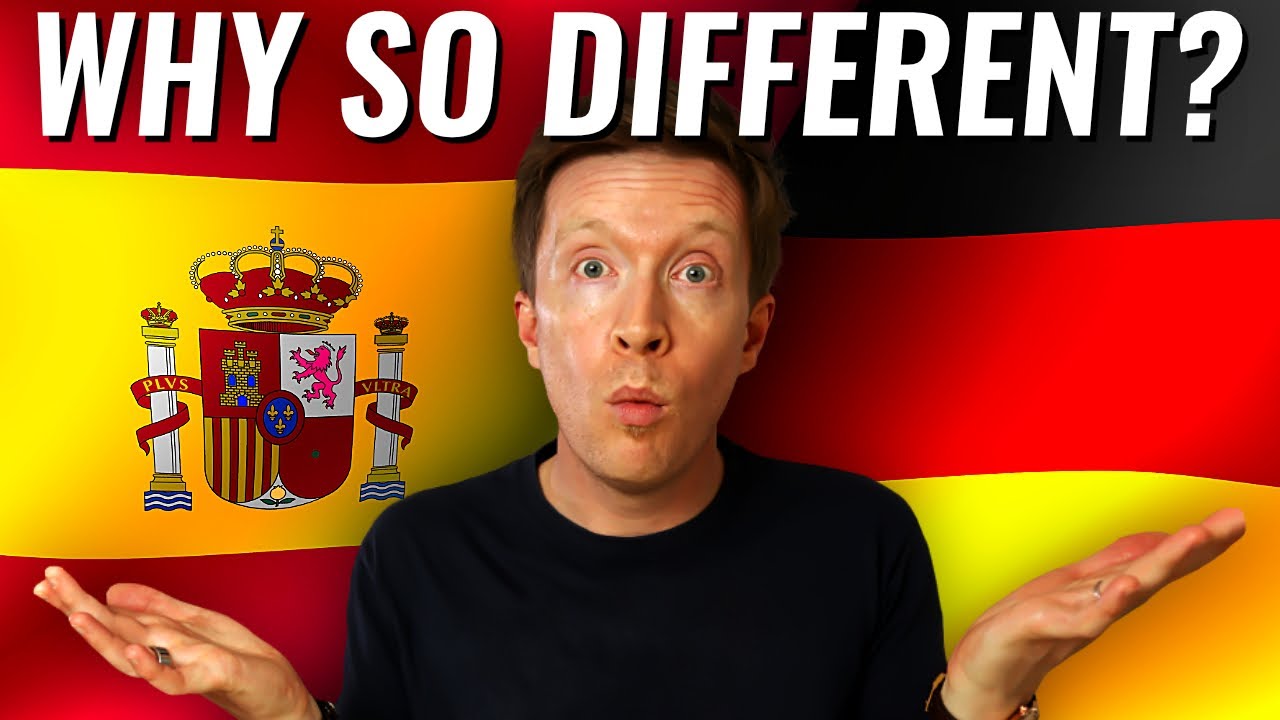
German vs French vs Spanish vs Italian
Автор: Metatron's Academy
Загружено: 2024-12-20
Просмотров: 24173
Link to the original video
• Does German Sound Aggressive? We Compare W...
The German language, or Deutsch, stands as one of Europe's most influential and historically significant languages. As the official language of Germany, Austria, and parts of Switzerland, it serves as the native tongue for approximately 100 million speakers worldwide, making it the most widely spoken first language in the European Union.
German belongs to the West Germanic branch of the Indo-European language family, sharing common ancestry with English and Dutch. This relationship becomes apparent when examining basic vocabulary – for example, "house" in English corresponds to "Haus" in German, and "water" to "Wasser." Despite these similarities, German has developed distinctive features that set it apart from its linguistic cousins.
One of the most characteristic aspects of German is its complex grammatical system. The language employs three grammatical genders (masculine, feminine, and neuter), four cases (nominative, accusative, dative, and genitive), and a sophisticated system of verb conjugation. Perhaps most famously, German is known for its compound words, where multiple words can be joined together to create new, longer words. The often-cited "Donaudampfschifffahrtsgesellschaftskapitän" (Danube steamship company captain) serves as a playful example of this linguistic feature.
German sentence structure presents another distinctive characteristic. While English follows a relatively rigid Subject-Verb-Object order, German employs a more flexible system where the conjugated verb must appear in the second position in main clauses, but moves to the end in subordinate clauses. This creates what linguists call a "verb-second" and "verb-final" pattern, adding both complexity and precision to German expression.
The language's influence on global culture and thought cannot be overstated. German has been the language of numerous influential philosophers, scientists, and artists. The works of Kant, Nietzsche, and Hegel have shaped philosophical discourse, while scientific terms coined by German speakers remain in international use. The language's precision and ability to create new compound words has made it particularly valuable in academic and technical fields.
Modern German continues to evolve, adapting to contemporary needs while maintaining its structural integrity. The influence of English, particularly in technology and popular culture, has led to the adoption of numerous anglicisms, though these are often debated among language purists. Despite these changes, German retains its position as a crucial language for international business, diplomacy, and cultural exchange.
The dialect diversity within German-speaking regions adds another layer of richness to the language. From the distinct variations of Swiss German to the regional dialects of Bavaria and Berlin, these linguistic variations reflect the historical and cultural diversity of German-speaking communities while maintaining mutual intelligibility through the standard form, Hochdeutsch.
In the digital age, German has successfully adapted to new communication needs. Its structured nature and precise vocabulary make it well-suited for programming and technical documentation. The language's continued importance in the European Union and global markets ensures its relevance for future generations.
Learning German opens doors to a rich cultural heritage and contemporary opportunities. While its grammar may initially challenge learners, the logical structure of the language and its connections to English provide helpful entry points for those willing to invest the time in mastering it. As Europe's economic powerhouse, Germany continues to attract international students and professionals, making German language skills increasingly valuable in today's interconnected world.
#german #italian #french

Доступные форматы для скачивания:
Скачать видео mp4
-
Информация по загрузке: