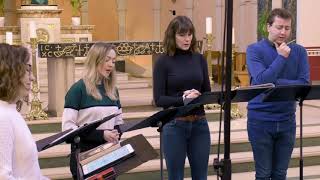
Elgar: Serenade, II for Brass Septet – Septura
Автор: Septura's Brass Tube
Загружено: 2018-09-24
Просмотров: 3804
Website – http://septura.org/
Facebook – / septuraofficial
Twitter – / septuraofficial
Sheet music – http://www.resonatamusic.com
Elgar began his musical career as a professional violinist, and so it is no surprise that his works for strings – the violin and cello concertos, the Introduction and Allegro, and of course the Serenade – form such a central part of his output. However, in his mid-forties he also took up the trombone. This came a little less naturally to him, as recalled by his close friend Dora Penny (the subject of Variation X of the Enigma Variations):
"On one occasion, he [Elgar] got up and fetched a trombone that was standing in a corner and began trying to play passages in the score. He didn't do very well and often played a note higher or lower than the one he wanted...and as he swore every time that happened, I got into such a state of hysterics that I didn't know what to do. Then he turned to me [and said]: 'How do you expect me to play this dodgasted thing if you laugh?' I went out of the room as quickly as I could and sat on the stairs, clinging to the banisters 'til the pain eased but it was no good. I couldn't stop there as he went on making comic noises, so I went downstairs out of earshot for a bit.”
Perhaps this insider knowledge of brass instruments (and the difficulties they sometimes present) contributed to Elgar’s very idiomatic writing, demonstrated so clearly in the symphonies, Enigma, and the Severn Suite (written for the National Brass Band Championship in 1930). And given his affection for brass, he might have approved of our appropriation for brass septet of his favourite work, the Serenade, despite describing it as “really stringy in effect”.
Composed in 1892 as a gift for his wife to mark their third wedding anniversary, the Serenade was one of Elgar’s earliest successful works – predating Enigma, the piece that really established him as the foremost British composer since Purcell, by six years. Nevertheless, it contains all the hallmarks of Elgar’s mature style, particularly in the elegiac slow movement, with its rising and falling lines giving way to an archetypal Elgarian tune of great emotional intensity.
Septura:
Trumpets:
Philip Cobb
Simon Cox
Huw Morgan
Alan Thomas
Trombones:
Matthew Gee
Matthew Knight
Peter Moore
Dan West
Tubas:
Pete Smith
Sasha Koushk-Jalali
http://www.naxos.com/person/Septura/2...
Recorded by Phil Rowlands and Jim Unwin.

Доступные форматы для скачивания:
Скачать видео mp4
-
Информация по загрузке: