Academic Seminar Prep: Who should save the planet?
Автор: English for University Academic Success
Загружено: 2025-12-31
Просмотров: 6
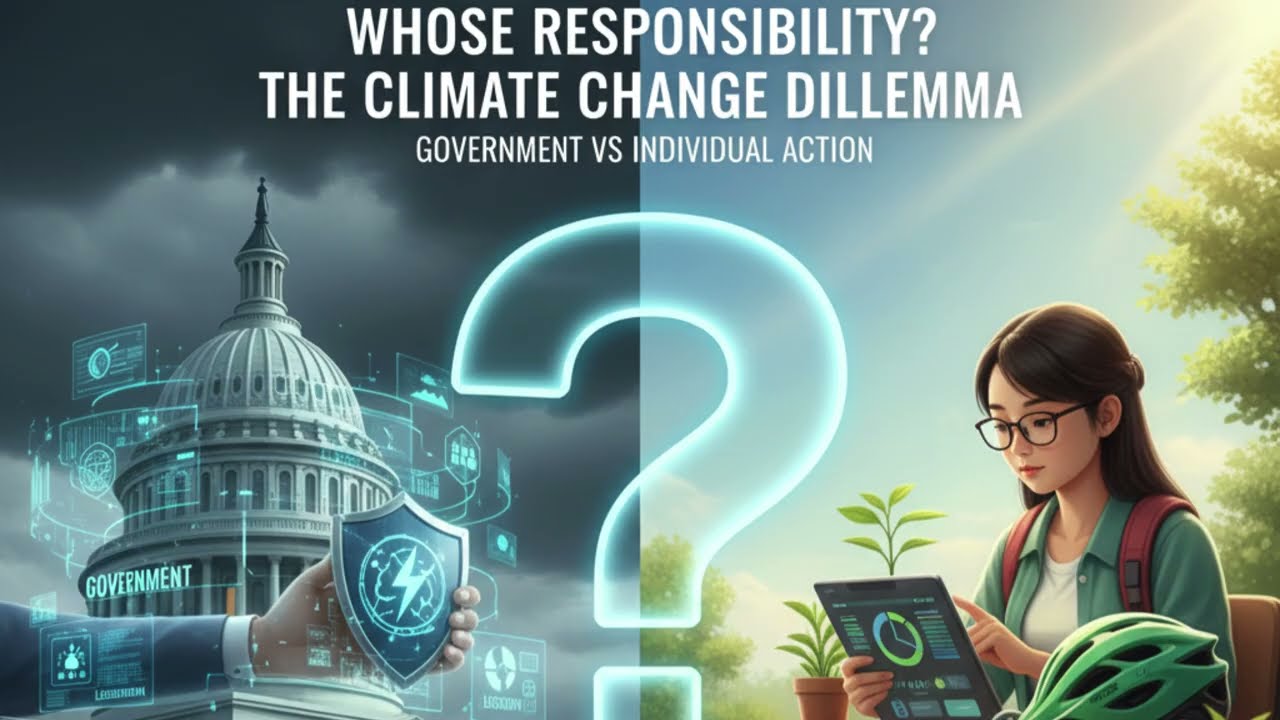
Who Should Save the Planet? Individual Responsibility vs. Government Action | EAP Academic Seminar
Description: Is climate change a problem that individuals must solve through lifestyle changes, or is it a systemic issue that only governments can fix? In this episode, we dive into the philosophical debate between personal ethics and institutional duty.
Using research by Fragnière and Torpman, we explore the "Causal Inefficacy" problem—the idea that one person's actions are too small to matter—and counter it with the "Non-Aggression Principle." We also discuss the moral difference between "subsistence emissions" (survival) and "luxury emissions."
This podcast serves as a model for university students to practice evaluating complex arguments and using evidence to support a stance in an academic seminar.
📚 PRE-LISTENING TASK: SEMINAR PREPARATION To participate effectively in our seminar, you must engage with the two source articles: Fragnière (2016) and Torpman (2021). Follow these steps:
Strategic Reading: * Start with the Abstract and Introduction to identify the central moral questions.
Read the Conclusion to understand each author's final recommendation.
Skim and Scan the body of the papers to find specific definitions (e.g., look for the "Non-Aggression Principle" in Torpman).
Annotate: Make notes in the margins. Write "L" for Lifestyle duties and "I" for Institutional duties.
Decide Your Stance: Do you believe individuals have a moral duty to reduce their carbon footprint even if the government does not require it?
Find Your Evidence: Highlight at least two specific arguments from the text. Remember to cite your source during the seminar (e.g., "Torpman argues that non-subsistence emissions violate the rights of others...").
📖 PRE-STUDY VOCABULARY: Study these academic terms before listening:
Moral Obligation: A duty to act based on what is considered right or wrong.
Causal Inefficacy: The argument that an individual’s action is too small to produce a significant result in a global problem.
Boundary-crossing: Interfering with the "space" or rights of another person (a key concept in Libertarianism).
Non-aggression Principle: The idea that it is wrong to initiate physical force or harm against others.
Subsistence Emissions: Carbon emissions that are necessary for basic survival (e.g., heating or cooking).
Offsetting: Compensating for carbon emissions by funding an equivalent carbon saving elsewhere (e.g., planting trees).
📌 PODCAST TIMESTAMPS:
0:00 – Introduction: The scale of the climate crisis.
1:10 – The Causal Inefficacy Myth: Does one person really matter?
3:30 – Survival vs. Luxury: Defining "Subsistence Emissions."
5:45 – The Duty of Integrity: Why we should act even if others don't.
8:15 – Institutional Duties: The individual as a citizen vs. a consumer.
10:40 – Conclusion: Can individual and government actions work together?
🔗 DOWNLOAD THE READINGS:
Article 1 (Fragnière): https://www.researchgate.net/publicat...
Article 2 (Torpman): https://link.springer.com/article/10....
#HigherEd #Climate Change #Academic English #EAP #CriticalThinking, #Individual Responsibility #Ethics
Доступные форматы для скачивания:
Скачать видео mp4
-
Информация по загрузке: