9th Science | Chapter 6 | Classification of plants | Lecture 1 | maharashtra board |
Автор: NEXT YOU
Загружено: 2025-06-15
Просмотров: 168
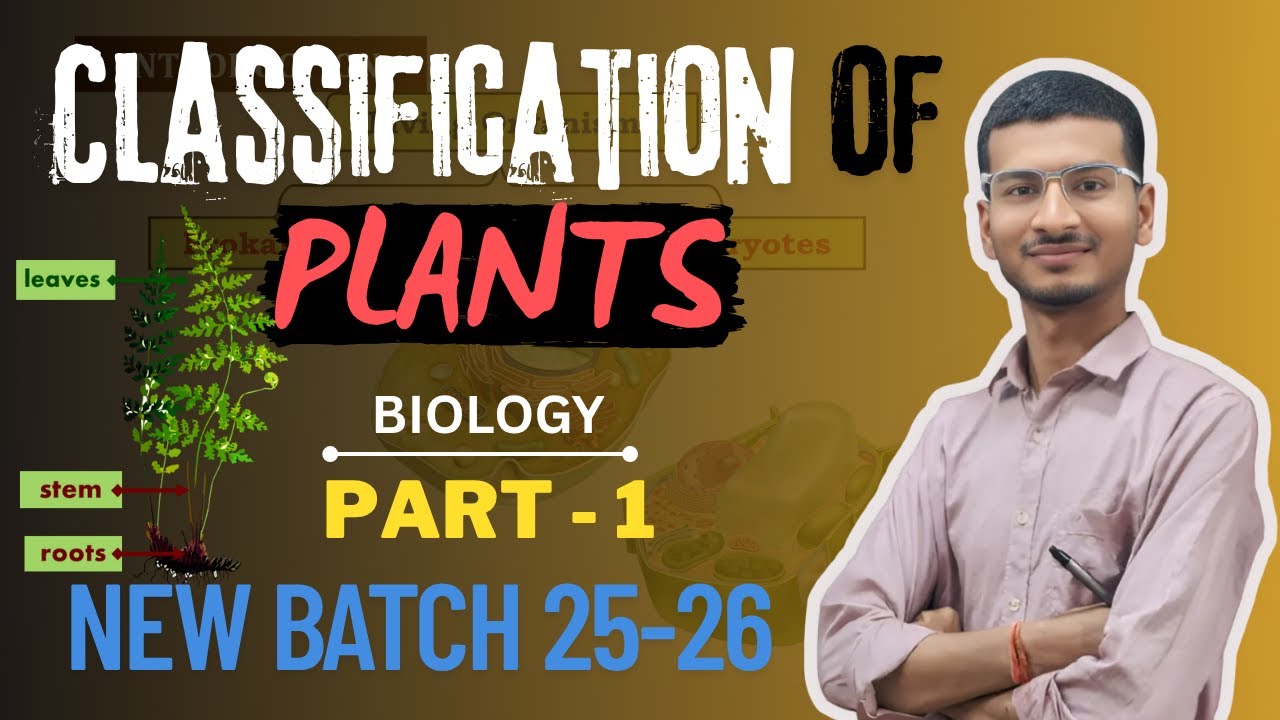
For Maharashtra Board Class 9th standard, the classification of plants is typically covered in the Science and Technology curriculum, specifically in the chapter "Classification of Plants." This chapter introduces students to the diversity of the plant kingdom and the systematic way in which plants are grouped based on various characteristics.
Here's a detailed description of what students learn:
I. Introduction to Plant Classification:
Need for Classification: Students understand why classifying plants is important – to organize the vast diversity, simplify their study, identify relationships, and understand evolution.
Basis for Classification: The key criteria used for classifying plants are introduced:
Presence or absence of organs (roots, stem, leaves).
Presence or absence of specialized conducting tissues (xylem and phloem) for water and food transport (vascular vs. non-vascular).
Presence or absence of seeds.
If seeds are present, whether they are enclosed within a fruit or not.
Number of cotyledons in the seeds (for flowering plants).
II. Major Divisions of the Plant Kingdom:
The plant kingdom is broadly divided into two sub-kingdoms:
A. Cryptogams (Non-flowering and Non-seed bearing plants): These are considered more primitive plants that reproduce using spores. They include:
Division I: Thallophyta (Algae)
Characteristics:
Simple, undifferentiated plant body called a 'thallus' (no true roots, stems, or leaves).
Mostly aquatic.
Autotrophic (contain chlorophyll for photosynthesis).
Can be unicellular or multicellular, filamentous, colonial, branched, or unbranched.
Examples: Spirogyra, Ulothrix, Chara, Volvox.
Division II: Bryophyta (Amphibians of the Plant Kingdom)
Characteristics:
Grow in moist and shady places.
Plant body is flat, ribbon-like, and lacks true roots, stems, and leaves. Instead, they have root-like rhizoids and stem-like/leaf-like parts.
Lack specialized tissues for conduction of water and food.
Require water for reproduction (hence, "amphibians").
Reproduce by spore formation.
Examples: Moss (Funaria), Marchantia, Riccia.
Division III: Pteridophyta (Ferns)
Characteristics:
First terrestrial plants to have well-differentiated plant bodies with true roots, stems, and leaves.
Possess specialized conducting tissues (xylem and phloem).
Do not bear flowers or fruits.
Reproduce by spores, which are formed on the posterior surface of their leaves (sporophylls).
Examples: Fern (Nephrolepis), Marsilea, Adiantum.
B. Phanerogams (Flowering and Seed-bearing Plants): These are more advanced plants that produce seeds for reproduction. They are further classified based on whether their seeds are covered or naked:
Division I: Gymnosperms
Characteristics:
Bear 'naked' seeds, meaning the seeds are not enclosed within a fruit.
Mostly evergreen, perennial, and woody.
Often have male and female flowers on different sporophylls of the same plant (or sometimes different plants).
Their stems generally do not have branches, and leaves form a crown.
Examples: Cycas, Pinus (Pine), Thuja (Morpankhi), Picea (Christmas tree).
Division II: Angiosperms (Flowering Plants)
Characteristics:
Most advanced and diverse group of plants.
Produce flowers, which are their reproductive organs.
Seeds are enclosed within a fruit.
Highly developed vascular system.
Sub-classification of Angiosperms (based on cotyledons):
Dicotyledonous Plants (Dicots): Seeds have two cotyledons (seed leaves). They typically have tap roots, reticulate venation in leaves, and flowers with 4 or 5 parts (or multiples).
Examples: Bean, mango, tamarind, sunflower.
Monocotyledonous Plants (Monocots): Seeds have a single cotyledon. They usually have fibrous roots, parallel venation in leaves, and flowers with 3 parts (or multiples).
Examples: Corn, wheat, rice, onion, bamboo.
#MahaPlantsClass9 (Slight variation, still very strong)
#Class9PlantScienceMH (Highlights "science" aspect)
#MHBoardPlantBiology9 (Connects to Biology curriculum)
#PlantTaxonomyMH9 (Uses the more scientific term "taxonomy")
#KingdomPlantaeMaharashtra9 (Focuses on the kingdom level)
#BioClassificationStd9MH (Broader for biology classification)
MaharashtraScience9th (General science for the board and grade)
#Std9BiologyMaharashtra (Directly for biology content)
#MahaBoardStudyPlants (Action-oriented, for students looking to study)
Доступные форматы для скачивания:
Скачать видео mp4
-
Информация по загрузке: