How to Stop Code Execution in Inactive Nativescript Vue Components
Автор: vlogize
Загружено: 2025-09-24
Просмотров: 0
Discover how to effectively manage code execution in your Nativescript Vue app to prevent data redundancy and ensure optimal performance.
---
This video is based on the question https://stackoverflow.com/q/62465944/ asked by the user 'Alexander Schurf' ( https://stackoverflow.com/u/7729356/ ) and on the answer https://stackoverflow.com/a/62466161/ provided by the user 'Tim VN' ( https://stackoverflow.com/u/7265507/ ) at 'Stack Overflow' website. Thanks to these great users and Stackexchange community for their contributions.
Visit these links for original content and any more details, such as alternate solutions, latest updates/developments on topic, comments, revision history etc. For example, the original title of the Question was: how to stop code execution if the component is inactive in Nativescript Vue
Also, Content (except music) licensed under CC BY-SA https://meta.stackexchange.com/help/l...
The original Question post is licensed under the 'CC BY-SA 4.0' ( https://creativecommons.org/licenses/... ) license, and the original Answer post is licensed under the 'CC BY-SA 4.0' ( https://creativecommons.org/licenses/... ) license.
If anything seems off to you, please feel free to write me at vlogize [AT] gmail [DOT] com.
---
How to Stop Code Execution in Inactive Nativescript Vue Components
In application development, managing resources and ensuring that your code runs efficiently is crucial. If you've encountered a scenario where your code continues to execute even when your component is inactive, you're not alone. This common issue arises when an application performs background tasks, such as sending data at regular intervals. When users navigate away or minimize the app, these tasks can stack up, leading to duplicated efforts and overloading the system.
The Problem
For instance, imagine that your application sends device data every 5 seconds. However, if a user minimizes the app or navigates away, the function continues to run in the background. When they return to the app, another instance of the data-sending function may already be running, resulting in duplicated data submissions. This not only strains resources but could also lead to confusion for users as they receive repeated notifications or updates.
Example Scenario
Let's break down the example you've provided:
[[See Video to Reveal this Text or Code Snippet]]
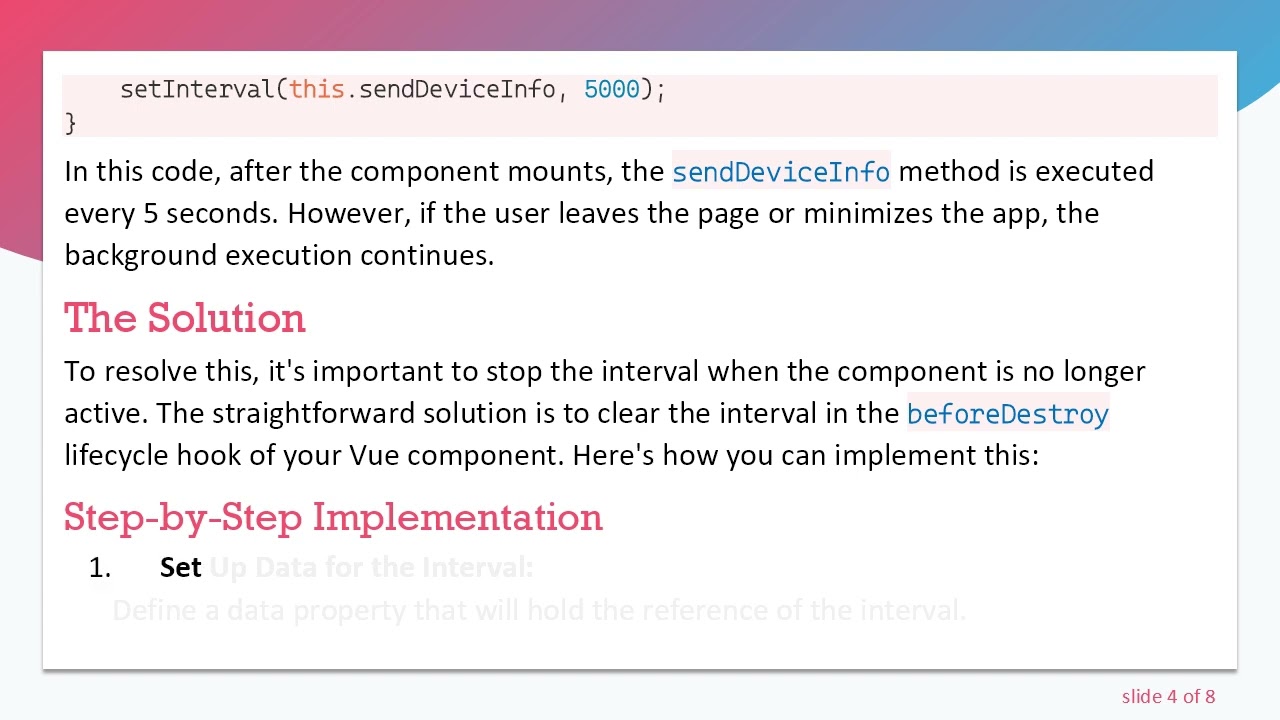
In this code, after the component mounts, the sendDeviceInfo method is executed every 5 seconds. However, if the user leaves the page or minimizes the app, the background execution continues.
The Solution
To resolve this, it's important to stop the interval when the component is no longer active. The straightforward solution is to clear the interval in the beforeDestroy lifecycle hook of your Vue component. Here's how you can implement this:
Step-by-Step Implementation
Set Up Data for the Interval:
Define a data property that will hold the reference of the interval.
[[See Video to Reveal this Text or Code Snippet]]
Create the Interval on Component Mount:
When the component mounts, assign the interval to the property created in the previous step.
[[See Video to Reveal this Text or Code Snippet]]
Clear the Interval on Component Destruction:
In the beforeDestroy lifecycle hook, clear the interval using the reference stored in the data property.
[[See Video to Reveal this Text or Code Snippet]]
Complete Code Example
Here’s a complete example showing how all these parts come together:
[[See Video to Reveal this Text or Code Snippet]]
Conclusion
By implementing the strategies outlined above, you can manage code execution in Nativescript Vue applications effectively, preventing unnecessary data submissions when components are inactive. This not only enhances user experience but also optimizes the performance of your application. Always remember to clean up your intervals to keep your application performing at its best!
Доступные форматы для скачивания:
Скачать видео mp4
-
Информация по загрузке: