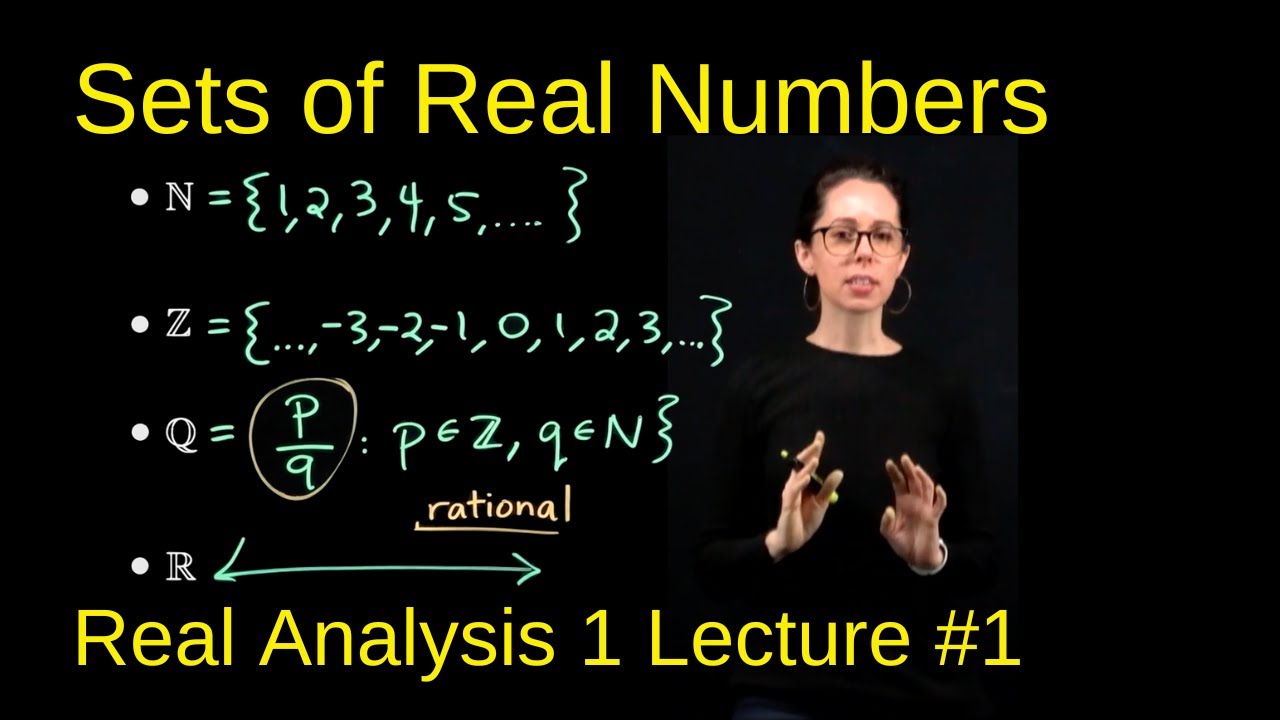
Axiomatic Structure of R, Real Analysis 1
Автор: Dr. Bevin Maultsby
Загружено: 2026-01-26
Просмотров: 75
I lay out the axiomatic structure of the real number line. The long-term goal in real analysis is to study functions of a real variable, but before we can do that carefully, we need a precise understanding of the real numbers themselves and how sets of real numbers behave. These sets will become the domains for the functions we study later, so getting this foundation right really matters.
I start by introducing the three groups of axioms we assume for the real numbers. (1) First are the field axioms, which formalize the familiar properties of addition and multiplication. (2) Then we move on to the order axioms, which capture the idea that real numbers can be compared using inequalities in a consistent way. Together, these tell us that the real numbers form an ordered field.
(3) Perhaps the most important and least familiar part of the lecture is the completeness axiom. To state it, I introduce the ideas of upper bounds and supremum, or least upper bound. The completeness axiom says that every nonempty set of real numbers that is bounded above has a supremum. This single assumption is what distinguishes the real numbers from other ordered fields and is what ultimately rules out "holes" in the number line.
This axiomatic framework is what we will build on throughout the rest of the course.
Previous video: • Sets of Real Numbers, Real Analysis 1
Next video: • Видео
#realanalysis #advancedcalculus #realnumbers #mathematics #maths #mathlecture

Доступные форматы для скачивания:
Скачать видео mp4
-
Информация по загрузке: