How to make Solar System Model/Comparing the planets of our Solar System Model
Автор: Think Creative Make Creative
Загружено: 2021-02-12
Просмотров: 119713
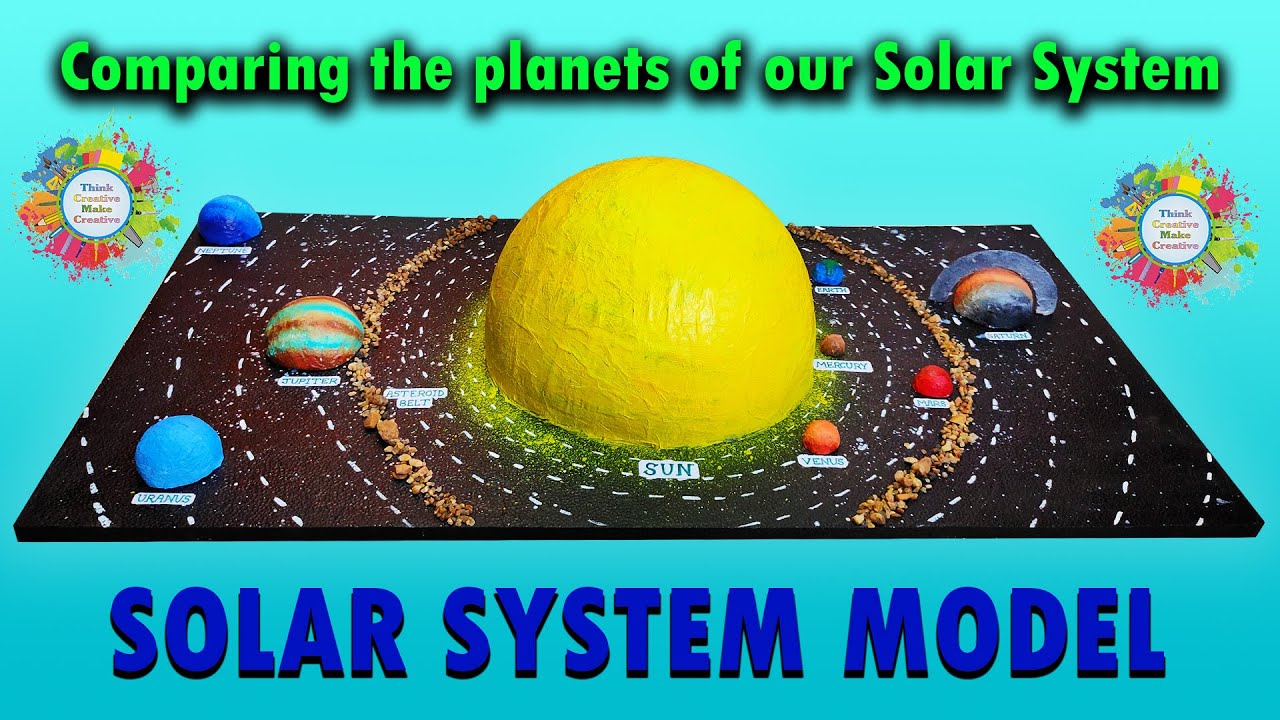
Hello friends, here I show you How to Make Solar System Model/Comparing the planets of our Solar System model with Thermocol and other basic objects. Please see carefully and make it easily. It will help the students of the school/college to create their project. Thank you.
Materials Required: Thermocol, Balloon, Small Sand stone, Tissue Paper, Acrylic Colors, , Glue, Knife, Sand paper etc.
MERCURY is the closest planet to the Sun. It orbits the Sun quickly, once every 88 days. It rotates slowly, however, only once every 59 days. Mercury is small, about 4850 kilometers (~3000 miles) in diameter. Because Mercury is so close to the Sun, the side of its surface that faces the Sun is very hot, ~800oK. The surface of Mercury is gray to orange in color, and is covered with craters. Mercury is named for a mythical god who ran very fast.
VENUS, the second planet away from the Sun, is Earth’s closest neighbor. It is about the same size as the Earth, a little over 12,000 kilometers (7300 miles) in diameter. Venus has a very thick atmosphere, composed largely of sulphuric acid and CO2. We could not breathe on Venus, because the atmosphere would be very toxic to humans. This atmosphere gives Venus a brownish-yellow color. It also traps heat (the greenhouse effect) making the surface of Venus the hottest in the Solar System, about 900oK. Venus rotates very slowly, taking 243 days to complete one turn. It is named for the Roman goddess of love.
EARTH is a little more than 12,000 kilometers in diameter. It differs from the other planets because it has liquid water on its surface, maintains life, and has active plate movement. It rotates on its axis every 24 hours (a day) and revolves around the Sun every 365 days (a year). The Earth has one moon.
MARS is a little more than half the size of the Earth, having a diameter of 6,790 kilometers. It takes Mars 687 days to revolve once around the Sun. It rotates at about the same speed as the Earth, taking 24.6 hours. Mars has a very thin atmosphere which is composed largely of CO2. Its surface is very cold, and is covered with craters, volcanoes, and large canyons. Mars is reddish in color. Mars has two small moons. It is named for the Roman god of war.
JUPITER is the largest planet in the Solar System, with a diameter of 142,980 kilometers, more than 11 times wider than the Earth. Jupiter orbits the Sun once every 12 years. It rotates very fast, in 9 hours and 19 minutes.. Its surface is made up of gas (mostly hydrogen), so that if you landed on the surface you would sink into it. Jupiter probably has a core of metallic hydrogen and rock, although evidence for this is theoretical. The outer gaseous part of Jupiter is broken into bands of white, yellow, red, and brown clouds. Jupiter has 4 rings mainly composed of dust. Huge oval-shaped storms also occur on the surface. Jupiter has 67 known satellites (as of 2016) including the four large Galilean moons (Io, Europa, Callisto, and Ganymede) plus many more small ones some of which have not yet been named. Jupiter is named for the Roman supreme god of heaven.
SATURN is well known for its system of three rings. It is a large planet: at 120,536 kilometers it is only a little smaller than Jupiter. It revolves around the Sun in 12 years, and rotates a little more than 10 hours. Like Jupiter, Saturn is composed of mostly gas, and has a core composed of rock and metallic hydrogen. The surface of Saturn looks banded, and has a brown-yellow, butterscotch color. Saturn’s rings are probably composed of small particles of ice and rock. Saturn has 62 moons (as of 2016). It is named for the Roman god of agriculture.
URANUS is 51,118 kilometers in diameter, about 4.4 times the size of the Earth. It revolves around the Sun slowly, taking 84 years to complete one orbit. It rotates in about 17 hours. It is covered by a thick layer of gas, and has a fairly uniform blue-green color. Uranus has 27 moons (as of 2016) and is surrounded by a system of nine rings. It is named for another Roman god, the grandfather of Jupiter
NEPTUNE is slightly smaller than Uranus, with a diameter of 49,500 kilometers. It circles the Sun once every 165 years, and rotates in 16 hours. Its atmosphere appears blue , and is marked by large dark blue storm systems. It is surrounded by a system of five rings and at least 14 moons. Neptune is named for the Roman god of the ocean.
Email: gavirmalo007@gmail.com
https://www.facebook.com/gavir.malo.3...
https://www.instagram.com/gavir2020/?...
solar system model# school projects# science projects# planets comparing model#
Доступные форматы для скачивания:
Скачать видео mp4
-
Информация по загрузке:


![[색연필 드로잉] 태양계 행성 그림 그리기(수금지화목토천해) / Drawing the planets of the Solar System](https://image.4k-video.ru/id-video/FFQZhqE_ajM)


