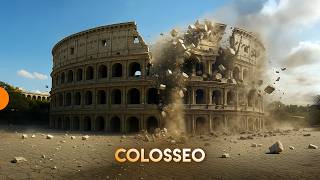
What is Roman concrete? How was it used in ancient construction and transportation
Автор: UrbanHistory
Загружено: 2025-09-01
Просмотров: 52
While modern construction struggles with crumbling infrastructure and environmental concerns, the ancient Romans mastered a building material so strong that many of their structures still stand today. This marvel is known as Roman concrete, or opus caementicium, and it played a pivotal role not just in Roman architecture, but in shaping the urban form of Roman cities across the empire.
Roman concrete was more than just a building material—it was the backbone of Roman city planning. It enabled the creation of aqueducts, amphitheaters, baths, temples, apartment blocks (insulae), and vast networks of roads. Before Roman concrete, stone masonry dominated construction. It was labor-intensive, inflexible, and often lacked durability. But with the invention and refinement of concrete, Roman architects gained the freedom to think in curves, domes, and arches—shapes that had been nearly impossible or prohibitively expensive to build on a large scale before.
At its core, Roman concrete was a mixture of lime (calcium oxide), water, volcanic ash (called #pozzolana), and small stones or rubble. The key ingredient here was the pozzolana, which triggered a chemical reaction with the lime and water to create a material that set not only in air but also underwater. This allowed Romans to build ports and harbors, like the one at Caesarea Maritima, that could withstand centuries of waves, salt, and weather.
This innovation had profound effects on Roman urban design. Cities were no longer limited by the constraints of traditional materials. Large public buildings could be constructed quickly and affordably. Massive concrete foundations supported towering basilicas and bath complexes. Arches and vaults made from concrete allowed engineers to span wide spaces—transforming interiors into open, well-lit, and monumental public spaces.
Perhaps the most iconic example is the Pantheon in Rome, built around 126 CE. Its massive concrete dome—still the world’s largest unreinforced concrete dome—showcases the ingenuity of Roman engineering. It used lighter materials, like pumice, toward the top of the dome to reduce weight and stress. Without concrete, such a structure would have been nearly impossible.
Concrete also enabled the rise of the insula, or Roman apartment block. These multi-story buildings, often housing the urban poor, were a direct result of concrete’s ability to support taller structures. This form of high-density living became essential in crowded cities like Rome, where efficient land use was critical.
Moreover, Roman concrete laid the groundwork for roads and infrastructure. The famous Roman roads—stretching over 400,000 km—were often underpinned by concrete layers. Bridges, drainage systems, and aqueducts all relied on the material's strength and durability. This allowed the Roman city to be not just well-planned, but highly functional, integrating infrastructure, transportation, and public utilities in ways that wouldn’t be replicated until modern times.
In a way, Roman concrete was the physical expression of Roman order—durable, expansive, and methodically planned. Its rediscovery in recent years has sparked a new wave of research. Scientists are now analyzing the microstructure of ancient Roman concrete to create more sustainable alternatives to modern cement, which is a major contributor to global CO₂ emissions.
In the story of urban history, Roman concrete isn't just a material—it's a technology that shaped Roman civilization. It allowed Rome to build higher, last longer, and plan better. And perhaps, looking back, it could even help us build more wisely for the future.
#urbanhistory #urbanplanning #romanconcrete #romanempire #romanhistory #rome #history #urbanization #urbanism #contructionwork #constructionmaterials #projectmanagement #civilengineering #watermanagement #aqueducts #concrete #masonry #architecture #architecturehistory #romanengineering #ancientrome

Доступные форматы для скачивания:
Скачать видео mp4
-
Информация по загрузке: