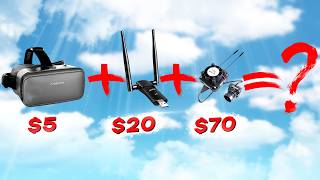
Eachine Sphere Link Goggle Test – Range & Video Breakup Review using PixelPilot and OpenIPC
Автор: Whirly Bloke
Загружено: 2025-04-06
Просмотров: 6800
In this video, I put the Eachine Sphere Link digital FPV system to the test — using a DroneMask and Android phone (Samsung Galaxy S20) as a heath Robison goggle setup running Pixel Pilot. I cover the real-world latency, video quality, range, and how the system handles video breakup during flight.
📦 Test Setup:
Eachine Sphere Link TX/RX
Samsung Galaxy S20 running Pixel Pilot
DroneMask V2
Stock dipole antennas
OpenIPC-based system using wfb-ng
🚀 What’s Covered:
In-goggle experience with a phone
How video holds up past 1km
Freezing, artifacting, and LOS vs NLOS
Thoughts on range improvements with better antennas
The state of OpenIPC and why it’s exciting for open-source FPV
💬 Quick Notes:
No, you can’t just plug the USB-C from the receiver into an HDMI port — I explain why in the video.
Yes, you can get great results with modern phones and the right setup.
OpenIPC is open-source and always evolving — this is just the beginning.
📌 Get the Eachine Sphere Link: https://wirly.co/o1ly4
📌 More info on OpenIPC: https://wirly.co/m7i7q
📌 PixelPilot: https://wirly.co/83658
🔔 Subscribe for more FPV content! [Insert Link]
☕ Buy me a coffee: https://ko-fi.com/whirlybloke
► Instagram - / whirlybloke
00:00 Hello and welcome
00:54 Building the Test Drone
01:42 Makeshift Goggles with DroneMask
02:35 Test Objectives: Range & Breakup
03:00 Flight Test Begins
04:00 Pushing the Range
05:15 Flying Back & Observations
06:00 Thoughts on Goggle Experience
06:50 Antenna Swap Test
07:40 Mounting & Wiring Overview
09:10 Camera UART Wiring
10:15 Betaflight OSD Setup
10:55 Latency & Display Quality
12:00 USB-C to HDMI Explained
13:05 Range, Breakup & Safety
14:30 Final Thoughts on OpenIPC
15:10 Thanks for watching

Доступные форматы для скачивания:
Скачать видео mp4
-
Информация по загрузке: