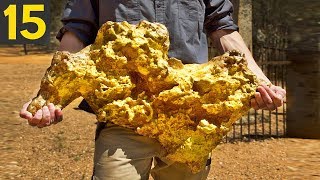
Gold Reserve Worth $13 Trillion Discovered in Liberia
Автор: 2zaq
Загружено: 2025-12-27
Просмотров: 3389
Imagine this: three million ounces of pure gold, shimmering just beneath the surface, buried under the rich, red dirt of Liberia’s remote southeast. That’s enough gold to wipe out the nation’s entire debt, or maybe, if you prefer, build 2,000 kilometers of brand-new paved roads, finally connecting communities that have been isolated for generations.
Or, for a more personal touch, it’s enough to buy every single Liberian citizen a shiny new motorcycle. Sounds like a dream, doesn’t it? What’s truly wild is that until just over a decade ago, almost no one believed this kind of treasure was even there. Liberia, a country often overlooked in the grand scheme of global resource wealth, was about to unveil a secret that could rewrite its future.
For generations, local fishermen casting their nets along the winding Dugbe River had a little secret. They’d rinse gravel in their weathered palms, watching tiny, iridescent flecks catch the sunlight. “They laugh in the sun,” they’d say, a quiet, almost mythical description of the gold dust they occasionally found.
But outside of these local whispers, the idea of significant gold in Liberia was largely dismissed. Geologists, flying home from more established mining hubs like Ghana, would often chuckle at the tales. For a long time, Liberia had been considered a geological afterthought, a bit player compared to the diamond rushes of Kimberley or the gold belts of West Africa’s other nations. It simply wasn't on the serious exploration map.
Then, something shifted. In 2009, a small, intrepid Canadian junior mining company called Hummingbird Resources decided to take a punt. They weren’t swayed by the prevailing skepticism. Instead, they looked at faded, almost forgotten government maps from the 1960s – old geological surveys that most people had probably tossed aside.
On one of these, they spotted a shear zone, a fracture in the earth’s crust, that looked, to their trained eyes, like a crack in a dinner plate. It was a subtle sign, but enough to spark a flicker of hope.
Taking a leap of faith, they helicoptered in a drill rig – one so light it weighed less than a pickup truck – into the dense, humid jungle. It was a gamble, a shot in the dark. They spun the first hole, and what they found was nothing short of astonishing: thirty-four meters grading at 3.2 grams per tonne.
That one intercept, that single core sample, was so rich, so promising, it effectively paid for the entire initial exploration program, even before they’d fully unpacked all their equipment. It was the first undeniable proof that the fishermen’s whispers weren't just folklore; they were a geological prophecy. This wasn't just a whisper anymore; it was a shout.
That initial discovery was just the beginning. By 2011, persistent drilling and careful analysis had outlined not one, but two significant deposits – christened Dugbe F and Tuzon – together boasting more than two million ounces of gold. And the good news kept coming.
A revised feasibility study in 2022 pushed that total past an incredible 3.3 million ounces. Let's put that into perspective: at today’s gold price, which has been remarkably strong, that’s north of six billion U.S. dollars in gross metal value.
To give you an idea of the sheer scale, that’s roughly a fifth of Liberia's entire GDP in a single deposit. This isn't just a big find; it's a game-changer.
The ore body itself is long enough to stretch across Monrovia’s international airport runway, with tips still dangling into the Atlantic Ocean. Now, you might hear that the average grade is 1.5 grams per tonne and think, "Hmm, that's a bit skinny by South African standards."
And you'd be right, if you were comparing it to the ultra-deep, high-grade veins of the Witwatersrand. But here’s the clever bit: the ore at Dugbe is soft, it’s oxidized, and crucially, it’s within 150 meters of the surface. What does that mean in mining terms?
It means you won’t need expensive, high-energy blasting to get to it. You could practically shovel it out of the ground, making the extraction process significantly cheaper and less complex.

Доступные форматы для скачивания:
Скачать видео mp4
-
Информация по загрузке: