How to Create a Nested Dictionary from a Text File in Python
Автор: vlogize
Загружено: 2025-10-11
Просмотров: 2
Learn how to convert a structured text file into a well-organized nested dictionary in Python with this comprehensive guide.
---
This video is based on the question https://stackoverflow.com/q/68706353/ asked by the user 'Trent Xavier' ( https://stackoverflow.com/u/11308135/ ) and on the answer https://stackoverflow.com/a/68706485/ provided by the user 'Matthew B' ( https://stackoverflow.com/u/14008667/ ) at 'Stack Overflow' website. Thanks to these great users and Stackexchange community for their contributions.
Visit these links for original content and any more details, such as alternate solutions, latest updates/developments on topic, comments, revision history etc. For example, the original title of the Question was: How to make a nested dictionary from a text file in python?
Also, Content (except music) licensed under CC BY-SA https://meta.stackexchange.com/help/l...
The original Question post is licensed under the 'CC BY-SA 4.0' ( https://creativecommons.org/licenses/... ) license, and the original Answer post is licensed under the 'CC BY-SA 4.0' ( https://creativecommons.org/licenses/... ) license.
If anything seems off to you, please feel free to write me at vlogize [AT] gmail [DOT] com.
---
How to Create a Nested Dictionary from a Text File in Python
In the world of data processing, manipulating files to extract meaningful information is a common practice. Suppose you have a text file structured in a specific way and your goal is to convert this information into a nested dictionary in Python. If you’re encountering this scenario, you’re in the right place! In this post, we’ll go through the problem and provide a clear, step-by-step solution.
Problem Overview
Imagine you have a text file that looks like this:
[[See Video to Reveal this Text or Code Snippet]]
You want to transform this structured information into a nested dictionary format, such as:
[[See Video to Reveal this Text or Code Snippet]]
This will make the data much more manageable for further processing. Let’s dive into how you can achieve this with Python.
Step-by-Step Solution
Here is a well-structured approach to parsing the text file and creating a nested dictionary.
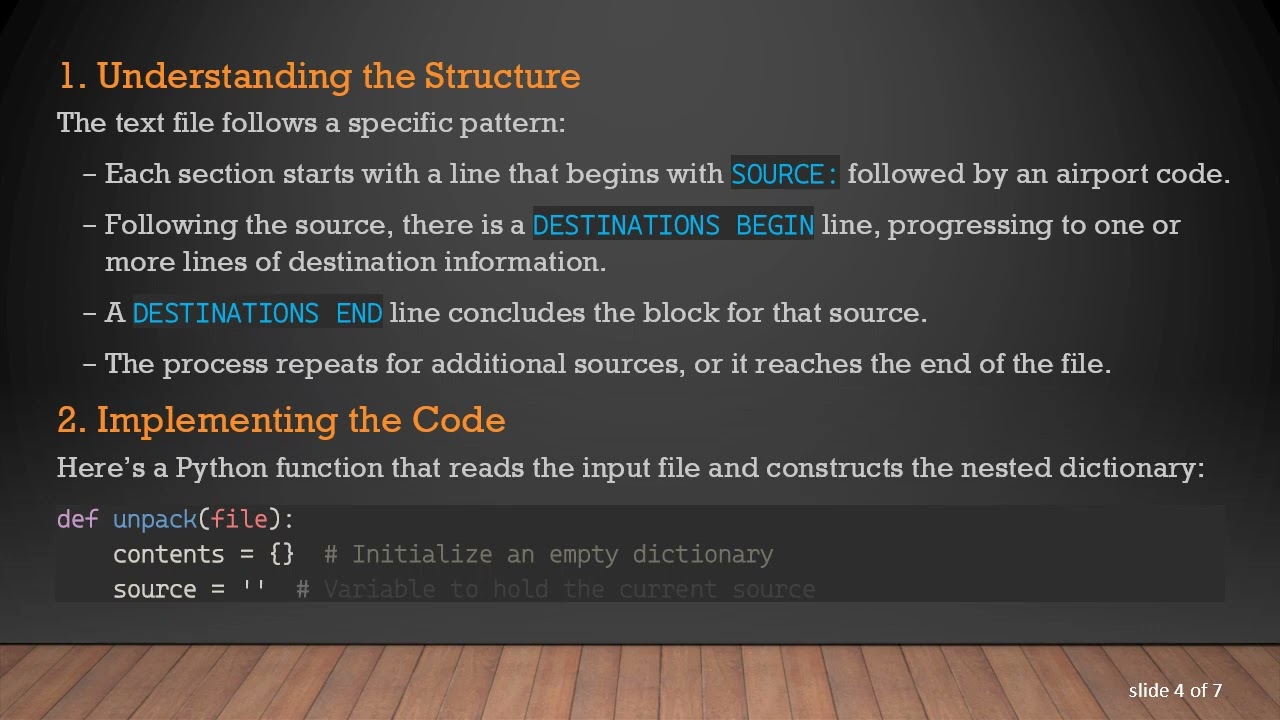
1. Understanding the Structure
The text file follows a specific pattern:
Each section starts with a line that begins with SOURCE: followed by an airport code.
Following the source, there is a DESTINATIONS BEGIN line, progressing to one or more lines of destination information.
A DESTINATIONS END line concludes the block for that source.
The process repeats for additional sources, or it reaches the end of the file.
2. Implementing the Code
Here’s a Python function that reads the input file and constructs the nested dictionary:
[[See Video to Reveal this Text or Code Snippet]]
3. Explanation of the Code
Function Definition: We define a function called unpack that takes the file contents as input.
Dictionary Initialization: We initialize an empty dictionary contents to store our results.
Line Processing:
For each line, we check its type (whether it’s a source, destination header, or destination data) and act accordingly.
We extract the source code and ensure our dictionary is structured correctly.
We split destination lines to isolate the codes and store them in the dictionary.
4. Running the Function
To run the function, you open the file containing your data and call unpack, passing the file content with file.read(). The resulting nested dictionary will be printed out, and it should match your expected structure.
Conclusion
By following this guide, you can effectively parse a structured text file and convert it into a nested dictionary with a simple Python script. Feel free to customize the function further to handle more complex datasets or additional formatting needs!
By mastering techniques like these, you can enhance your Python skills and tackle data manipulation challenges with confidence.
Доступные форматы для скачивания:
Скачать видео mp4
-
Информация по загрузке: