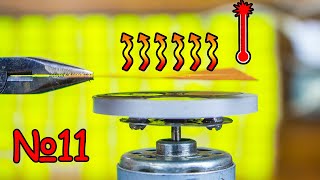
Electric Generator
Автор: Manocha Academy
Загружено: 2025-02-18
Просмотров: 162448
Electric Generator
For Live Classes, Concept Videos, Quizzes, Mock Tests & Revision Notes please see our Website/App:
Our Website: http://bit.ly/2KBC0l1
Android App: https://bit.ly/3k48zdK
CBSE Class 12 Courses: https://bit.ly/4h0L7IN
CBSE Class 11 Courses: https://bit.ly/48isN9Q
CBSE Class 10 Courses: https://bit.ly/363U55V
CBSE Class 9 Courses: https://bit.ly/39Pm7mM
CBSE Class 8 Courses: https://bit.ly/3bJByzB
ICSE Class 10 Courses: https://bit.ly/2MaXpFo
ICSE Class 9 Courses: https://bit.ly/3iFV7dl
ICSE Class 8 Courses: https://bit.ly/3boM5OB
IGCSE Courses: https://bit.ly/2YNwQcn
Artificial Intelligence: https://bit.ly/3vm3FAE
Python Coding: https://bit.ly/3nX0s2y
Java Coding: https://bit.ly/3chHTAK
Facebook page: http://bit.ly/2s6VYhf
An electric generator is a device that converts mechanical energy into electrical energy. It operates on the principle of electromagnetic induction, which was discovered by Michael Faraday. This principle states that when a conductor moves through a magnetic field or when a magnet moves around a conductor, an electric current is induced within the conductor.
The working of an electric generator involves the movement of a conductor through a magnetic field. As the conductor cuts through the magnetic field lines, it generates an electric current. The type of current produced depends on the design of the generator. Alternating current (AC) generators, also known as alternators, produce AC by rotating a coil within a stationary magnetic field. Direct current (DC) generators, on the other hand, use a commutator to convert alternating current into direct current.
An electric generator consists of several main components. The rotor, also called the armature, is the rotating part that generates electricity. The stator is the stationary part that contains the coil. The magnetic field, which is essential for induction, is produced by either permanent magnets or electromagnets. AC generators use slip rings and brushes to help transfer current, whereas DC generators use a commutator to convert AC to DC.
Electric generators have a wide range of applications. They are used in power plants, including hydroelectric, thermal, and wind energy plants, to generate electricity on a large scale. They also serve as backup power sources for homes, hospitals, and businesses during power outages. Additionally, generators are found in automotive alternators and are used in portable power units for outdoor activities and emergency situations.
Would you like me to expand on any section or simplify it further?
At Manocha Academy, learning Science and Math is Easy! The school coursework is explained with simple examples that you experience every day! Yes, Science & Math is all around you! Let's learn every day from everyday life!

Доступные форматы для скачивания:
Скачать видео mp4
-
Информация по загрузке: