How to Remove First and Last Characters from Specific Strings in a List Using Python
Автор: vlogize
Загружено: 2025-09-07
Просмотров: 1
Learn how to remove unwanted characters from strings in a list with Python, focusing on specific conditions for filtering.
---
This video is based on the question https://stackoverflow.com/q/63321652/ asked by the user 'CameronScarpati' ( https://stackoverflow.com/u/14073101/ ) and on the answer https://stackoverflow.com/a/63321782/ provided by the user 'pure_Redwood' ( https://stackoverflow.com/u/12825656/ ) at 'Stack Overflow' website. Thanks to these great users and Stackexchange community for their contributions.
Visit these links for original content and any more details, such as alternate solutions, latest updates/developments on topic, comments, revision history etc. For example, the original title of the Question was: How do you remove first and last char from a string inside of a list depending on specific sets of characters in the list. (Python)
Also, Content (except music) licensed under CC BY-SA https://meta.stackexchange.com/help/l...
The original Question post is licensed under the 'CC BY-SA 4.0' ( https://creativecommons.org/licenses/... ) license, and the original Answer post is licensed under the 'CC BY-SA 4.0' ( https://creativecommons.org/licenses/... ) license.
If anything seems off to you, please feel free to write me at vlogize [AT] gmail [DOT] com.
---
How to Remove First and Last Characters from Specific Strings in a List Using Python
In programming, efficiently manipulating strings within lists is a common requirement, especially in data management and processing tasks. This guide will address a specific problem: how to remove the first and last characters from certain strings in a list, depending on specific criteria.
The Problem
You may have encountered a situation where you have a list of strings, each containing information you want to extract, while discarding irrelevant parts. For instance, consider the following list:
[[See Video to Reveal this Text or Code Snippet]]
In this example, you may want to keep only the names of members by removing unwanted leading and trailing characters.
The Solution
Fortunately, Python provides powerful tools to achieve this. Here’s a step-by-step guide to clean up your string data.
Step 1: Identify Relevant Parts
For each entry in the list, you’ll need to determine which part of the string you want to keep. In this case, the names of the members are situated after a specific length of characters.
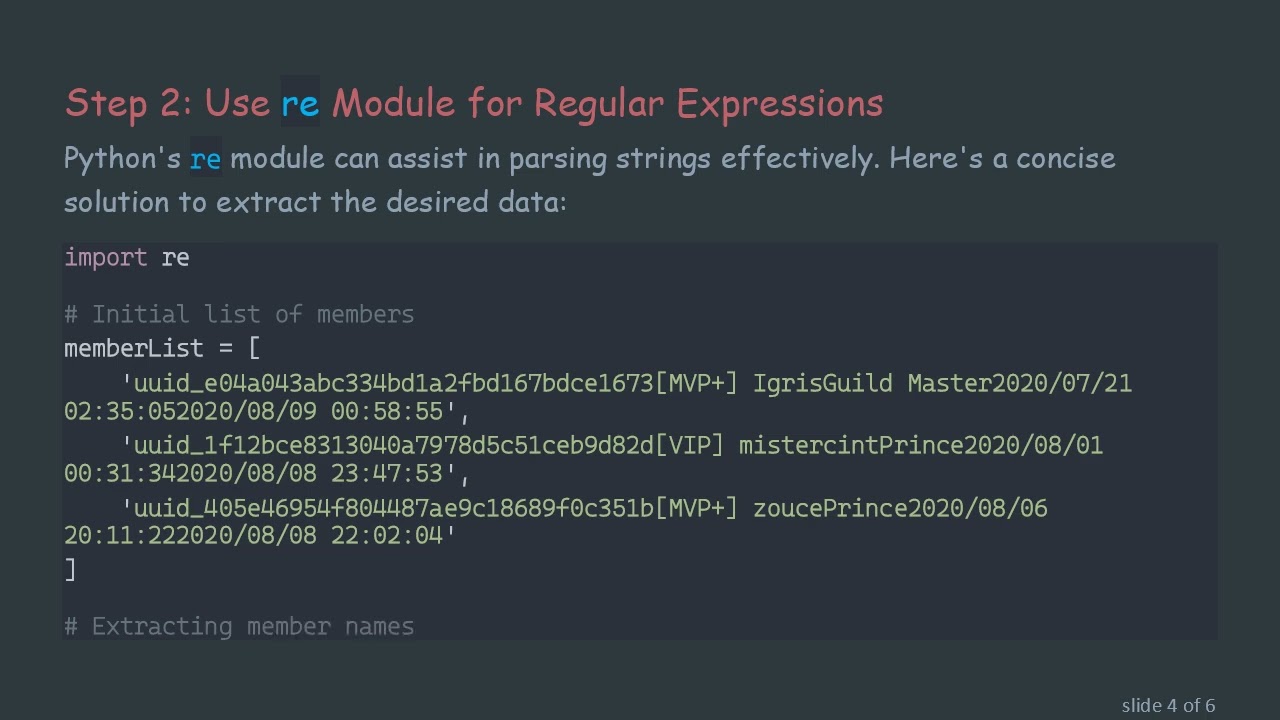
Step 2: Use re Module for Regular Expressions
Python's re module can assist in parsing strings effectively. Here's a concise solution to extract the desired data:
[[See Video to Reveal this Text or Code Snippet]]
Step 3: Understanding the Code
Import the re module: This allows you to leverage regular expressions for string manipulation.
List comprehension: This technique allows for more readable and concise code. We use it to iterate over memberList and apply our transformation.
String manipulation: The re.sub function is used to identify and separate the first letter of names into new strings.
Final output: The resulting list members will contain the cleaned names, like so:
[[See Video to Reveal this Text or Code Snippet]]
Conclusion
By using the power of Python, you can efficiently manipulate strings in lists to extract the relevant information you need. In our example, we were able to clean up the member names from a more complex string, showcasing how regular expressions and list comprehensions can streamline your code.
If you're dealing with similar scenarios, don't hesitate to apply these techniques and customize them as needed. Happy coding!
Доступные форматы для скачивания:
Скачать видео mp4
-
Информация по загрузке:


![Python - Полный Курс по Python [15 ЧАСОВ]](https://image.4k-video.ru/id-video/cfJrtx-k96U)


