Configuring ESLint and Prettier: Enforcing max-len Without Being Restrictive
Автор: vlogize
Загружено: 2025-09-28
Просмотров: 2
Discover how to configure ESLint and Prettier to enforce max-len while allowing flexibility in line breaks. Learn to set up your coding environment effectively!
---
This video is based on the question https://stackoverflow.com/q/63419894/ asked by the user 'Kirk Ross' ( https://stackoverflow.com/u/1704772/ ) and on the answer https://stackoverflow.com/a/63538345/ provided by the user 'David Bradshaw' ( https://stackoverflow.com/u/2087070/ ) at 'Stack Overflow' website. Thanks to these great users and Stackexchange community for their contributions.
Visit these links for original content and any more details, such as alternate solutions, latest updates/developments on topic, comments, revision history etc. For example, the original title of the Question was: ESLint / Prettier -- enforce max-len / printWidth, but don't require it?
Also, Content (except music) licensed under CC BY-SA https://meta.stackexchange.com/help/l...
The original Question post is licensed under the 'CC BY-SA 4.0' ( https://creativecommons.org/licenses/... ) license, and the original Answer post is licensed under the 'CC BY-SA 4.0' ( https://creativecommons.org/licenses/... ) license.
If anything seems off to you, please feel free to write me at vlogize [AT] gmail [DOT] com.
---
Configuring ESLint and Prettier: Enforcing max-len Without Being Restrictive
In the world of JavaScript and particularly when using frameworks like Vue.js, developers strive for clean and maintainable code. Tools like ESLint and Prettier play a crucial role in achieving this goal. One common issue developers face is how to enforce the max-len (maximum line length) rule without making it a strict requirement. This guide will guide you through the steps of achieving this balance.
The Problem: Wanting Control Over Line Breaks
Developers often want to maintain a clean code structure, which includes having a defined maximum line length. However, strict enforcement can be overly constraining, especially when it comes to handling line breaks according to personal or project preferences. Specifically, the question arises:
Is there a way to configure ESLint alongside Prettier to enforce the max-len rule but not require it?
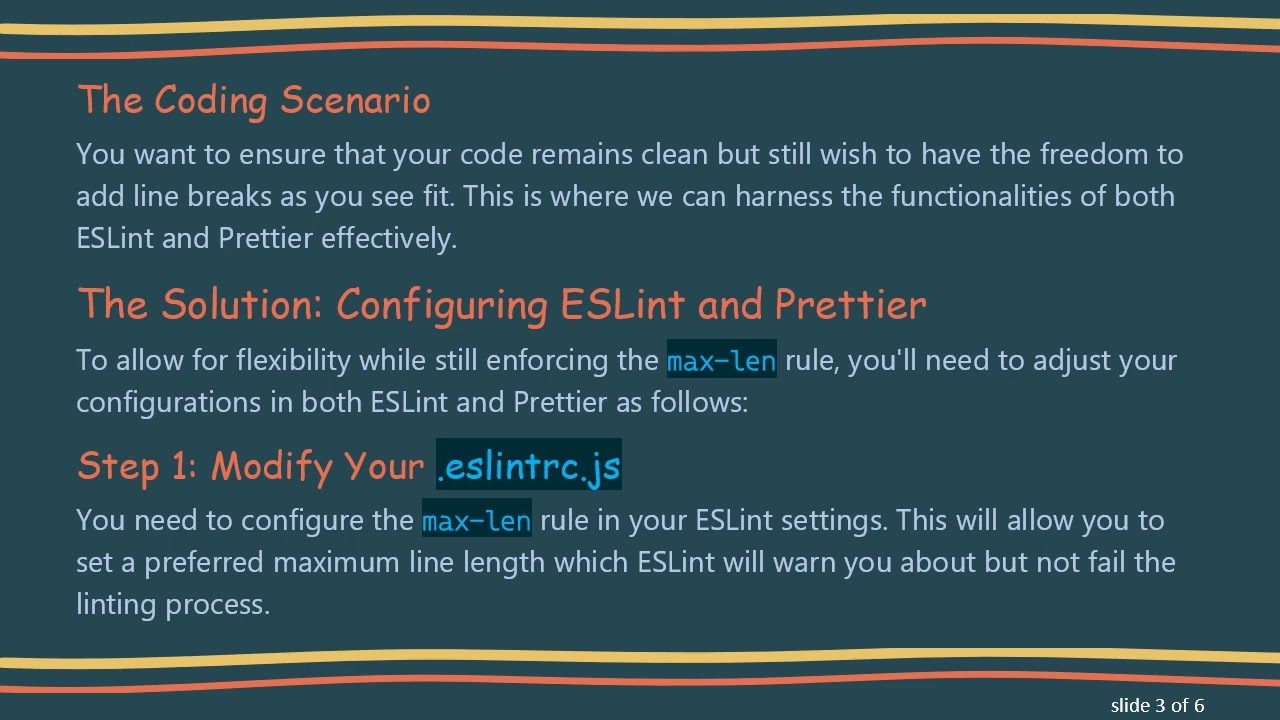
The Coding Scenario
You want to ensure that your code remains clean but still wish to have the freedom to add line breaks as you see fit. This is where we can harness the functionalities of both ESLint and Prettier effectively.
The Solution: Configuring ESLint and Prettier
To allow for flexibility while still enforcing the max-len rule, you'll need to adjust your configurations in both ESLint and Prettier as follows:
Step 1: Modify Your .eslintrc.js
You need to configure the max-len rule in your ESLint settings. This will allow you to set a preferred maximum line length which ESLint will warn you about but not fail the linting process.
[[See Video to Reveal this Text or Code Snippet]]
Explanation:
The 0 in the array means the rule is turned off (it won't result in errors).
160 is your preferred maximum line length.
Setting it as a warning allows you to see issues without failing your build.
Step 2: Adjust Your prettier.config.js
Next, you'll need to set a very high printWidth in your Prettier settings. This essentially turns off strict enforcement of line length when formatting your code.
[[See Video to Reveal this Text or Code Snippet]]
Explanation:
By setting the printWidth to 999, you’re basically telling Prettier to ignore its own line length restrictions.
This provides you with maximum flexibility in adding line breaks wherever they are needed without Aesthetic and functional constraints.
Benefits of This Configuration
Flexibility: You can still structure your code according to your preferences.
Clean Code: With warnings in place, you’re encouraged to keep line lengths reasonable.
Collaboration: Team members can follow the same practices, leading to consistent code.
Conclusion
By carefully configuring both ESLint and Prettier, you can enforce coding standards without being overly restrictive. Setting ESLint's max-len as a warning and adjusting Prettier’s printWidth gives you the perfect balance: a clean codebase that doesn’t stifle your creativity.
Now that you know how to configure ESLint and Prettier for your needs, give it a try in your next JavaScript or Vue.js project!
Доступные форматы для скачивания:
Скачать видео mp4
-
Информация по загрузке: