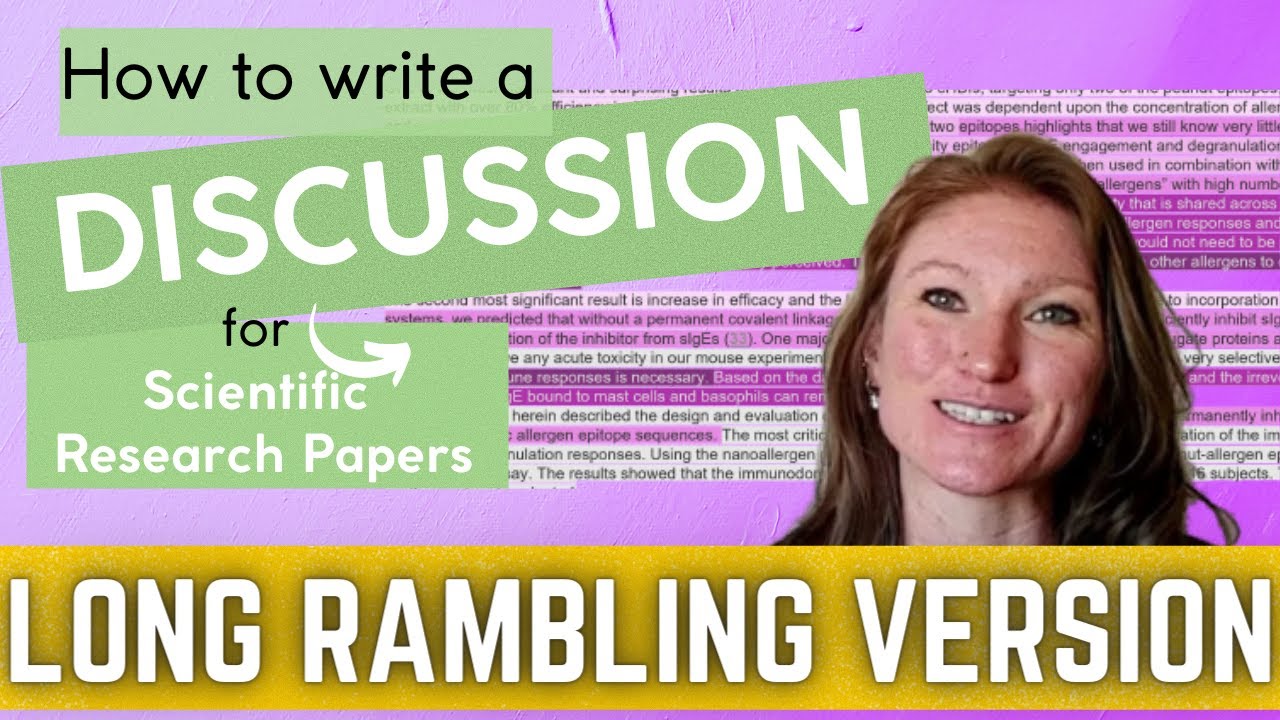
How to write a DISCUSSION for scientific research papers | Step-by-step breakdown
Автор: Butler Scientific Communications
Загружено: 2020-04-07
Просмотров: 25490
👀 Watching in 2024? ❤️👉 WATCH THE UPDATED VERSION of this video here: • How to write Discussion for Research Paper...
🔥**This video is ONE THIRD of ONE MODULE of my e-course "Blank Page to Manuscript Draft".
To get this same information for EVERY PART of your scientific research paper, find my course here:
https://bit.ly/BlankPageManuscriptDraft
🔥**Get 25% off the course for finding me on YouTube using this code: YT25OFF
✅FOREVER ACCESS ✅Exact FORMULAS ✅HOW TO AVOID common mistakes ✅Access to me for all questions
00:58 How the breakdowns work
02:10 The scope of your paper
04:04 Six key parts of a discussion section
07:41 Breakdown of an "ideal" discussion
14:03 Biggest mistake #1
15:39 Biggest mistake #2
16:46 Biggest mistake #3
18:17 How to "breakdown" your own discussion
For access to the original manuscript: - Deak et al., PNAS (2019), 116 (18) 8966-8974; DOI:10.1073/pnas.1820417116
https://www.pnas.org/content/116/18/8...
For more posts, subscribe to our channel!
You can also follow on Facebook: www.facebook.com/ButlerSciComm
Or LinkedIn: / butler-scientific-communications
You can read the full blog post of this breakdown of a discussion of a scientific research paper here - https://bit.ly/2Vb8VRN
The History of my Manuscript Breakdowns
One of the thing I wanted to do at ButlerSciComm was develop formulas scientists could use to write their manuscripts faster and with less stress.
I developed the formulas I now teach by reading tons of manuscripts across disciplines and from the top journals, comparing papers that I considered to be "good", "readable", and "understandable" to papers that were "dense", "difficult to interpret", or well, "boring."
The 6 key points you need to include in a discussion - https://bit.ly/3aMyDCN
I've already shared a post including the 6 key points you need to have in your discussion and the discussion will be the first breakdown section we do together.
The 6 key points are:
1. Summary of results
2. Critical analysis of your results
Interprets the significance of your results for the reader
3. Relate results to field
Shows how your results fit into the field as a whole
4. Relate results to gap
Shows how your results relate to the gap in the field, i.e., edge of current knowledge
5. Beyond current knowledge
Speculation about how the field has changed or new hypotheses that can be made
6. Future directions
Future studies that can address new hypotheses or limitations to your current study
Initial breakdown:
Using the discussion from this paper, I walk you through how an ideal discussion is arranged, color coding the different key parts of a discussion as I have outlined above.
-Notice that there is a definite trend to the way the colors are distributed in this discussion section - the colors trend from the lightest concentrated at the top to the darkest at the bottom.
-This lines up nicely with what we know of the scope of the discussion - it should move the reader from the narrowest scope (your research) to the widest scope, which relates this work to the field as a whole.
-Notice that there are 4 paragraphs, and there are some distinct groupings between the colors present in the different paragraphs.
-The three different types of paragraph you'll find in a discussion:
--Blue (first): mostly grey (recap of results) and some of color #4 (the GAP in the field)
--Green (middle paragraphs): contain all colors, trend from lightest to darkest within paragraphs
--Orange (last): mostly last 3 colors (widest scope)
-The first paragraph, in the blue bracket, I term the introduction to the discussion.
This paragraph summarizes the key results of the paper (gray color) and relates them directly to the gap in the field that you sought to address with this paper.
-The second and third paragraphs, in green brackets, are the meat of the discussion.
These paragraphs take a key result and relate it back out to the field and then beyond the field by relating it to as many of the parts of a discussion (as many colors) as possible.
-The last paragraph, in the orange bracket, is the conclusion.
This entire paragraph should be forward thinking, showing the reader a bigger picture of what is possible with your work.
Common problems in the discussion section
Problem #1: In this discussion, there is a large block of text colored as the "field" at the beginning of the discussion. DON'T DO THIS!
Problem#2: The recap paragraph is at the end, and serves as the conclusion instead of a forward-thinking paragraph.
Problem #3: There is a lot of recapping and analyzing the results, but most of the text that was in darker colors is missing.
Your turn to highlight your discussion!
-Do you see any of the same problems I pointed out before?
-Are you missing any colors?
-Do you have too much of any one color?
-Would doing any rearranging help improve the flow or impact of your paper?
Доступные форматы для скачивания:
Скачать видео mp4
-
Информация по загрузке: