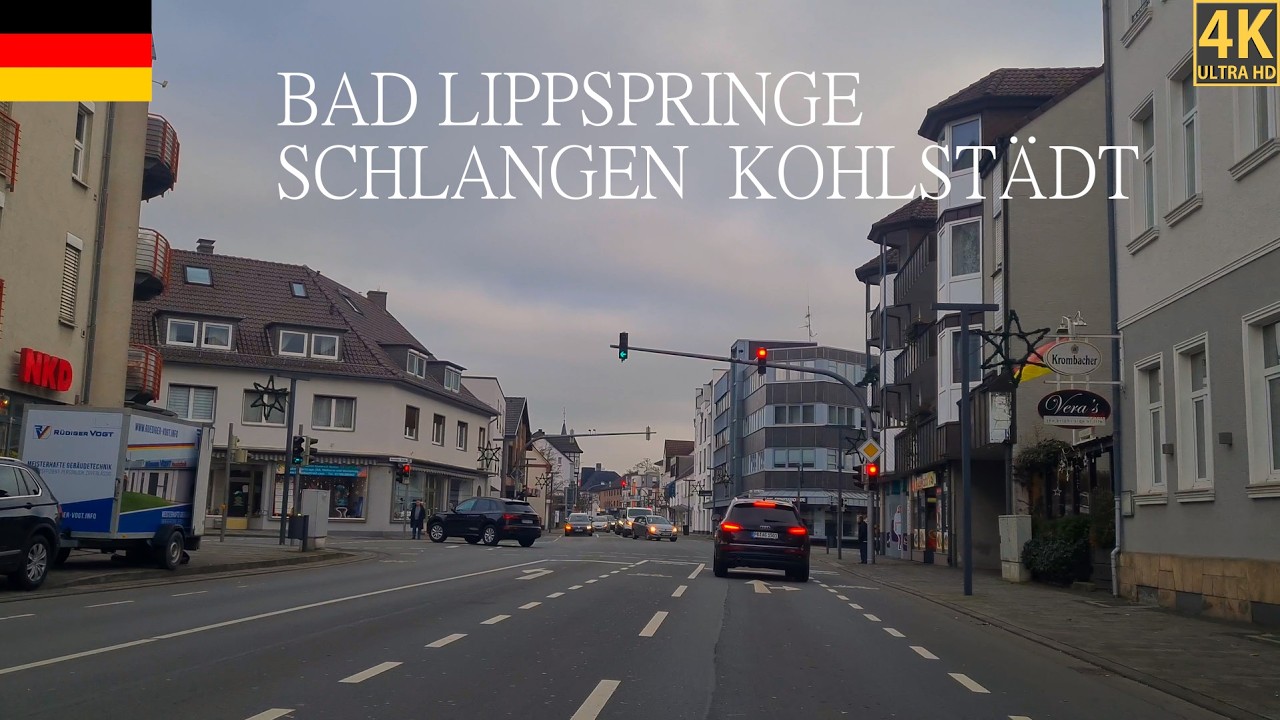
4K Driving Through Bad Lippspringe - Schlangen and Kohlstädt - Paderborn - Lippe - Germany 4K
Автор: RC Scenic Drives
Загружено: 2026-01-04
Просмотров: 324
Bad Lippspringe was first mentioned in 780. Charlemagne referred to it as "Lippiogyspringiae" and held three imperial assemblies there during the Saxon-Frankish War (772-804) in the years 776, 780, and 782. At the assembly of 782, among other things, the Frankish county system was introduced in Saxony. Numerous finds prove that the area around Schlangen was settled in the Neolithic period. Bronze Age burial mounds made of sod and turf were discovered near the Lippe border in the Strohe Valley. Excavations of 9th-century foundations under the patronage of St. Kilian, the patron saint of the present Reformed Church, prove that Schlangen already existed at that time. The old Romanesque church stood at the crossroads of ancient long-distance trade routes. Schlangen, along with its districts of Kohlstädt and Oesterholz-Haustenbeck, is first mentioned in the biography of Bishop Meinwerk of Paderborn. The nun Oda of Geseke bequeathed her inheritance in the villages of Lanchel (Schlangen), Astanholte (Oesterholz), and Colstidi (Kohlstädt) to the church in Paderborn. Kohlstädt was first mentioned around the year 1036 under the name Colstidi. The name Kohlstädt is self-explanatory as a place of coal. In the Middle Ages, charcoal was produced from the forests of Lippe. A document from 1365 mentions the "coal-burning sites," and charcoal kilns continued to operate until the 1930s.
Im Jahre 780 wurde Bad Lippspringe erstmals erwähnt. Karl der Große bezeichnet ihn als „Lippiogyspringiae“ und hielt hier während des sächsisch-fränkischen Krieges (772 bis 804) drei Reichsversammlungen in den Jahren 776, 780 und 782 ab. Auf der Reichsversammlung von 782 wurde unter anderem die fränkische Grafschaftsverfassung in Sachsen eingeführt. Zahlreiche Funde belegen, dass die Gegend um Schlangen im Neolithikum besiedelt war. Aus der Bronzezeit stammen Grabhügelgruppen aus Plaggen und Grassoden nahe der lippischen Grenze im Strohetal. Ausgrabungen von Fundamenten aus dem 9. Jahrhundert unter dem Kilianpatrozinium der jetzigen reformierten Kirche beweisen, dass Schlangen schon zu dieser Zeit bestanden hat. Die alte romanische Kirche stand an der Kreuzung alter Fernstraßen. Schlangen wird gemeinsam mit seinen Ortsteilen Kohlstädt und Oesterholz-Haustenbeck in der Lebensbeschreibung des Bischofs Meinwerk von Paderborn erstmals erwähnt. Die Nonne Oda zu Geseke übergab damals ihr Erbgut in den Dörfern Lanchel (Schlangen), Astanholte (Oesterholz) und Colstidi (Kohlstädt) an die Kirche zu Paderborn. Erste Erwähnung fand Kohlstädt um das Jahr 1036 unter dem Namen Colstidi. Der Name Kohlstädt erklärt sich selbst als Stätte der Kohle. Im Mittelalter wurde aus den lippischen Wäldern Holzkohle gewonnen. In einer Urkunde von 1365 wird über die „Kohlenstätten“ berichtet, und Kohlenmeiler rauchten bis in die 1930er Jahre.
Bad Lippspringe foi mencionada pela primeira vez em 780. Carlos Magno referiu-se a ela como "Lippiogyspringiae" e realizou três assembleias imperiais ali durante a Guerra Saxônica-Franca (772-804), nos anos de 776, 780 e 782. Na assembleia de 782, entre outras coisas, o sistema de condados francos foi introduzido na Saxônia. Numerosos achados comprovam que a área ao redor de Schlangen era habitada no período Neolítico. Túmulos funerários da Idade do Bronze, feitos de turfa e relva, foram descobertos perto da fronteira com Lippe, no Vale de Strohe. Escavações de fundações do século IX, sob o patrocínio de São Kilian, o santo padroeiro da atual Igreja Reformada, comprovam que Schlangen já existia naquela época. A antiga igreja românica ficava na encruzilhada de antigas rotas comerciais de longa distância. Schlangen, juntamente com seus distritos de Kohlstädt e Oesterholz-Haustenbeck, é mencionada pela primeira vez na biografia do Bispo Meinwerk de Paderborn. A freira Oda de Geseke legou sua herança nas aldeias de Lanchel (Schlangen), Astanholte (Oesterholz) e Colstidi (Kohlstädt) à igreja de Paderborn. Kohlstädt foi mencionada pela primeira vez por volta de 1036, sob o nome de Colstidi. O nome Kohlstädt é autoexplicativo, indicando uma região produtora de carvão. Na Idade Média, o carvão vegetal era produzido a partir das florestas de Lippe. Um documento de 1365 menciona os "locais de queima de carvão", e os fornos de carvão continuaram a operar até a década de 1930.
Bad Lippspringe a fost menționat pentru prima dată în 780. Carol cel Mare l-a numit „Lippiogyspringiae” și a ținut acolo trei adunări imperiale în timpul războiului saxon-franc (772-804) în anii 776, 780 și 782. La adunarea din 782, printre altele, a fost introdus în Saxonia sistemul comitatelor france. Numeroase descoperiri dovedesc că zona din jurul Schlangen a fost locuită în perioada neolitică. Movile funerare din epoca bronzului, făcute din gazon și gazon, au fost descoperite lângă granița cu Lippe, în Valea Strohe. Săpăturile fundațiilor din secolul al IX-lea, aflate sub patronajul Sfântului Kilian, sfântul patron al actualei Biserici Reformate.
Доступные форматы для скачивания:
Скачать видео mp4
-
Информация по загрузке:


![[4K]🇺🇸Зимняя прогулка по Нью-Йорку | Верхний Вест-Сайд Манхэттена | Ужин в Song’e Napule🍕 (2026)](https://image.4k-video.ru/id-video/PS4hdPPioQw)