Missing Piece Of Human DNA Finally Discovered In China (And It's Still Inside 4% Of You)
Автор: Strata Files
Загружено: 2026-01-03
Просмотров: 4654
146,000-Year-Old Skull Hidden In Well Finally Reveals What Denisovans Looked Like
For 15 years, Denisovans were ghosts. Scientists knew they existed because of DNA extracted from a pinky finger bone found in a Siberian cave in 2010. But no one knew what they looked like, where they lived, or how widespread they were. Every attempt to extract DNA from suspected Denisovan fossils failed. The species remained invisible.
The story begins in 1933, during the Japanese occupation of northeastern China. Workers building a bridge across the Songhua River in Harbin discovered an enormous skull buried in the riverbed. Recognizing it was unusual, one of the workers hid it at the bottom of an abandoned well to prevent Japanese authorities from confiscating it. For 90 years, the skull remained there, known only to the worker's family.
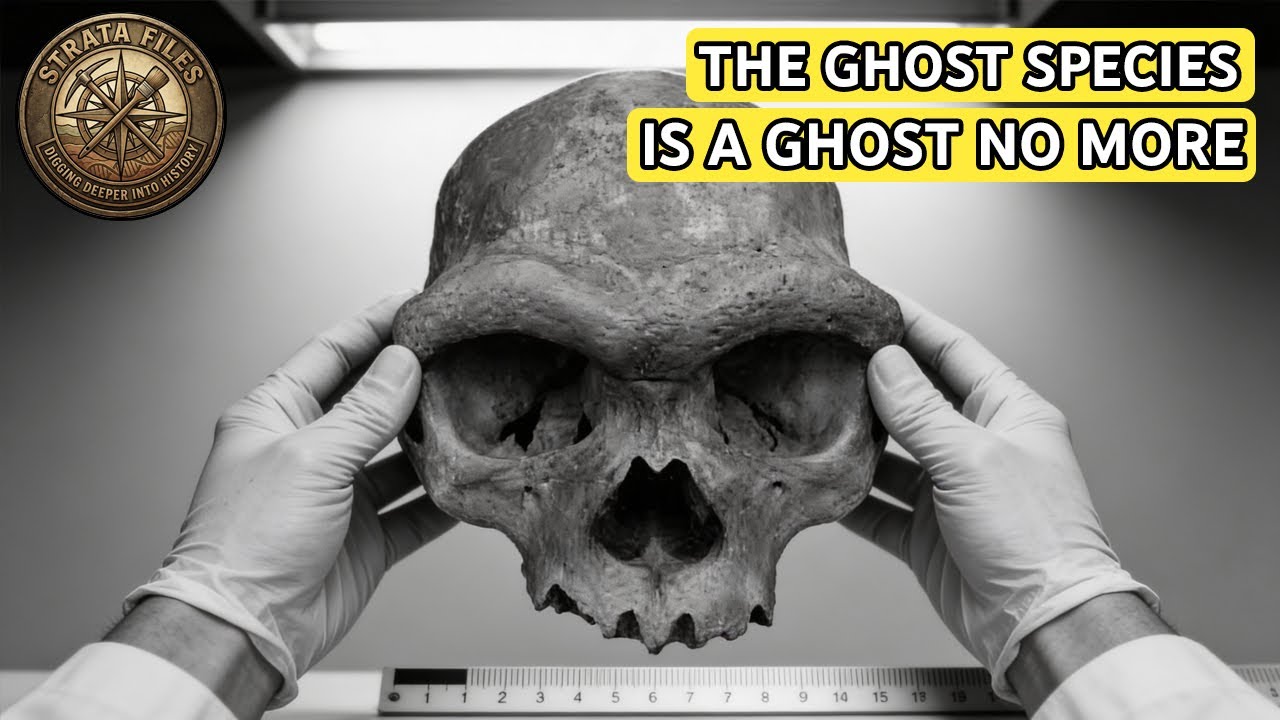
In 2018, before he died, the man told his family where the skull was hidden. They retrieved it and donated it to Ji Qiang at Hebei GEO University. When researchers examined it, they were stunned. The skull measured 9 inches long, housed a brain capacity of 1,420 cubic centimeters (comparable to modern humans), and displayed massive features: square eye sockets, a 5.7-inch brow ridge, thick skull bones, and molars with three roots instead of two. This wasn't Homo sapiens. But what was it?
In 2021, researchers initially classified it as a new species: Homo longi, or "Dragon Man," named after the Heilongjiang province where it was found. The skull was dated to approximately 146,000 years ago, placing it in the Middle Pleistocene when multiple human species coexisted across Asia.
But there was a problem. No one could extract DNA. The petrous bone, the densest part of the skull that usually preserves ancient DNA best, yielded nothing. The skull seemed destined to remain genetically silent.
This is the breakthrough scientists have been waiting for. The Denisovan pinky finger from Siberia revealed the species existed, but it was just a fragment of a child's hand. Dragon Man is a complete adult skull showing exactly what Denisovans looked like. The massive brow ridge, enormous face, and robust features were adaptations for surviving Ice Age cold in northern Asia. These weren't small, delicate hominins. They were built like tanks.
And they're part of us. Genetic studies show modern humans interbred with Denisovans multiple times. Melanesians and Papua New Guineans carry 4-6% Denisovan DNA. Tibetans inherited the EPAS1 gene from Denisovans, which allows them to thrive at high altitudes. Indigenous Australians, Filipinos, and populations across Southeast Asia all carry Denisovan genetic variants that influence immunity, brain development, and adaptation to diverse environments.
The most dramatic proof of interbreeding is "Denny," a 90,000-year-old bone fragment found in Denisova Cave. DNA analysis revealed Denny was a first-generation hybrid: her mother was Neanderthal, her father was Denisovan. This proves these species weren't isolated. They met, interbred, and their children survived.
The Dragon Man skull changes everything. It proves Denisovans had massive, robust skulls adapted for cold climates. It confirms they lived in northern China 146,000 years ago. And it demonstrates that dental calculus can preserve DNA when bone fails, opening new possibilities for identifying other Denisovan fossils across Asia.
📚 ACADEMIC SOURCES:
Fu, Q. et al. (2025). "Mitochondrial genome of the Harbin archaic human and its implications for Denisovan evolution." Cell 188(12): 3201-3214.
Zhang, L. et al. (2025). "Dental calculus as a novel source of ancient DNA from Middle Pleistocene hominins." Science 387(6701): 892-898.
Ji, Q. et al. (2021). "Late Middle Pleistocene Harbin cranium represents a new Homo species." The Innovation 2(3): 100132.
Shao, Q. et al. (2021). "Geochemical provenancing and direct dating of the Harbin archaic human cranium." The Innovation 2(3): 100131.
Ni, X. et al. (2021). "Massive cranium from Harbin in northeastern China establishes a new Middle Pleistocene human lineage." The Innovation 2(3): 100130.
Reich, D. et al. (2010). "Genetic history of an archaic hominin group from Denisova Cave in Siberia." Nature 468: 1053-1060.
Slon, V. et al. (2018). "The genome of the offspring of a Neanderthal mother and a Denisovan father." Nature 561: 113-116.
Huerta-Sánchez, E. et al. (2014). "Altitude adaptation in Tibetans caused by introgression of Denisovan-like DNA." Nature 512: 194-197.
Sawyer, S. et al. (2015). "Nuclear and mitochondrial DNA sequences from two Denisovan individuals." Proceedings of the National Academy of Sciences 112(51): 15696-15700.
Demeter, F. et al. (2022). "A Middle Pleistocene Denisovan molar from the Annamite Chain of northern Laos." Nature Communications 13: 2557.
#DragonMan #Denisovans #AncientDNA #HumanEvolution #history #Anthropology #Paleogenetics #Archaeology
Доступные форматы для скачивания:
Скачать видео mp4
-
Информация по загрузке:


