Pinaceae - UK wild plants - Five-minute families
Автор: Five-minute families
Загружено: 2025-05-30
Просмотров: 344
Learning to identify plant families is a great help in identifying individual plant species you come across. Plants are classified into families based on characteristics that they share; so, the way to identify a plant’s family is to know these characteristic features.
Today we’re going to look at the Pinaceae, the Pine family. This is a family of trees and some shrubs, and the species are therefore all woody perennials. They are found across the temperate Northern Hemisphere with only one species present naturally in the Southern Hemisphere. They often grow in cold or dry habitats and soils.
The Pinaceae are conifers, a group of plants that produce not flowers and fruits but cones that disperse pollen and hold their seeds. The Pinaceae are the largest family of conifers with around 230 species. They are of huge significance both ecologically and economically. They cover vast swathes of land in the cold Boreal forests and are key species in many other ecosystems. Lots are grown in plantations for timber and wood pulp, important for building, manufacturing and paper-making, such as Pseudostuga menzensii, Douglas Fir; Larix × marschlinsii, Hybrid Larch; Pinus contorta, Lodgepole Pine; Pinus nigra, Austrian and Corsican Pine; and Picea sitchensis, Sitka Spruce. Some are also grown as ornamental plants, like Abies koreana, Korean Fir; Cedrus atlantica, Atlas Cedar cultivars; and Pinus mugo, Dwarf Mountain Pine. Several are grown for use as Christmas trees, including Picea abies, Norway Spruce and Abies nordmanniana, Nordmann Fir. Various resins are extracted for use in industry and in scented products, and parts of some species are used medicinally. The seeds of certain Pinus species are eaten, notably Pinus pinea, Stone Pine.
There is only one native species of Pinaceae in the UK, and that’s Pinus sylvestris, the Scots Pine. However, many others are to be seen as ornamentals or plantation trees.
The Pinaceae have separate male and female cones, or pollen and seed cones, both of which grow on the same plant. This makes them monoecious, as opposed to dioecious: where pollen and seed cones would be found on different individuals. Each type of cone is usually found on distinct parts of the tree. Often the pollen cones are clustered near the end of the shoots and these are the smaller of the two cone types. They release pollen – huge amounts of it – into the wind which delivers it to the larger seed cones.
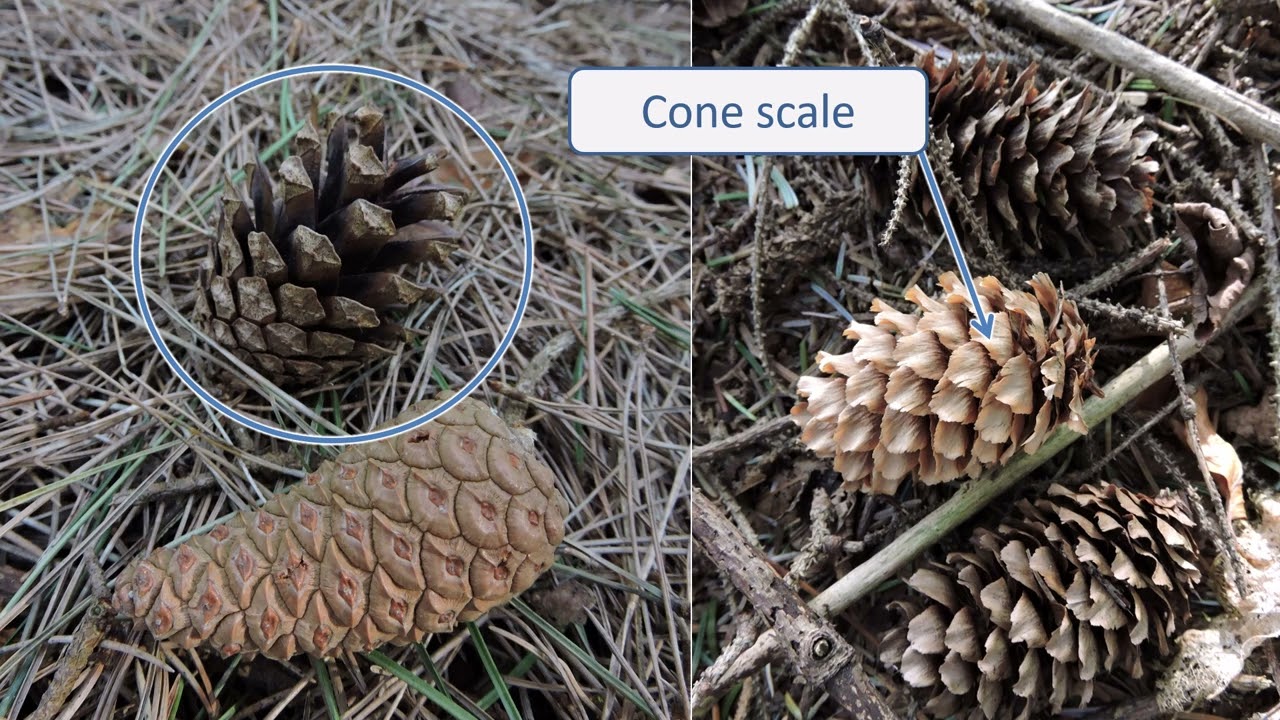
The seed cones are made of overlapping woody scales arranged in a spiral pattern. Each scale has two ovules which lie on the upper side (the inner side when the cones are closed). As non-flowering plants, the Pinaceae do not have ovaries that enclose the ovules. Each scale has a bract beneath it, which may or may not be easily seen. When mature the scales of the cones may open to release the two seeds, like in Pinus, the pines, and Picea, the spruces; or detach, like in Cedrus, the cedars. Whether the seed cones hang down, stand upright or project out from the shoots can indicate which genus you have.
The seeds are usually winged and are dispersed by the wind.
The leaves of Pinaceae species are narrow and generally needle-like. They are simple and entire and contain resin that gives them an aromatic smell when broken or crushed. They are arranged on the stems in one of three ways. In Larix and Cedrus, the leaves grow in clusters on short shoots that jut out from the branches. In Pinus, the leaves grow in groups on the shoots called fascicles. How many needles are in each fascicle helps in identification to species. In other genera, such as Abies and Picea, the needles are arranged singly along the shoots in a roughly spiral pattern, and the way they are attached can be useful for identification too. For instance, Picea leaves are attached to little pegs that remain on the stem when the leaves come off. The plants are mostly evergreen, though a small number are deciduous, like Larix, the larches, and Taxodium, the swamp cypresses.
Pinaceae trees often have a distinctive shape due to the way they branch in layers around the trunk.
The bark of Pinaceae species varies but is often furrowed in mature trees. The wood also contains resin, which can be seen oozing out where plants have been damaged.
So, a woody plant that has small pollen cones and large seed cones with spirally overlapping woody scales, and the scales either open or detach to release winged seeds, that has needle-like leaves either spirally along the stems, in clusters on short shoots or in fascicles, and that produces aromatic resin, is a good fit for the Pinaceae.
Three species you can look out for are:
• Pinus sylvestris, Scots Pine, a tree with fascicles containing two needles and bark that turns orange towards the top of the trunk
• Pseudostuga menzesii, Douglas Fir, a large tree with cones that have long, three-pronged bracts
• Tsuga heterophylla, Western Hemlock, a tree with leaves of two different lengths and small seed cones
Доступные форматы для скачивания:
Скачать видео mp4
-
Информация по загрузке: