Creating a New Instance of an AppCombo in ExtJS 3.4
Автор: vlogize
Загружено: 2025-09-14
Просмотров: 3
Learn how to dynamically create an instance of an extended element in ExtJS 3.4, specifically the `AppCombo`, and effectively load its store.
---
This video is based on the question https://stackoverflow.com/q/62438088/ asked by the user 'FrenkyB' ( https://stackoverflow.com/u/867703/ ) and on the answer https://stackoverflow.com/a/62438248/ provided by the user 'Arthur Rubens' ( https://stackoverflow.com/u/10196301/ ) at 'Stack Overflow' website. Thanks to these great users and Stackexchange community for their contributions.
Visit these links for original content and any more details, such as alternate solutions, latest updates/developments on topic, comments, revision history etc. For example, the original title of the Question was: Create new instance of extended element
Also, Content (except music) licensed under CC BY-SA https://meta.stackexchange.com/help/l...
The original Question post is licensed under the 'CC BY-SA 4.0' ( https://creativecommons.org/licenses/... ) license, and the original Answer post is licensed under the 'CC BY-SA 4.0' ( https://creativecommons.org/licenses/... ) license.
If anything seems off to you, please feel free to write me at vlogize [AT] gmail [DOT] com.
---
How to Dynamically Create an Instance of AppCombo in ExtJS 3.4
When working with ExtJS 3.4, creating complex components can sometimes lead to confusion, especially when you want to extend existing elements like the ComboBox. A frequent question among developers is how to dynamically create a new instance of a custom extended element — in this case, AppCombo, a specialized ComboBox. In this guide, we'll explore how to accomplish this effectively, ensuring you can enhance your applications using the ExtJS framework.
Understanding the Problem
You already have a custom ComboBox defined as follows:
[[See Video to Reveal this Text or Code Snippet]]
The question arises when you want to create a new instance of this AppCombo dynamically and load its store. While you can easily instantiate a standard ComboBox, the process differs slightly for your custom class.
The Solution: Creating a New Instance
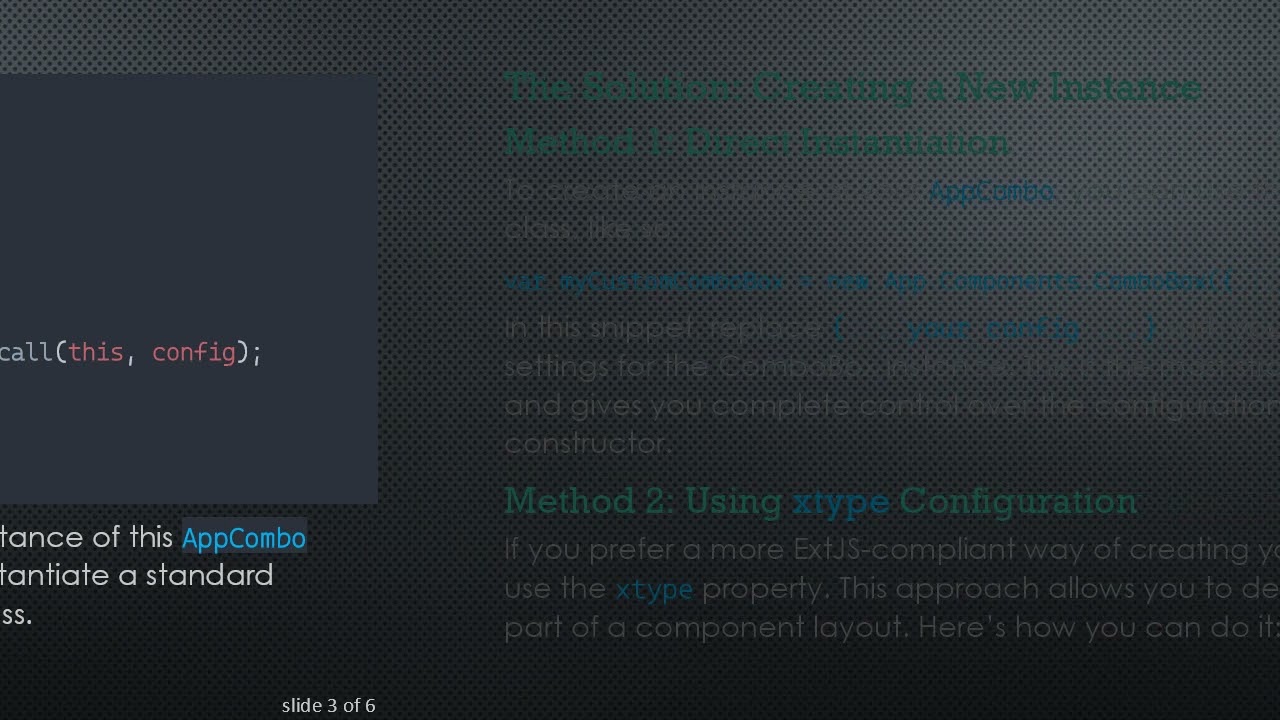
Method 1: Direct Instantiation
To create an instance of your AppCombo, you can use the new keyword with your class, like so:
[[See Video to Reveal this Text or Code Snippet]]
In this snippet, replace {... your config ...} with your specific configuration settings for the ComboBox instance. This is the most straightforward approach and gives you complete control over the configuration properties passed to the constructor.
Method 2: Using xtype Configuration
If you prefer a more ExtJS-compliant way of creating your component, you can use the xtype property. This approach allows you to define your ComboBox as part of a component layout. Here’s how you can do it:
[[See Video to Reveal this Text or Code Snippet]]
By specifying the xtype, ExtJS handles the creation of your component based on the registered class. This method is useful when you're working with layouts or containers that manage multiple components.
Final Thoughts
Creating an instance of an extended element like AppCombo in ExtJS 3.4 is a straightforward process if you understand the distinction between direct instantiation and using ExtJS's xtype feature. By using either method, you can efficiently load and manage your custom ComboBox in your application.
Whether you opt for direct instantiation or the convenience of xtype, both approaches will allow you to make the most of your expanded components in ExtJS. Take your time to explore both methods to see which fits best into your project and coding style.
With these techniques, you can enhance your applications and provide users with dynamic and powerful UI elements that cater to their needs.
Доступные форматы для скачивания:
Скачать видео mp4
-
Информация по загрузке: