Preventive Lec 9 - Periodontal indices
Автор: Beni-Suef National University
Загружено: 2026-01-02
Просмотров: 527
Periodontal Indices and the Epidemiology of Periodontal Disease:
Introduction to Periodontal Indices
Periodontal indices are standardized methods used to measure the occurrence and prevalence of periodontal disease to provide a unified diagnosis
. Measuring periodontal disease is more difficult than measuring dental caries for several reasons:
• The periodontium consists of two parts: the visible gingiva (where inflammation is obvious) and the periodontal ligament and bone, which are hidden and require X-rays for assessment
• It is a chronic disease that develops over many years, making it difficult to determine the exact cause of tooth loss without longitudinal studies
Classification of Periodontal Indices
Indices are categorized based on four major measurement criteria:
1. Degree of Inflammation: Measures gingival inflammation only, without considering bone loss
2. Degree of Destruction: Measures bone loss and can also include gingival disease
3. Treatment Needs: Evaluates the disease specifically to determine the required clinical intervention
4. Causative Factors: Measures the amount of bacteria, plaque, or calculus
Every index must define its concept (what it measures), the teeth examined (all teeth vs. selective "index teeth"), the areas measured, and the scoring criteria
--------------------------------------------------------------------------------
Key Periodontal Indices
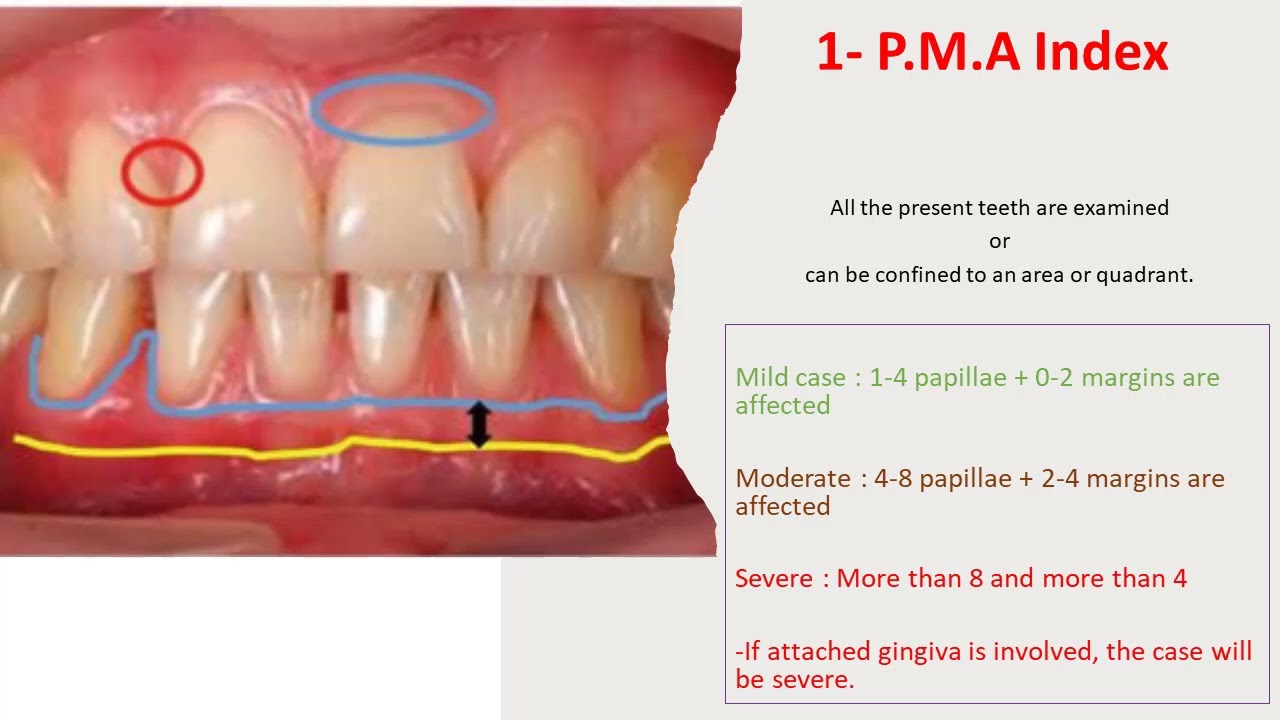
1. P-M-I Index (Papillary, Marginal, Attached)
This index provides a numerical value based on the number of inflamed units. It focuses on the interdental papilla, marginal gingiva, and attached gingiva
. It does not measure clinical signs but rather counts the affected areas
2. Gingival Index (GI)
Considered the best for clinical studies, it measures the severity of inflammation (color, consistency, contour, and bleeding) rather than just a numerical count
• Method: Uses a periodontal probe to check for bleeding
• Teeth: Uses selective teeth (Ramfjord teeth), including upper right 6 and 2, upper left 4, lower left 6 and 2, and lower right 4
• Scoring (0–3):
◦ 0: Healthy.
◦ 1: Mild inflammation (no bleeding).
◦ 2: Moderate inflammation (bleeding on probing).
◦ 3: Severe inflammation (ulceration and spontaneous bleeding)
3. Russell’s Periodontal Index (PI)
This is a composite index because it measures both inflammation and bone destruction
• Scoring: Ranges from 0 (healthy) to 8 (advanced destruction with loss of function). A score of 6 indicates gingivitis with the start of bone loss (loss of attachment)
• Modified Russell Index: Uses selective teeth for faster epidemiological surveys
4. Periodontal Disease Index (PDI) of Ramfjord
Used primarily in clinical trials, it examines specific teeth (6, 1, 4 in the upper and lower arches)
. Scoring for bone loss is based on pocket depth: 3–6 mm is score 5, and more than 6 mm is score 6
5. Community Periodontal Index of Treatment Needs (CPITN)
A unique index used for surveys and clinical work to measure gingivitis, bone loss, and calculus
• Instrument: Uses the WHO/CPITN probe, which has a 0.5 mm ball tip and a black color-coded band between 3.5 mm and 5.5 mm
• Scoring:
◦ 0: Healthy.
◦ 1: Bleeding.
◦ 2: Calculus (requires scaling).
◦ 3: Shallow pocket (4–5 mm; black band partially visible).
◦ 4: Deep pocket (over 6 mm; black band disappears)
6. Oral Hygiene Index (OHI)
Consists of two components: the Debris Index (DI) and the Calculus Index (CI)
. It examines the "worst" tooth in each of the six segments of the mouth, measuring a total of 12 surfaces
--------------------------------------------------------------------------------
Epidemiological Factors (The Triad)
The prevalence of periodontal disease is influenced by the interaction of three factors: Host, Agent, and Environment
A. Host Factors
• Age: Periodontal disease risk increases with age
• Gender: Generally higher in males, though females show increased risk during pregnancy due to hormonal changes
• Oral Hygiene: There is an inverse relationship; better hygiene leads to less disease
• Systemic Factors: Includes diabetes, nutrition (Vitamin C deficiency increases inflammation), and smoking
• Local Factors: Malocclusion and crowding make cleaning difficult, leading to plaque accumulation
B. Agent Factors
The primary causative agent is bacteria found in dental plaque and calculus
C. Environmental Factors
• Geographic Distribution: Habits and traditions in different regions (e.g., Asia/Africa vs. Europe) affect disease rates
• Fluoride: High fluoride in drinking water reduces dental caries, which in turn reduces food/plaque trap areas, potentially decreasing periodontal disease
• Socioeconomic Status: Income and education levels significantly impact oral health awareness and access to care
#جامعة_بنى_سويف_الأهلية
Доступные форматы для скачивания:
Скачать видео mp4
-
Информация по загрузке: