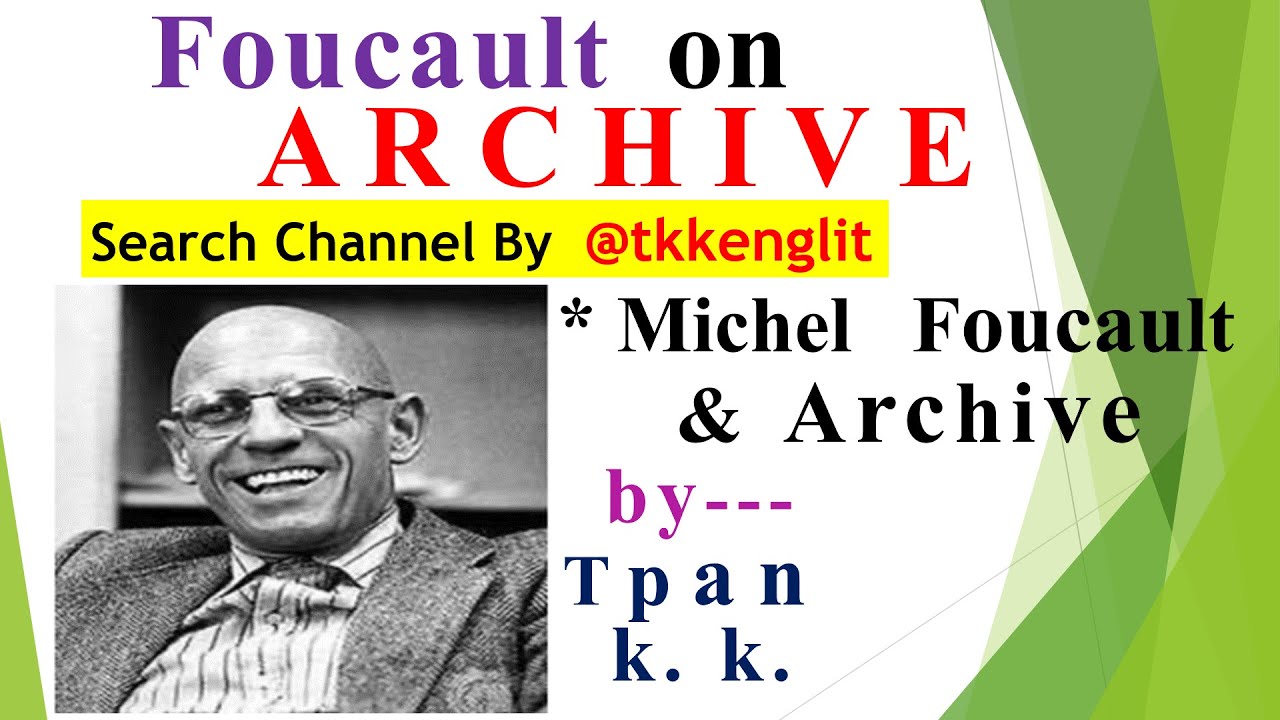
Foucault 8 | Archive | archive by foucault | michel foucault concept | works of foucault |
Автор: edutainment englit
Загружено: 2023-07-29
Просмотров: 265
Foucault: The Philopher who predicted our Nightmare | A is for Archaeology (Michel Foucault)
What is Discourse Analysis? | Michel Foucault | Keyword
Michel Foucault was a philosophical historian who questioned many of our assumptions about how much better the world is today compared with the past. When he looked at the treatment of the mad, at the medical profession and at sexuality, he didn't see the progress that's routinely assumed.
“Michel Foucault (1926-1984) was a French 20th-century philosopher and historian who spent his career forensically critiquing the power of the modern bourgeois capitalist state, including its police, law courts, prisons, doctors and psychiatrists. His goal was to work out nothing less than how power worked and then to change it in the direction of a Marxist-anarchist utopia. Though he spent most of his life in libraries and seminar rooms, he was a committedly revolutionary figure, who met with enormous popularity in elite Parisian intellectual circles (Jean Paul Sartre admired him deeply) and still maintains a wide following among young people studying at university in the prosperous corners of the world…”
Biography of Michel Foucault | Critical Theory English Literature| Net / SET / BA / MA |
Michel Foucault was a French historian and philosopher, associated with the structuralist and post-structuralist movements. He had strong influence not only in philosophy but also in a wide range of humanistic and social scientific disciplines.
Foucault’s work is transdisciplinary in nature, ranging across the concerns of the disciplines of history, sociology, psychology, and philosophy. At the first decade of the 21st century, Foucault is the author most frequently cited in the humanities in general.
In this introduction to Foucault I look at the poststructuralist philosopher’s influences and context (Nietzsche, Levi-Strauss & Sartre, among others), and summarise his position through his three most influential works, The Order of Things, Discipline and Punish, and The History of Sexuality. Foucault’s thought takes two approaches that are loosely related – the archaeological and the genealogical. The most important concept is that power and knowledge are intimately linked.
For Foucault, different time periods – what he calls epistemes – have different underlying assumptions, codes, and rules, mostly unconscious or at least structural, about how to think about things in the world.
Foucault analyses the way we're discipline by power in the same way. In her introduction to Discipline and Punish, Lisa Downing puts like this: Foucault analyses the ‘means by which the body is made to conform to the utilitarian ends of social regimes thanks to the operations of disciplinary power.’
Finally, the central question outlined in vol. 1 is that of the ‘repressive hypothesis'. The narrative dominant in the 70s argued that where Westerners were once sexually oppressed, we have become slowly more liberated, more liberal. Is it really that simple? Like the rest of his work, Foucault questions this progressive, teleological narrative.
theory of michel foucault
Foucauldian discourse analysis
discourse analysis
discourses
I am tapan kumar kundu(tapan k.k.)
welcome to edutainment Youtube channel
tapankundu1292@gmail.com
wb ssc
repeated question net/set
literary theory and criticism discussion
Mes de Foucault en Siglo XXI
Michel Foucault "History of Sexuality" Chapter-by-Chapter Guide
Religion & Capitalism CONTROLLED Society w. Sexual Repression! History of Sexuality
Sex & Sexuality: Crash Course Sociology #313
Foucault: WTF? An Introduction to Foucault, Power and Knowledge
Let's Talk About Sex: The Reality of the Sexual Pleasure Disparity | Grace Wetzel | TEDxStLawrenceU
#michel foucault
#foucault
#archive
In this captivating installment of Foucault 8, we delve into the profound concept of the archive, a crucial aspect of Michel Foucault's works. As we explore the archive by Foucault, we'll uncover the intricate relationships between power, knowledge, and history. Tapan Kundu, a renowned expert in the field, guides us through this fascinating journey, making complex theoretical concepts accessible and engaging. If you're interested in edutainment that challenges your perspectives and broadens your understanding of the world, then this video is for you. Join us as we venture into the realm of critical theory and discover the significance of the archive in modern society.
Доступные форматы для скачивания:
Скачать видео mp4
-
Информация по загрузке: