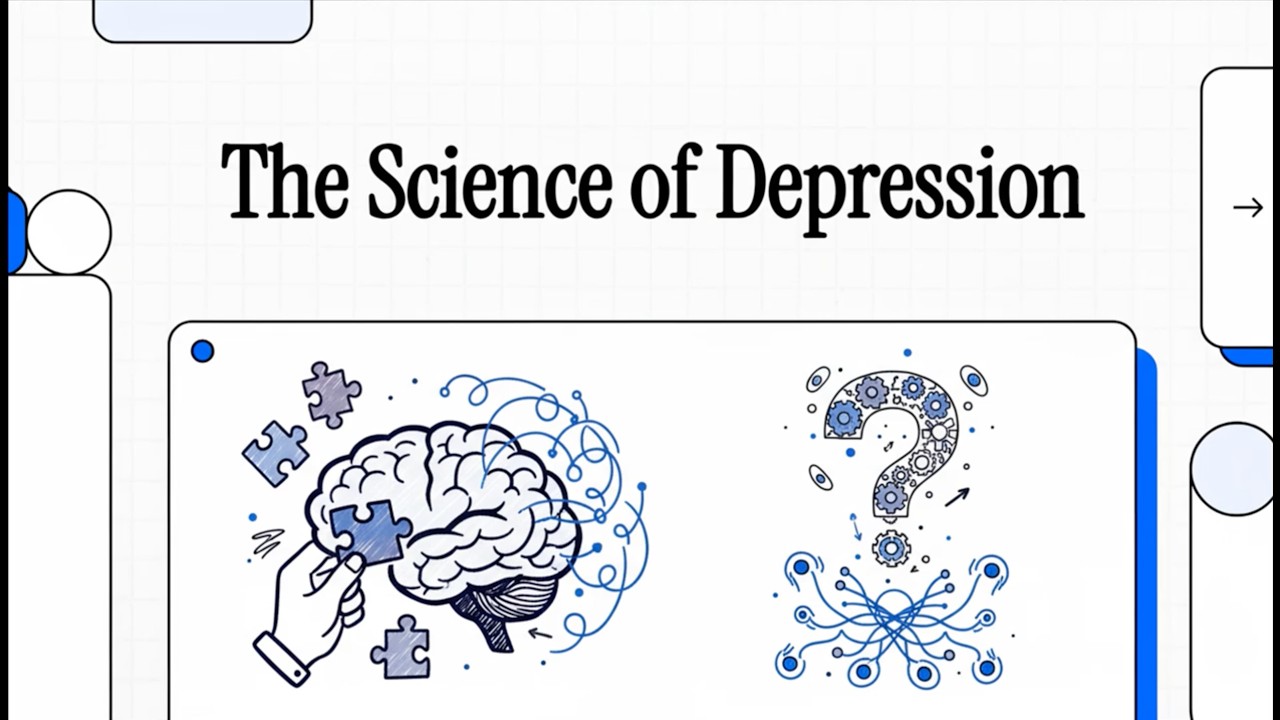
The Science of Depression (Krishnan & Nestler, 2008)
Автор: NourishED Research Foundation
Загружено: 2026-01-06
Просмотров: 16
This micro-lecture explores Krishnan & Nestler's 2008 Nature publication "The molecular neurobiology of depression," which remains sound (https://pmc.ncbi.nlm.nih.gov/articles....
I. Depression: Not Just A Serotonin Deficiency
Depression is biologically complex, involving diverse causes and symptoms.
Cannot be fully captured by simple “chemical imbalance” models.
Animal models + clinical data have revealed key biological underpinnings of deperssion.
Even though certain human symptoms (e.g., guilt, suicidality) cannot be reproduced in animals.
Modern neuroscience reframes depression as a disorder of maladaptive:
(A) Neuroplasticity.
(B) Stress responses.
(C) Circuit‑level dysfunction.
II. How Stress Shapes the Depressed Brain
Chronic stress drives structural and functional changes in the brain.
Particularly in regions like the hippocampus, prefrontal cortex, and nucleus accumbens.
These regions have high expression (amount) of stress hormone receptors.
This makes them sensitive and responsive to stress.
These regions are also known to have high levels of adult neural plasticity.
Neurogenesis: Cell proliferation, self-regeneration (New cell birth).
Neuroplasticity: Changes in number and strength of connection between brain cells.
III. Cellular Impacts of Stress
Acute (short, controllable, "good") stress ↑ neurogenesis; ↑ mood.
Chronic (long, extreme, "bad") stress ↓neurogenesis; ↑ cell death; ↓ mood.
This alters synaptic strength, neuronal excitability, & reward processing.
Known to correlate with (in humans) and cause (in rodents) depression pathology.
IV. Molecular & Cellular Mechanisms
Monoamines (serotonin, dopamine, norepinephrine) play a role in depression.
However, they are not the "end-all."
They largely serve to stimulate BDNF synthesis, neurogenesis, & neuroplasticity.
They are one part of a much larger biological picture.
Neurotrophic factors like BDNF play a central role in depression (and reversal).
BDNF: Brain-derived neurotrophic factor.
BDNF binds to its TrkB receptor, stimulates neurogenesis, neruoplasticity; cell resilience.
Disruptions in BDNF synthesis and TrkB binding contribute to depressive symptoms.
Impacts of Chronic Stres:
Disrupts BNDF synthesis (transcription, translation) & function (↓ neurogenesis, mood).
Disrupts 5-HT receptor expression & function (↓ 5-HTR = ↓BDNF stimulation).
V. The Role of Stress Resilience
Resilience is an active biological process, not just the absence of pathology.
Resilient individuals: Adaptive molecular & circuit responses that counteract cell stress damage.
Understanding resilience mechanisms is central to neural protective therapeutic strategies.
VI. Implications for Treatment & Future Directions
Beyond monoamines.
New focus on treatments targeting:
Glutamate signaling.
Synaptic plasticity.
Circuit‑level modulation.
E.g.1, Deep brain stimulation (DBS) & rapid‑acting glutamate modulators (e.g., ketamine).
E.g.2, Psychoplastogens, Psyhedelics (Ketamine, Esketamine; Psilocybin; DMT, Ayahuasca).
#depression #depressionresearch #neurobiology #mentalhealthresearch #stressresilience #neuroplasticity #bdnf #brainplasticity #neuroplasticity #neuralplasticity #neurogenesis #psychedelicscience #psychedelicresearch #psychedelictherapy #ketaminetherapy #depression #treatmentresistantdepression #stress #mentalhealth @BrennaBrayPhD @NIMHgov @NIHVideoCast @RAND REACH Center @nunmedu @NSFScience @naropauniversity @BBRFoundation @NIH_NCCIH @NIDANIH @NIMHD_NIH @AmericanPsychiatricAssociation @americanmedicalassociation @NamigreenvillescOrg @namiccns @BitsdeCiencia @BrainFactsorg @BrainMindSummit @factbrain9six @MagnetBrainsEducation @mentalhealth @MentalHealthTreatment @Neuroscience @HaloNeuroscience @DrCarolineLeaf @BosqueNeuroscience @prsneurosciences @neuroscienceonline2420 @uofubraininstitute @PacificNeuroscienceInstitute @theneurosciencegirl @Spirituelles-Neurowissen-Joy @JoshNeuroplasticitySchool @NeuroplasticIdeas @neurogenesisinstitute2659 @neurogenesisinstitute9900 @ResetKetamine @unicornonk @SPRAVATO @Psych @psychucommunity661 @psychiatricgenomicsconsort2267 @Psychopharmacologyinstitute @psychedelicsupport @PsychedelicSpotlight @psykedeliskvetenskap @Psych2go @psychetruth @PsychedelicsCom @Psychedelic @ThePsychedelicScientist @YalePsychiatry @yalepsychedelicsciencegrou9534 @stanfordpsychedelicscience12 @stanfordpsychiatryandbehav9531 @OxfordPsychedelicSociety @departmentofpsychiatryuniv763 @Psychology-OxfordUniversity @MountSinaiNYC @NYCPathology @IcahnSchoolofMedicine @LighthousePsychiatry @synapticinstitute @naropaallianceforpsychedel7015 @StudentsVeteransNaropa @FUNKER530 @americanveteranscenter @HHS @bluemorpho6070
Доступные форматы для скачивания:
Скачать видео mp4
-
Информация по загрузке: