How to Input a Mix Feature into an LSTM Model?
Автор: vlogize
Загружено: 2025-10-11
Просмотров: 1
A guide on how to effectively input mixed features into an LSTM model using Python and TensorFlow. Learn about handling word indices and numerical values to improve model performance.
---
This video is based on the question https://stackoverflow.com/q/68713976/ asked by the user 'DaCard' ( https://stackoverflow.com/u/10934417/ ) and on the answer https://stackoverflow.com/a/68717062/ provided by the user 'Abhishek Prajapat' ( https://stackoverflow.com/u/13412418/ ) at 'Stack Overflow' website. Thanks to these great users and Stackexchange community for their contributions.
Visit these links for original content and any more details, such as alternate solutions, latest updates/developments on topic, comments, revision history etc. For example, the original title of the Question was: How to input a mix feature into a LSTM model?
Also, Content (except music) licensed under CC BY-SA https://meta.stackexchange.com/help/l...
The original Question post is licensed under the 'CC BY-SA 4.0' ( https://creativecommons.org/licenses/... ) license, and the original Answer post is licensed under the 'CC BY-SA 4.0' ( https://creativecommons.org/licenses/... ) license.
If anything seems off to you, please feel free to write me at vlogize [AT] gmail [DOT] com.
---
How to Input a Mix Feature into an LSTM Model?
When diving into the world of machine learning and deep learning, one common challenge developers face is how to efficiently process and input mixed features into models. Particularly, when working with Long Short-Term Memory (LSTM) networks, you might find yourself needing to combine text data (in the form of word indices) with numerical data. In this post, we will explore a practical example of how to achieve this using TensorFlow and Keras.
The Challenge: Combining Features
Imagine you have two features:
Feature x1: A vector of word indices representing textual data.
Feature x2: A vector of numerical values.
Both of these feature vectors have equal length—50 in this case—across 6000 data points. Inputting these into an LSTM model effectively can be tricky. Here’s how you initially combined them:
[[See Video to Reveal this Text or Code Snippet]]
This produced a combined structure, but you quickly realize that you need an embedding layer to handle the text data effectively. Let's break down how to modify your LSTM model to incorporate this.
Building the LSTM Model
Initial Model Setup
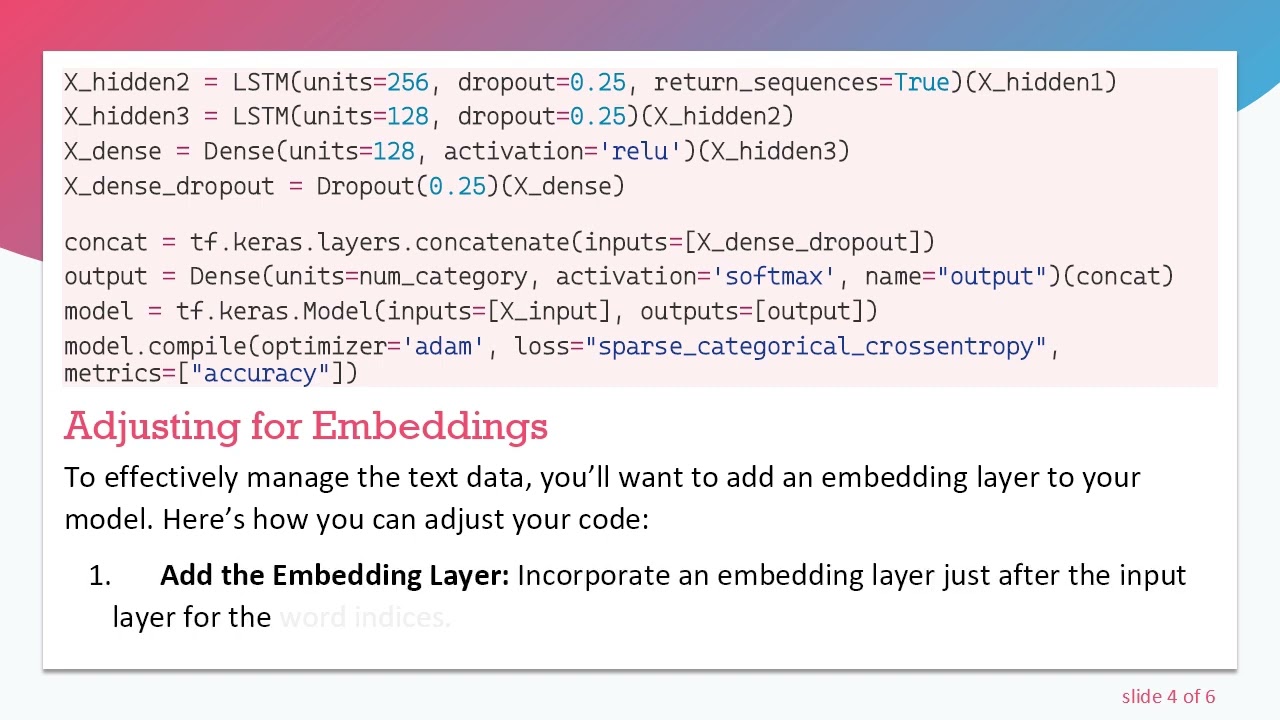
The original setup of the LSTM model might look something like this:
[[See Video to Reveal this Text or Code Snippet]]
Adjusting for Embeddings
To effectively manage the text data, you’ll want to add an embedding layer to your model. Here’s how you can adjust your code:
Add the Embedding Layer: Incorporate an embedding layer just after the input layer for the word indices.
[[See Video to Reveal this Text or Code Snippet]]
Combine Features for the LSTM: Now, concatenate the embedded vectors with the other feature.
[[See Video to Reveal this Text or Code Snippet]]
Handling the ValueError
If you encounter a ValueError: A Concatenate layer requires inputs with matching shapes except for the concat axis, you need to ensure that the dimensions match up. You can do this by reshaping one of the inputs before concatenation:
[[See Video to Reveal this Text or Code Snippet]]
Completed Model Structure
Now, you can proceed with the rest of your LSTM model as before, adding layers and compiling it. The final form will look similar to the earlier mentioned structure but will now effectively handle mixed features without issues.
Conclusion
By efficiently combining word indices and numerical values, the model can leverage both types of information during training. By adding an embedding layer and ensuring input shapes match, you eliminate potential errors and enhance the model's performance in your tasks.
Explore this method further and play around with different embeddings and LSTM configurations to see what works best for your particular dataset! Happy coding!
Доступные форматы для скачивания:
Скачать видео mp4
-
Информация по загрузке:




![Курс Python с Абсолютного нуля! [12 часов из 80] Python курс - качественный старт для начинающих!](https://image.4k-video.ru/id-video/lYMLLI-MJek)